Author: Dr Rajesh P

  • Meniscus Lesions Tied to Neuropathic Pain in Knee OA

    zedie's avatarARYAN'S BLOG

    Meniscal extrusion on MRI significantly associated with increasing pain scores in knee osteoarthritis.

    Meniscus lesions, specifically extrusions, were a risk factor for neuropathic pain in patients with knee osteoarthritis (OA), results of a pilot study suggested.

    The presence of meniscal extrusion on MRI, in both medial (P=0.006) and lateral (P=0.023) compartments, was significantly associated with increasing neuropathic pain (NP) pain scores in knee OA patients, according to Camille Roubille, MD, of the University of Montreal Hospital Research Center in Quebec, and colleagues.

    The presence of meniscal tears in the lateral compartment (P=0.011) was also significantly associated with pain scores, they wrote online in Arthritis Research and Therapy.

    “Our finding of an association between NP and lateral meniscal tear is somewhat unexpected as literature indicates that meniscal tears are not usually associated with symptoms,” the authors wrote.

    The multicenter, cross-sectional, observational study included 50…

    View original post 552 more words

  • Scapular dyskinesis

    Definition

    Scapular dyskinesia is defined as observable alterations in the static position of scapula or abnormal patterns of motion of scapula during coupled scapulohumeral movements in relation to the thorax.

    Introduction

    • Due to inhibition or disorganization of activation patterns of scapular stabilizing muscles.
    •  Disrupts the normal rhythm of scapulohumeral motion and shoulder kinematics.
    •  Associated with various shoulder pathologies such as impingement, adhesive capsulitis, instability, SLAP lesions, rotator cuff injuries and acromioclavicular disorders.
    • May be the cause, effect or compensation. Exact role in shoulder dysfunction unknown.
    • It may exacerbate symptoms or adversely affect the outcomes of treatment.
    • Other causes are pectoralis minor contracture, Glenohumeral internal rotation deficit (posterior capsule of shoulder contracture), excessive thoracic kyphosis or excessive lumbar lordosis.
    • Frequently seen in athletes with shoulder injuries. It is also in asymptomatic individuals.
    • Treatment directed towards underlying cause and by kinetic chain based rehabilitation protocols to restore normal muscle activation protocols.

    Functions of scapula

    • Provision of a stable but mobile foundation for humeral head during glenohumeral motion
    • Scapulothoracic motion
    • Elevation of acromion during abduction to prevent impingement of supraspinatus.
    • As a link in the kinematic chain for proximal-to-distal sequencing of velocity, forces and energy of shoulder function.

    Scapular kinematics

    • Scapula, shoulder and humerus are either stabilized or moved during various activities to generate, absorb or transfer forces.
    • To optimize function, the scapula should move in coordination with the movements of humerus to maintain the instant centre of rotation and the alignment of glenohumeral joint. This has been likened to the balancing of a ball on seals nose.

    To read more

    http://learningorthopaedics.com/scapular-dyskinesis/

  • Ulnar nerve palsy

    Anatomy

    • Ulnar nerve is a branch of medial cord of brachial plexus which arises from C8 and T1 ventral rami.
    • It lies between the axillary artery and vein.
    • It lies posteromedial to the brachial artery.
    • In the arm at the level of coracobrachialis insertion, it pierces the medial intermuscular septum to enter the extensor compartment where it lies anterior to the medial head of triceps.
    • At the elbow it lies in the retrocondylar groove behind the medial epicondyle.
    • It enters the cubital tunnel between the 2 heads of flexor carpi ulnaris to reach the flexor compartment where it lies on the anterior surface of flexor digitorum profundus. It supplies the FCU and the medial half of FDP.
    • 7 cm proximal to the wrist it gives off the dorsal branch which supplies sensation to the ulnar part of dorsum f hand up to the proximal interphalangeal joints.
    • 5 cm above the wrist it gives off the palmar branch which supply the ulnar side of palm.
    • Nerve passes superficial to the flexor retinaculum, medial to the ulnar artery and radial to the FCU through the Guyon’s canal which lies between the pisiform medially and the hook of hamate laterally.
    • In the Guyon’s canal it divides into superficial and deep branches.
    • Superficial branch supplies the palmaris brevis and provides sensation to medial one and a half fingers.
    • Deep branch passes along with the deep branch of ulnar artery between the FDM and ADM. It pierces the ODM to reach the deep surface of flexor tendons.
    • Along with deep palmar arch it passes transversely.
    • Deep branch supplies hypothenar muscles, interossei, medial two lumbricals and ends by supplying adductor pollicis, deep head of flexor pollicis brevis and first dorsal interossei.
    • Ulnar nerves supplies
      • FCU
      • Medial half of FDP
      • Hypothenar muscles
      • Interossei
      • Medial 2 lumbricals
      • Adductor pollicis
      • Deep head of flexor pollicis brevis

    Pathoanatomy

    • Martin-Gruber anastomosis
      • Seen in 15%
      • Between ulnar and either median or AIN in the forearm.
      • Carry motor fibres from median to ulnar for intrinsic muscles.
      • May result in intact intrinsic function in proximal ulnar lesions.
      • 4 Patterns
        • Type I 60%- Motor from median to ulnar to supply median innervated muscles
        • Type II 35%- Motor branch from median to supply ulnar
        • Type III 3%- Motor from ulnar to median to supply ulnar innervated muscles
        • Type IV- Motor from ulnar to median to supply median innervated muscles
    • RichieCannieu anastomosis
      • Between deep branch of ulnar and recurrent branch of median nerve.
      • Ulnar to median
      • May result in intact thenar muscle function in presence of median nerve injury.
    • Sites of nerve entrapment
      • At the elbow
        • Arcade of Struthers- Myofascial band extending from medial intermuscular septum to the medial head of triceps, 8 cm above medial epicondyle
        • Medial intermuscular septum where it pierces
        • Medial head of triceps
        • Medial epicondyle
        • Epicondylar groove
        • Cubital tunnel between 2 heads of FCU which are connected by aponeurotic Osborne’s ligament
        • Flexor pronator aponeurosis between FDP and FDS.
      • At the Guyon’s canal
        • Zone I- Proximal to bifurcation
        • Zone II- Distal to bifurcation. Contains deep branch.
        • Zone III- Contains the superficial branch
    • Functional losses in ulnar nerve injury
      • Loss of key pinch due to paralysis of adductor pollicis and first dorsal Interossei.
      • Clawing due to paralysis of Interossei and lumbricals in presence of functioning extrinsic extensors leading to MCPJ hyperextension and functioning long flexors leading to flexion of IPJ.
      • Loss of forward flexion of mobile fourth and fifth carpometacarpal joints lead to loss of transverse palmar arch manifested as inability to cup the hand to hold water.
      • Loss of normal integrated MCPJ and IPJ flexion. Normal finger flexion starts at MCPJ followed by IPJ. In ulnar nerve palsy IPJ flexes first followed by MCPJ. This rolling motion will lead to inability to grasp objects.
      • Loss of FDP function of medial 2 digits in high ulnar nerve palsy leads to diminished grip strength.

    Clinical Features

    • Duchenne sign- Clawing
    • Cross finger test- Inability to cross index and middle finger over each other.
    • Pitres Testut sign- Inability to abduct middle finger to either side.
    • Wartenberg sign- Abduction of little finger.
    • Loss of normal sequence of finger flexion- Normally MCPJ flexes then the IPJ flexes. In ulnar nerve palsy MCPJ flexes last.
    • Loss of key pinch
    • Jeannes sign- MCPJ of thumb hyperextended during key pinch.
    • Masse sign- Loss of hypothenar eminence and flattened palmar metacarpal arch.
    • Pollock sign- Inability to flex DIPJ of little and ring fingers.
    • Froments sign- Substitution of adductor pollicis by FPL during key pinch.
    • Bouvier manoeuvre- Correct the hyperextension of MCPJ and ask the patient to extend IPJ. If IPJ extension is improved then Bouvier test is positive and claw and is termed simple claw hand. If IPJ extension doesn’t improve then test is negative and clawing is called complex claw hand.
    • Associated sensory loss over medial aspect of arm and forearm indicate medial cord lesion.
    • Systemic conditions mimicking ulnar palsy
      • Charcot Marie Tooth disease
      • Syringomyelia
      • Leprosy
      • Klumpke’s paralysis
      • Pancoast tumour
      • Cervical IVDP

    To continue

    http://learningorthopaedics.com/ulnar-nerve-palsy/

  • Examination of knee

    INTRODUCTION

    It is important to have a systemic plan for the examination of knee arrive at the correct diagnosis, to identify its impact on the patient, to understand the patients’ needs and concerns and then to formulate a treatment plan that is individualized for the particular patient. A thorough knowledge of the normal anatomy, biomechanics of knee and the pathology of various knee disorders is a must for proper examination of knee and for the interpretation of physical findings.
    First listen to the patient carefully to understand his concerns and needs and also to gain his confidence.
    The involved and the normal knee should be adequately exposed to examine the knee. Always examine the spine and the hip to rule out conditions that lead to referred pain in the knee and any associated hip and spine disorders.
    Always compare with the uninvolved side as wide range of anatomic and functional variations exist.
    Examination should be gentle and as painless as possible to avoid worsening of injury and to ensure a cooperative patient.
    The function of the knee is assessed by the patient’s ability to weight bear, walk, ability to squat, sit cross-legged, run, stair climb and the level of restriction of activities of daily living and the occupational and recreational activities.


    To continue

    http://learningorthopaedics.com/examination-of-the-knee-joint/


  • Acromioclavicular joint injuries

    Anatomy

      •The average dimension of Acromioclavicular joint is 9mm superoinferiorly and 19mm anteroposteriorly. Joint is straight and vertical in 30% of population and in 70% the joint is oblique downwards and medially.

      •Articular cartilage of clavicle end becomes fibrocartilaginous after 17 years of age and the acromial end becomes fibrocartilaginous at 23 years.

      •A fibrocartilaginous disk of variable size and shape attached to the superior capsule is present between the articular surfaces. The fibrocartilaginous disk is partial and meniscus like in 50%, remnant like in 30%, absent in 20% and complete in less than 2%.

      Biomechanics

    •Anteroposterior stability of ACJ is provided by the ACJ capsule and ligaments. The superior and anterior capsule and ligaments are the strongest.

    •Superoinferior stability is provided by the coracoclavicular ligaments. Coracoclavicular ligaments have trapezoid and conoid parts. They are confluent at the coracoid and separate at the clavicle side. They form the primary suspensory complex of the upper limb.

    •Conoid ligament is conical and is attached to the posterior-medial aspect of coracoid process. Trapezoid ligament is quadrangular and attaches to coracoid shaft. Trapezoid ligament is attached 2.5cm from the lateral end of clavicle to the trapezoid ridge and the conoid portion is attached 4.5 cm from the lateral end of clavicle to the conoid tubercle. This is important for anatomical reconstruction of coracoclavicular ligaments.

    •Conoid footprint is posterior and measures 25-30mm. Conoid portion provides 60% of the superoinferior stability.

    •Deltoid inserts to the superior capsule and anterior surface of lateral 1/3rd of clavicle. Trapezius inserts to the superior capsule and dorsal surface of lateral end of clavicle. Their attachments are also detached in higher grades of ACJ injury.

    •Joint allows axial rotation of clavicle and anteroposterior and superoinferior sliding of acromion.

    Mechanism of injury

      •Acromioclavicular joint injuries occur due to direct trauma over the acromion with the arm in the adducted position.

      •Once the ligaments are ruptured, the acromion is pulled down by the weight of the upper limb and the lateral end of clavicle is pulled up by the sternocleidomastoid and the trapezius.


      Investigations

    •Zanca view showing both Acromioclavicular joints is the best view for diagnosis. Measure and compare the coracoclavicular distance on either side.

    •Zanca view taken in the standing position. Should show both ACJ. It is a true AP view with 10-150 cephalic tilt.

    •Axillary view is needed for diagnosis of posterior displacement in type IV injury. Axillary view taken in 70-900 abduction with the beam directed cranially.

    •Normal distance from superior border of coracoid to inferior border of clavicle ranges 1.1cm to 1.3 cm. Side to side difference of > 25% diagnostic of injury.

    •Stress x-rays taken with 10-15 pounds hanging from the forearm with the shoulder muscles relaxed. But it is impractical in acute cases due to pain.

    •Associated injuries to the glenohumeral joint especially SLAP lesions are common. Hence MRI scans may be necessary in higher grades of injury.

    Rockwood & Young classification

      1.Acromioclavicular sprain.

      2.Acromioclavicular ligaments ruptured and coracoclavicular ligaments intact. Joint displaced to a third of the width of clavicle.

      3.Acromioclavicular and coracoclavicular ligaments ruptured with 25-100% displacement.

      4.Acromion displaced posteriorly into the trapezius.

      5.100-300% dislocated.

      6.Acromion displaced below the coracoid.

      To continue click the following link

      http://learningorthopaedics.com/acromio-clvicular-joint-injuries/

  • Pediatric radial neck fractures

    • Extra-articular fracture involving proximal humerus proximal to the bicipital tuberosity.
    • Usually a physeal injury either Salter-Harris I or II.
    • 1% of pediatric fractures and 5-10% of pediatric elbow injuries.
    • Major concerns are vascularity of proximal fragment, risk of growth arrest and proximal radioulnar and radiocapitellar malalignment.

    Anatomy

    • Radial head has 150 lateral angulation on AP view and 50 angulation on lateral views.
    • Secondary centre for ossification appears at 4 years of age. Ultrasound, MRI or arthrography may be necessary in those younger than 4 years for diagnosis.
    • Stabilized by annular ligament and lateral ligament complex.
    • Radial nerve passes anteriorly and the posterior interosseous nerve enters the supinator muscle 2.5cm below the radial head.

    Classification

    Wilkin’s classification

    Type I- Valgus injury

    • Salter Harris I or II
    • Salter Harris III or IV
    • Metaphyseal

    Type II- With elbow dislocation

    • Occurred with initial injury (Radial head anterior)
    • Occurred during reduction (Radial head posterior)

    O’Brien classification

    I – <300 angulation

    II- 30-600 angulation

    III- >600 angulation

    Judet classification

    I- Undisplaced

    II- Less than 300 angulated

    III- 30-600 angulation

    IV A- 60-800angulation

    IV B- >800 angulation

    Treatment

    • Ligament injury especially ulnar collateral ligament seen in 30-50%.
    • Prognosis depends on the age, amount of displacement, associated injury, body mass index and treatment method.
    • Poor prognosis factors
      • Age more than 10 years
      • Displacement more than 100%
      • Obesity
      • Open reduction
      • Associated dislocation of elbow
      • Delayed surgery
    • Closed treatment is recommended if the displacement is less than 3mm, angulation less than 450 if there is no block to forearm rotations and elbow movement.
    • Indications for surgery
      • Angulation is more than 300
      • Displacement more than 3mm
      • Age more than 9 years
    • Every effort should be made to reduce by closed or percutaneous methods as open reduction is associated with higher incidence of complications.
    • Reduction ladder
      • Closed reduction
      • Percutaneous reduction
      • Open reduction
    • Kaufman or Israeli technique
      • Done under C-arm.
      • Flex elbow to 900.
      • Supinate and pronate to identify the plane of maximum angulation.
      • With the thumb milk the head from distal to proximal to reduce the fracture.
    • Patterson technique
      • Done under C-arm.
      • Traction in extended position.
      • Supination and varus force.
      • Digital pressure over the radial head to reduce the fracture.
    • Metaizeau technique
      • Done under C-arm
      • Pass a titanium elastic nail proximal to the distal radius physis.
      • Drive the nail into the radial head under image guidance
      • Rotate the nail to reduce the fracture.
    • Immediate open reduction indications
      • Open fractures
      • Neurovascular compromise
      • >100% displacement
    • Transcapitellar pins associated with higher complications
    • Complications
      • Seen in 30%.
      • May go up to 50% in severely displaced fractures
      • Loss of pronation more than supination.
      • Osteonecrosis
      • Heterotopic ossification
      • Nonunion
      • Growth arrest
      • Radioulnar synostosis
  • Hoffa Fractures

    Partial articular, coronal plane fractures of the posterior part of femoral condyles are called Hoffa fractures. It was first described by Albert Hoffa; a German surgeon in 1904.

    They are rare and account for less than 1% of distal femoral fractures. In one study on supracondylar intercondylar fractures of distal femur, 38% had a coronal fracture. Of these 76% were unicondylar and rest were bicondylar. 85% of unicondylar fractures involved the lateral condyle.

    They are three times more common in the lateral femoral condyle probably because of following reasons;

    1) Physiologic genu valgum which puts greater compressive stresses on the lateral side

    2) Frontal impact on a flexed knee is more likely to involve the outer aspect resulting in shearing force on the posterior part of lateral femoral condyle.

    To continue please visit

    http://learningorthopaedics.com/hoffa-fractures/

  • Triage in Orthopaedics

    • The definition of Triage is to draw or choose after examination. It is the process of sorting patients depending on the severity of injury and the prioritization of treatment.
    • Triage was introduced by Baron Dominique  Jean Larrey (1766-1842), Surgeon to Napoleon’s Imperial Guard who stated “You must always begin with those who are most seriously wounded without regard to rank or other distinction”.
    • It is used when the numbers of those who need treatment overload the available medical resources; seen mainly due to mass casualty incidents which lead to large influx of patients. In ICRC hospitals it is declared when seven or more patients arrive simultaneously.
    • Mass casualty incidents may be due to sudden unexpected disasters such as earthquakes or terrorist attacks or due to insidious such as guerrilla war or radiation disasters.
    • The aim of triage is to maximize the survival rate of the injured by the rational utilization of resources in order to benefit the maximum number by categorizing the patients depending on the need for treatment and its timing and the likely benefit from treatment. It is to “greatest good for the greatest number” and not “everything for everyone”.
    • Each organization has its own variation of triage protocol.
    • Patients are categorized into the following.
      • Code Red- Patients who require immediate medical or surgical treatment.
      • Code yellow- Patients with less severe injuries who can be made to wait.
      • Code Green- Patients who require ambulatory care
      • Code Black- Patients with little or no hope of survival
    • Red Cross classification
    • NATO classification
    • Though the rules or triage appear simple, implementation may be difficult due to cultural issues, human difficulties, ethical issues, logistical problems and medical difficulties.
    • Triage officer initially was the most experienced surgeon but now it is often the anaesthestist-intensivist.
    • Triage officer should have control over his own emotions and over the team. As per common agreement all decisions regarding amputation and not to treat due to lethal injuries should be decided collegially by at least 2 experienced clinicians.
    • Orthopaedic triage
      • After initial triage is done and patient category is determined, secondary triage is done to assess the extremity injuries to provide care for individual injuries.
      • In case of limited resources or large number of patients, ‘minimum acceptable care’ such as splinting of fractures is provided.
      • Various scores such as MESS(Mangled extremity severity score), LSI (Limb salvage index) or Ganga Hospital Score can be used to determine whether to salvage or amputate the limb.
  • Bone Morphogenic Protein

    Biologic alternatives to bone graft can be classified into cell based or molecule based. Bone Morphogenic Proteins (BMPs) are a group of molecules that works by inducing the mesenchymal stem cells to differentiate into bone forming cell lines that form new bone. BMPs are involved in many physiological and pathological processes such as inflammatory response, bone formation and resorption, growth signaling pathways, oncogenesis and immune response. The purity, local effects, systemic effects, immunogenicity, and biocompatibility influence the safety and efficacy of BMP as a bone graft substitute. The two commercially available forms of BMP,; rhBMP-2 and rhBMP-7 result in endochondral ossification.

    Introduction

    Formation of bone (ossification) occurs by both intramembranous ossification and endochondral ossification. In intramembranous ossification, the primitive mesenchymal cells are first transformed to osteoprogenitor cells and then into osteoblasts which lays down osteoid. Intramembranous ossification is seen in the skull, mandible, and the clavicle. Endochondral ossification is seen in the long bones; here the primitive mesenchymal cells transform into chondroblasts which lays down cartilage, the cartilage matures then degenerates. Degenerated cartilage is invaded by blood vessels and also by osteoblasts which forms bone.
    The cellular events of both endochondral and intramembranous ossification involve the mesenchymal stem cells (MSCs). MSCs may be bone marrow derived or periosteum derived. MSCs are pluripotent progenitors that can differentiate into osteoblast, chondroblast and other connective tissue cell lines. Differentiation of MSCs is regulated by signaling pathways and molecules such as bone morphogenetic proteins (BMP), Wnt, Notch, Hedgehog, and Fibroblast growth factor (FGF).
    The cellular and molecular events that govern the bone formation during development and fracture healing are similar. The process of fracture healing is similar to endochondral ossification. Healing of fracture needs appropriate cellular environment, adequate growth factors, sufficient bone matrix and mechanical stability. In some situations, the process of fracture healing may fail, leading to nonunion or delayed union. Such conditions as well as traumatic bone loss and spinal fusion surgery need stimulation of the process of bone formation. This can be achieved by biophysical methods such as ultrasound or biological interventions such as bone graft, bone marrow or biologically active molecules. Autogenous bone graft is capable of stimulation of bone formation by the process of osteogenesis, osteoconduction and osteoinduction. Osteogenesis is the direct formation of bone by the living osteoblasts in the graft. Osteoconduction is the ability to promote bone growth by allowing bone formation on its surface. Osteoinduction is the ability to induce the cells of recipient area to form new bone. Autogenous iliac crest bone graft (AICBG) is considered the gold standard for stimulation of bone formation in the treatment of bone defects and nonunions. However, limited availability of bone graft, morbidity of graft harvest, and the variable success rate of union highlights the need for a better option.
    One of the solutions to avoid the problems of autologous bone graft is the use of the parathyroid hormone (PTH), hypoxia-inducible factor 1α (HIF-1α), modulators of the Wnt signalling pathway and the BMPs as a bone graft substitutes as they are capable of osteoinduction. It was hoped that equal or better results can be achieved without the morbidity of graft harvest.

    To continue
    BMP

  • Examination of Musculoskeletal Swelling

    The aim of examination in patients with a musculoskeletal swelling is to identify the exact location, size, anatomical extent, biological nature and the effects of the swelling and to plan its treatment. Method of treatment depends on the nature of swelling, its anatomic location, its relation to adjacent anatomic structures and its effects on the patient and adjacent tissues.

    Swellings may either be due to normal variants (muscle hernias, anomalous muscle), normal tissue (rupture of long head of biceps), non-neoplastic (ganglions, bursa, infection, hematoma or cysts) or neoplastic. Neoplastic swellings may be benign or malignant.  An important aim of examination is to rule out malignancy and to rule out any limb threatening or life threatening complications. Malignant swellings generally have a short duration, grow rapidly and show features of invasion either locally or distantly. Once the clinical examination is over; the examiner should be able to answer the following questions.

    1. Is there a swelling or is it just an anatomical variant?
    2. Is it a neoplastic or non-neoplastic swelling?
    3. If neoplastic; is it benign or malignant?
    4. If malignant; is there any local infiltration and is there any metastasis?
    5. What is the site of the swelling?
    6. What is the plane of the swelling?
    7. What is its relation to nearby anatomic structures?
    8. Are there any complications due to the swelling?
    9. What is the probable tissue diagnosis?

    History

    1. How long since the swelling was found?
    2. How was it found?

    It might be noticed accidently, detected by someone else or detected because of pain.

    1. What has happened to the swelling since it was detected?

    It may change in size, shape, consistency or associated symptoms. So it is better to ask whether there was any change in the size, shape or symptoms after the swelling was first noted.

    1. Is the swelling enlarging?
    2. How rapidly is it enlarging?
    3. Is the any associated pain?
      1. Duration of pain?
      2. How pain started? It may start suddenly or gradually.
      3. How did it progress?
      4. Is the pain remaining the same, worsening, improving or fluctuating.
      5. Site of pain? This is the most valuable factor. The exact site should be noted. Ask the patient to point it out with a single finger. Also note the patient’s perception of the depth of pain; whether superficial or deep.
      6. Severity of pain? As the tolerance to pain vary between individuals, it is better to note the effect of pain on the patient. Ask for any interference to daily routine, recreational activities, work, sleep and need for analgesics.
      7. Character of pain?
      8. Any radiation?
      9. Is there rest pain?
      10. Is the pain interfering with sleep?
      11. Which came first; pain or swelling? Pain appears before the swelling in malignant swellings as rapid growth increases the tissue pressure.
      12. What are the aggravating factors and relieving factors?
    4. Any other swellings in the body?
    5. Is there any history of trauma?
    6. Is there any history of recent loss of weight and appetite?
    7. Is there any associated fever?
    8. Is there any numbness or weakness in the distal part of the limb?
    9. Is there any swelling of the distal part of the limb?

    Past History

    1. Previous illnesses, operations, accidents and hospital admissions.
    2. Hypertension, diabetes mellitus, coronary artery disease.
    3. Tuberculosis, bronchial asthma, allergies.
    4. Bleeding disorders.
    5. Sexually transmitted disease.
    6. Immunizations.

    Personal History

    1. Marital status.
    2. Sexual habits.
    3. Eating habits.
    4. Recreational habits.
    5. Smoking, drinking, substance abuse.
    6. Occupation. Occupational exposure to industrial toxins.
    7. Travel abroad.

    Family History

    1. Family tree.
    2. Age and health status of close relatives and companions.
    3. Similar illness in the family.
    4. Cause of death of close relatives.

    Treatment History

    1. Any drugs taken regularly; particularly steroids, antidiabetics, antihypertensives, antipsychotics, blood thinners, contraceptives.
    2. What was the treatment taken for the swelling so far?
    3. What all investigations were done?

    General Examination

    To be Continued


    Inspection

    Inspection of the limb.

    Inspection of swelling.

    1. Site.

    The site of swelling should be noted in exact anatomic terms. It’s relation to adjacent joint or bony landmarks should be identified. Identify whether the swelling is at a joint, proximal or distal juxta-articular region or the middle of a limb segment. Identify which aspect of the limb it is located such as anterior, posterior, medial or lateral.

    2. Size.

    Remember that the swelling is three dimensional; it has a length, width and depth. Often the swelling size may be discernible only in 2 dimensions and the third dimension especially the depth may not be identifiable on inspection; then it should be clearly mentioned.

    3. Shape.

    As a swelling is three dimensional, it cannot be round, square or oval. It may be described as hemispherical, spherical or ovoid.

    4. Surface.

    Surface on inspection may be smooth, irregular or mixed. Irregular surface may be bosselated, lobulated or rough. Smooth surface on inspection is seen in deep seated swellings and fluid filled swellings such as bursa or ganglion.

    5. Skin over the swelling.

    It may be normal, inflamed, ulcerated, infected, adherent, infiltrated with peau de orange appearance or perforated by the tumor tissue.

    6. Borders

    Borders may be well defined or indistinct. In deep seated swellings, margins may be indistinct on inspection but may be clearly defined on palpation.

    7. Number.

    Swelling may be solitary or multiple. Multiple swellings may be either within the same anatomic region or in other anatomic regions. Multiple swellings may be identical or dissimilar.

    TO BE CONTINUED…… Please visit again

  • Examination of the Sacroiliac Joint

    About 10-25% of patients with low back pain have SIJ as the primary source of pain. During pregnancy, 20-80% of pregnant women develop low back pain in the region of SIJ. Examination of sacroiliac joint (SIJ) is generally not given due importance. This leads to missed or wrong diagnosis. Examination of SIJ is never done alone and it should be examined as a part of hip examination and lumbar spine examination in those with hip or low back symptoms.

    Anatomy

    It is the largest axial joint in the body. The size, shape and surface contour shows wide individual variation. SIJ is an auricular or C- shaped joint. It lies between first to third sacral vertebrae. Only the anterior portion is a synovial joint and the posterior portion contains the strongest ligament in the body, the interosseous sacroiliac ligament. The innominate side is covered by fibrocartilage and the sacral side is covered by articular cartilage. Cartilage of the sacral side is thicker than the iliac side. The sacral side has a central depression and the innominate side has a central ridge.

    Stability of the sacroiliac joint is provided by the sacroiliac ligaments and accessory ligaments. The sacroiliac ligaments are the anterior and posterior sacroiliac ligaments and the interosseous ligaments. The ligaments are thicker posteriorly than anteriorly. Anterior sacroiliac ligaments are thickenings in the joint capsule. Interosseous ligaments are the most important and have superficial and deep portions which in turn are divided into superior and inferior bands. Posterior ligaments connect the lateral sacral ridge and the posterior iliac spine and iliac crest. The Accessory ligaments include the iliolumbar, sacrotuberous and sacrospinal ligaments.

    The structure of the sacroiliac joint evolves with the age of the person. These changes begin after puberty and continue through one’s life time. During adolescence the iliac side becomes rougher and develops areas of fibrous plaques. The changes accelerate after the third and fourth decade with surface irregularities, fibrillation and crevice formation. Sacral side changes begin 10-20 years after the iliac side changes. The joint develops fibrous ankylosis by the sixth decade. Erosions and plaque formation become wide spread by the eighth decade.

    The innervation of sacroiliac joint is not yet clearly established. As per various reports, the posterior part of the joint is innervated by branches from the dorsal rami of L3- S3 and the anterior third is innervated by branches from the ventral rami of L2-S2. Innervation from multiple segments leads to referral of pain from sacroiliac joint to different anatomical regions and diverse pain patterns can be observed. But pain from SIJ do not refer to areas above L5.

    Biomechanics

    The primary function of sacroiliac joint is to provide stability. It transmits the weight of the trunk to the lower limbs. It is weak in torsion and axial compression. Sacroiliac joint provides only small degrees of movement in all 3 axes. In males the movement is predominantly translational and in females it is rotational. Movements are more in females.

    Forward rotation of sacrum at the SIJ is called nutation. During nutation the sacral promontory moves anteriorly and inferiorly and the coccyx moves posteriorly and superiorly. This leads to decrease in antero-posterior width of pelvic brim and increase in antero-posterior width of pelvic outlet. The backward rotation of sacrum with opposite effects is called counter-nutation. These movements are probably important during childbirth.

    Epidemiology

    The prevalence of sacroiliac joint abnormality as the cause of pain in patients with low back pain is often missed. It is reported to be the primary source of pain in 10-25% of those patients with low back pain. Around 20-80% of pregnant women complain of posterior pelvic pain or low back pain felt in the region of sacroiliac joint. Pain during pregnancy usually begins during the 18-24 week period and usually subsides by the end of 2 months after delivery. However 5% may complain of persistent symptoms at the end of 3 years after delivery.

    History

    Pain in the sacroiliac region may be either due to localized causes or referred causes. Pain over the SIJ may be referred from intervertebral disc or facet joint lesions. In addition, pain of sacroiliac joint lesions may radiate to the buttock, lower lumbar region or buttock. Hence it is often difficult in many patients to identify the exact source of pain.

    Cause of pain may be intra-articular or extra-articular. Intra-articular causes may be arthritis, infection or trauma. Extra-articular causes may be enthesopathy, fractures, ligamentous injury or lesions of adjacent ilium, sacrum or soft tissue structures. Causes may be classified as inflammatory disease, infection, tumor, metabolic disorders, degenerative disease, iatrogenic conditions, referred pain, and trauma.

    Limb length discrepancy, abnormal gait, prolonged exercise or scoliosis may lead to mechanical derangement of sacroiliac joint leading to pain. Pregnancy is a well-known risk factor for sacroiliac pain due to weight gain, excessive lumbar lordosis, injury during delivery and hormone induced ligamentous laxity.

    Symmetrical or asymmetrical sacroiliitis is a common finding in spondylarthropathies.   Ankylosing spondylitis commonly causes symmetrical involvement and other spondylarthropathies lead to asymmetrical involvement.

    Examination

    Many of the problems of sacroiliac joint are missed and often attributed to hip or spine disease as the history and clinical tests are often nonspecific. Careful physical examination is needed for proper diagnosis.  Point specific tenderness at the sacral sulcus or posterior superior iliac spine is a consistent finding in sacroiliac joint lesions. Tests for sacroiliac joint can be divided into motion palpation tests and pain provocation tests. Gillet test is the most commonly done motion palpation test.

    Gillet test

    Patient position- Standing.

    Examiner position- Standing behind the patient, with one thumb over the S2 spinous process and the other thumb over the posterior superior iliac spine (PSIS) of the tested side.

    Procedure- Ask the patient to maximally flex the hip on the tested side.

    Interpretation- Normally PSIS moves inferiorly in relation to the S2 spinous process. If it remains at the same level then there is SIJ dysfunction.

    The provocative tests done for sacroiliac joint do not test the sacroiliac joint alone; hence lesions in the adjacent structures also will elicit a positive test. This is the main reason for lack of specificity for these tests.

    Sacroiliac distraction test

    Patient position- Supine on a couch.

    Examiner position- Standing with each hand placed over the anterior superior iliac spine on either side.

    Procedure- Apply posterior directed force to distract the sacroiliac joint.

    Interpretation- Pain at the sacroiliac region is suggestive of sacroiliac pathology.

    Thigh thrust test

    Patient position- Supine on a couch with the hip and the knee flexed to 900 and the hip slightly adducted.

    Examiner position- Standing with one hand placed over the sacrum and the other upper limb wrapped around the knee.

    Procedure- Apply posterior directed force to on the vertically oriented femur to apply a shearing force on the sacroiliac joint.

    Interpretation- Pain at the sacroiliac region is suggestive of sacroiliac pathology.

    Gaenslen’s test

    Patient position- Supine with one limb hanging over the edge of the couch.

    Examiner position- Standing.

    Procedure- Maximally flex one lower limb on to the abdomen and maximally extend the other hip hanging beyond the edge of the couch.

    Interpretation- Pain at the sacroiliac region is suggestive of sacroiliac pathology.

    Sacroiliac compression test

    Patient position- Lateral position with hip and the knee bend to 900.

    Examiner position- Standing with both hands placed on the iliac crest.

    Procedure- Apply firm pressure on the iliac crest.

    Interpretation- Pain at the sacroiliac region is suggestive of sacroiliac pathology.

    Patrick test or FABERE (Flexion-Abduction-External rotation- Extension) test or Figure 4 test

    Patient position- Supine

    Examiner position- Standing.

    Procedure- Ask the patient to keep the hip in flexion-abduction-external rotation position, knee in 900 flexion with the foot resting on the opposite limb. Apply pressure on the knee to force the hip into extension.

    Interpretation- Pain felt in the region of SIJ is suggestive of SIJ lesions.

    REAB (Resisted abduction) test

    Patient position- Supine.

    Examiner position- Standing holding the patients leg at the ankle.

    Procedure- Ask the patient to abduct against resistance.

    Interpretation- Pain felt in the region of SIJ is suggestive.

    Sacral thrust test

    Patient position- Prone position.

    Examiner position- Standing with both hands placed on the sacrum.

    Procedure- Apply firm pressure on the sacrum.

    Interpretation- Pain at the sacroiliac region is suggestive of sacroiliac pathology.

    Yeoman test

    Patient position- Prone position.

    Examiner position- Standing and holding the patient’s tested lower limb at the knee.

    Procedure- Hyperextend the hip.

    Interpretation- Pain at the sacroiliac region is suggestive of sacroiliac pathology.

    Thigh thrust test is most sensitive and distraction test is most specific. Only thigh thrust test reaches more than 80% sensitivity and specificity. In the absence of centralization, if three provocative tests are positive then the sensitivity, specificity and positive likelihood ratio are 93%, 89% and 6.97%, respectively. Hence practically it is sufficient to do the thigh thrust test, sacroiliac distraction test and the FABERE test to arrive at a diagnosis.

    Further Reading

    Laslett M, Young SB, Aprill CN, McDonald B. Diagnosing painful sacroiliac joints: a validity study of a McKenzie evaluation and sacroiliac joint provocation tests. Australian Journal of Physiotherapy 2003;49:89–97.

    Mark Lasletta, Charles N. Aprill, Barry McDonald, Sharon B. Young. Diagnosis of Sacroiliac Joint Pain: Validity of individual provocation tests and composites of tests. Manual Therapy 10 (2005) 207–218.

  • Surgical Sutures


    Surgical suture is a medical device used to approximate body tissues after an injury or surgery or to ligate blood vessels. Sutures must be easy to handle; have high tensile strength and should permit secure holding of the knot. It should be biocompatible, nontoxic and inert. Knowledge of physical characteristics of sutures is important for surgeons, in order to choose the right suture material.

    The choice of suture material depends on the following considerations.

    • Type of tissue to be closed.
    • Anatomic site.
    • Type of procedure.
    • Intended use of suture.
    • Amount of tension on the wound.
    • Number of layers of closure.
    • Depth of suture placement.
    • Anticipated amount of edema.
    • Anticipated timing of suture removal.

    General guidelines for selection of sutures

    • Smallest diameter suture adequate to hold the tissue should be used to minimize tissue trauma and to reduce the amount of foreign material inside the body.
    • Tensile strength should be sufficient to hold the tissue, but should not exceed the tensile strength of the tissue.
    • Monofilament sutures are preferable as they cause less tissue trauma and have lesser incidence of infection.
    • Absorbable sutures preferred for suturing of tissues inside the body, removable nonabsorbable sutures preferred for suturing of skin.
    • Synthetic absorbable sutures preferable over natural absorbable sutures as they cause less tissue reaction.

    History

    Earliest records of sutures use were from Egypt in 3000 BC. Oldest suture was found in a mummy from 1100 BC. Indian sage Sushrutha in his treatise called Susruthasamhitha described use of sutures in 500 BC. In ancient cultures, live ants and beetles were allowed to bite to close the wounds and the body of the insect was cut off keeping the head as a suture material. Silk, cotton and dried intestines of sheep or cattle (catgut) were other natural materials used as sutures.

    Till the 1930s, catgut made from dried and treated intestines of sheep or cattle was the main suture material used. Sterilization of catgut using phenol, introduced by Joseph Lister in the 1860s was another milestone in the history of sutures. Synthesis of nylon in 1938 heralded the arrival of modern sutures. In the 1960s, absorbable synthetic materials such as polyglycolic acid and polylactic acid were introduced.

    Classification

    Sutures can be classified into absorbable and nonabsorbable. These can be subdivided into natural and synthetic. These are further subdivided into monofilament and multifilament. Further classification is depending on the chemical composition, size and needle type.

    Absorbable sutures decompose within the body. Natural absorbable sutures are digested by enzymes and synthetic absorbable sutures are hydrolyzed. Hydrolysis is gradual penetration by water leading to dissolution of polymer chains. It causes less tissue reaction. Absorption may be accelerated in those with fever, infection and protein deficiency.

    Monofilament sutures are made of a single filament and multifilament sutures have multiple filaments either braided or twisted together. Twisted multifilament threads have considerable variability in their diameter and have a rough surface. Multifilament sutures have better knot holding security.

    Monofilament sutures have a low tissue drag as it passes smoothly through the tissues resulting in lesser tissue trauma. Pseudo-monofilaments are braided sutures coated to improve tissue drag. Monofilament sutures are mainly used as thinner sutures as the wiriness of thicker sutures impair their handling and knotability. The tensile strength and knot tying ability depends on the material properties, structure and thickness.

    Natural sutures are made from catgut, reconstituted collagen, cotton, linen or silk. Absorbable synthetic sutures are made from polylactic acid, polyglycolic acid or polydioxanone. The time at which absorbable sutures lose 50% of tensile strength is called half value and time at which it completely gets absorbed is called dissolution time. It varies depending on the material and its thickness.

    Synthetic nonabsorbable sutures are made of polypropylene, polyester, polyethylene terephthalate, polybutylene terephthalate, polyamide, Goretex or stainless steel. They are colored to be seen better using dyes such as logwood extract, chromium-cobalt-aluminum oxide, ferric ammonium citrate pyrogallol, D&C Blue No. 9 & No. 6, D&C Green No. 5 & No. 6. They are often coated to reduce tissue drag. Coating materials used for absorbable sutures are poloxamer 188 and calcium stearate with a glycolide-lactide copolymer. Coating materials used for nonabsorbable sutures are wax, silicone, fluorocarbon, or polytetramethylene adipate.

    Properties of Individual suture materials

    Catgut

    • Made from processed submucosa of sheep intestine
    • Consists of highly purified collagen
    • 2 types Plain & Chromic
    • Rate of absorption determined by type of catgut, type of tissue, condition of tissue and general health of patient
    • Plain catgut retains its tensile strength for 7-10 days and is completely absorbed by 70 days.
    • Chromic catgut is treated with Chromium salt to delay absorption. It gets absorbed by 90 days. Retains tensile strength for 10-14 days. Causes less tissue reaction.

    Poliglecaprone (Monocryl)

    • Copolymer of glycolide and epsilon-caprolactone.
    • Monofilament.
    • Tensile strength is 60-70% at 7 days, 30-40% at 14 days and completely lost at 28 days for dyed monocryl.
    • Tensile strength is 50-60% at 7 days, 20-30% at 14 days and completely lost at 21 days for undyed monocryl.
    • Completely absorbed at 90-120 days.
    • Mainly used for closure of subcutaneous tissue and for subcuticular sutures.

    Polyglactin (Coated VICRYL)

    • Copolymer of lactide and glycolide plus calcium stearate.
    • Braided with coating.
    • Tensile strength is 75% at 2 weeks, 50% at 3 weeks, 25% at 4 weeks and completely lost at 5 weeks.
    • Completely absorbed by 56-70 days.

    Polydioxanone (PDS)

    • Composed of polyester poly p-dioxanone.
    • Retains 70% tensile strength at 2 weeks, 50% at 4 weeks and 25% at 6 weeks.
    • Minimally absorbed at 90 days. Completely absorbed at 6 months.

    Surgical Silk

    • Can be twisted or braided.
    • Braided has better handling.
    • Made from the cocoon of silkworm moth larva.
    • Usually dyed black for easy visualization.
    • Loses tensile strength when exposed to moisture, hence should be used dry.
    • Although classified as nonabsorbable; loses its tensile strength at one year and is absorbed by two years.

    Surgical Steel

    • Monofilament or braided.
    • High tensile strength, low tissue reaction and secure knot holding.
    • 316 Alloy is used.
    • Disadvantages
      • Difficult handling.
      • May tear or cut through tissues.
      • Fragmentation, barbing and kinking.
      • Breakage and stretching.
      • May puncture surgeon’s or patient’s skin.

    Nylon

    • Monofilament or braided.
    • Categorized as nonabsorbable, but 15-20% removed each year by hydrolysis.
    • Nylon grade 6 used for manufacture of sutures of size 7-0 and larger. Nylon grade 6-6 used for sizes 7-0 and smaller.
    • Has poor knot holding capacity, hence more throws of knots are needed.
    • Moistening improves handling.

    Polypropylene (Prolene)

    • Minimal tissue reaction.
    • Can be used in contaminated and infected wounds.
    • Needs multiple knots.
    • Doesn’t lose strength or get absorbed.
    • Used in tendon repair, nerve repair and vascular repair.

    Needles

    • Needle is an important component of sutures. Needles are made from stainless steel or carbon steel. They are nickel plated or electroplated. 420 steel, 455 steel and 300 steel are the commonly used steels. Of this 300 steel is of the highest quality, highest ductility and highest bending strength.
    • Atraumatic needles are pressed or crimped into the suture materials to allow the diameter of the needle to be the same as the suture material.
    • As per suggestion of the Technical Committee of the Association of Manufacturers of Surgical Sutures the needle are labeled as follows. The first letter denotes the needle shape, second the needle type, third and fourth letters if present denote special characteristics of the needle. The number that follows the letter denotes the length of needle in millimeters.

    Recent developments

    Surgical Glue

    It uses chemical bond to hold the tissues together and to create a barrier for infection. Five main types of surgical glues used are the cyanoacrylates, fibrin based, collagen based, glutaraldehyde glues and hydrogels.

    Surgical zipper

    Staplers

    Absorbable staplers

  • Radial Head Fractures

    Introduction

    Radial head fractures are seen in 20% of elbow fractures. It may involve the radial head, radial neck or both. It may either be an isolated injury or associated with other fractures or ligamentous injury. Treatment depends on the type of fracture, amount of displacement, comminution and associated injuries. Previously radial head excision was a popular treatment, now it is being replaced by open reduction and internal fixation or radial head replacement. The assessment of these common fractures and treatment have evolved with better understanding of the anatomy and biomechanics of radial head and the development of evidence based guidelines.

    Anatomy

    Proximal radius consists of the radial head and the neck. The proximal surface of radial head is concave and articulates with the convex articular surface of capitellum. Radial head articulates with the capitellum of humerus. The rim of the radial head articulated with the lesser sigmoid notch of ulna. The radial head is elliptical in shape and the long axis is perpendicular to the lesser sigmoid notch in the  position of neutral rotation of the forearm. The radial head is variably offset 60 to 280 from the long axis of the radius with the average of 16.80. The mean diameter of the radial head is 22+/-3 mm. The mean radial neck-shaft angle is 7°+/-3°

    Stability to the radial head is provided by the lateral collateral ligament complex and the annular ligament. Posterolateral rotatory stability of the elbow is provided by the lateral ulnar collateral ligament and it should be protected during surgery. Lateral ulnar collateral ligament is attached to the lateral epicondyle of humerus proximally and to the ulna distally, behind the posterior attachment of annular ligament on the crista supinatoris. Annular ligament is composed of superior and inferior oblique bands. The axial stability of forearm is provided by the radio-capitellar articulation, interosseous ligament and the ligaments of the distal radioulnar ligament.

    Biomechanics

    The functions of the radial head are the following.

    1. Motion at the elbow and forearm by articulation with capitellum and lesser sigmoid notch.
    2. Secondary stabilizer of elbow against valgus instability. Primary stabilizer is the medial collateral ligament.
    3. Axial stability of forearm along with interosseous ligament and the ligaments of the distal radioulnar joint.
    4. Transmits 60% of load across the elbow. Load is more in the extended and pronated  position of elbow than in flexion.

    Mechanism of Injury

    Typically occur from a fall on the outstretched hand. Axial loading along with valgus force is thought to be important in the development of comminuted fractures. Failure of the lateral collateral ligament complex and subluxation of radial head can lead to shear fractures involving the anterolateral part of radial head. Fractures of the anterolateral lip of radius are the most common radial head fracture pattern.

    Epidemiology

    Proximal radius fracture is the most common elbow fracture. It accounts for about 5% of all fractures and 20% of elbow fractures. It may be an intra-articular radial head fracture or an extra-articular fracture of the radial neck. Radial head fractures are 7 times more frequent than the radial neck fractures. The incidence in male and females is equal but the injury in males is comparatively more severe. It may be an isolated injury, but about one third are associated with other fractures or ligament injuries. About 10% of those with undisplaced fractures, 50% of those with displaced fractures and three fourth of those with comminuted fractures are associated with other elbow injuries.  About 10% will have a coronoid fracture and 15-20% will have associated dislocation.

    Clinical Features

    Clinical features depend on the severity of injury and the associated injury. Patients with undisplaced fracture and no associated injuries often have only minimal symptoms. More serious injuries present with pain on the lateral aspect of elbow. Those with associated injuries or dislocation present with severe pain, deformity, swelling and severe restriction of elbow and forearm movements.

    Carefully look for ecchymosis and swelling of medial and lateral aspects of elbow indicating ligamentous injury.  Palpate the distal humerus, medial and lateral aspects of elbow, radial head, olecranon, radial shaft, ulnar diaphysis, interosseous membrane, distal radioulnar joint, lower end of radius and the ulnar styloid. Tenderness over the forearm and ulnar styloid should alert about the possibility of an Essex Lopresti lesion. Assess the elbow movement and forearm rotation. If there is any restriction, aspirate the joint to reduce intra-articular pressure, inject local anesthetic agent and reassess the range of movement. Mechanical block to motion is an indication for surgery. Gentle assessment of the medio-lateral stability of elbow is a must as it may lead to fracture displacement. Assess the shoulder and wrist for any injury. Rule out vascular compromise, nerve injury and compartment syndrome.

    Imaging

    Antero-posterior, lateral and oblique vies of the elbow should be taken with the beam centered over the radio-capitellar joint. X-rays of shoulder and forearm with wrist should be taken to rule out associated injuries. Ulna variance should be assessed to rule out axial instability on bilateral wrist x-rays taken in neutral rotation. X-rays should be carefully evaluated for associated lateral column injuries, dislocation and periarticular injuries. Identify the number, location and size or fracture fragments, assess the magnitude of displacement. Complex injuries and displaced fractures should be further assessed by CT scans. CT with 3D reconstruction is an excellent method for the evaluation of complex injuries. If ligamentous injury is suspected then MRI scan is warranted. Ultrasound scan of the forearm is helpful in detection of interosseous ligament injury.

    Classification

    Mason classification

    Type I – Partial head fractures without displacement

    Type II – Partial head fractures with displacement

    Type III – Comminuted fractures involving the whole head

    Type IV – Radial head fracture associated with an elbow dislocation (Added by Johnston).

    Broberg and Morrey modification is inclusion of radial neck fractures and definition of displaced fractures as fracture displacement >2mm and fragment size >30% of the articular surface.

    Mason Classification as Modified by Hotchkiss by adding treatment recommendations

    I – Minimal fracture displacement, no mechanical block to forearm rotation, intra-articular displacement less than 2 mm are treated by nonoperative treatment.

    II –  Fracture displaced more than 2 mm or angulated, possible mechanical block to forearm rotation are treated by open reduction and internal fixation.

    III – Severely comminuted fracture, with mechanical block to motion are treated by radial head arthroplasty.

    IV – Radial fracture with associated elbow dislocation.

    Mayo Extended Classification

    Type I – Non-displaced.

    Type II – Displaced more than 2 mm.

    Type III- Comminuted,  non-reconstructible  radial  head.

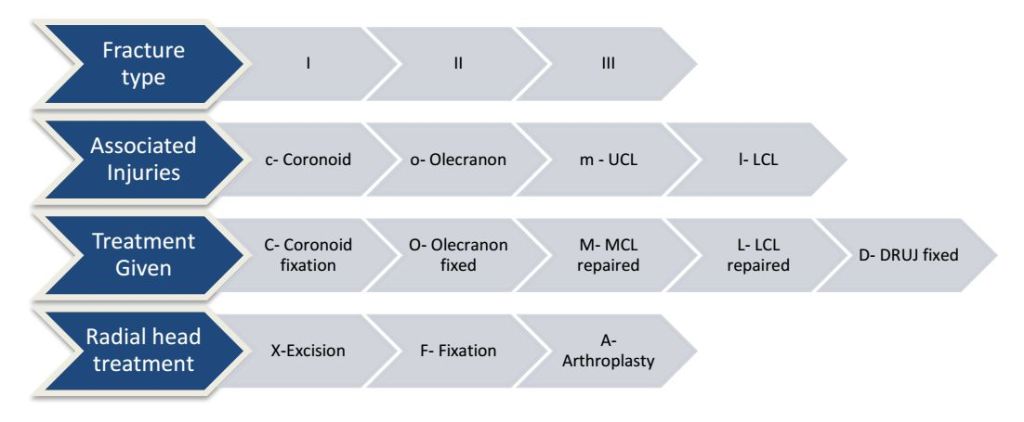
    The Mayo extended classification then adds a suffix to the fracture type to show any associated lesion.

    Suffix

    ‘c’ – Associated coronoid fracture. ‘C’ – If operative treatment was done.

    ‘o’ – Associated olecranon fractures. ‘O’ – If operative treatment was done.

    ‘m’ for medial collateral ligament (MCL) injury. ‘M’ – If operative repair was done.

    ‘l’  for  the  lateral  collateral  ligament  (LCL) injury. ‘L’ – If operative repair was done.

    ‘d’ for longitudinal distal radio-ulnar joint (DRUJ)  dissociation. ‘D’ – If operative treatment done.

    ‘X’ added for radial head excision.

    ‘F’ if radial head was fixed and

    ‘A’ if arthroplasty was done.

    Mayo Extended Classification
      Mayo Classification

    Management

    The factors that determine the treatment are the following.

    A. Radial head fracture configuration

    1.   Partial or completely articular

    2.   Fragment size –  <33% or more

    3.   Comminution – ❤ or more fragments

    4.   Impaction

    5.   Displacement – <2mm or more

    6.   Radial neck involvement

    B. Radiocapitellar alignment

    C. Associated fractures and ligamentous injury

    D. Block to elbow and forearm range of movement

    E. Elbow or forearm instability

    F. Bone quality

    Indications for surgery

    1. Displacement more than 2mm
    2. Restriction of range of movement
    3. Elbow or forearm instability
    4. Open fractures
    5. Polytrauma

    Guidelines

    • Fragment size if less than 33% of the radial head can be excised. If more than 33% it should be fixed
    • Comminution with more than 3 fragments is associated with poor outcome with ORIF. Either excise or replace
    • More than 2 mm displacement is considered to be an indication for surgery
    • Associated fractures of capitellum, coronoid, olecranon and distal radius need surgery
    • Block to elbow movement or forearm rotation is an indication for surgery
    • Elbow and forearm instability is an indication for surgery

    In fracture-dislocations of elbow; fixation/reconstruction is essential to restore coronal plane stability of elbow, to reduce the reliance on ulnar collateral ligament and to prevent proximal migration of radius. The options available for treatment are non-operative treatment, fragment excision, radial head excision, arthroscopic assisted reduction and fixation, open reduction and internal fixation and radial head replacement.

    Nonoperative treatment

    Indicated in undisplaced fractures and in minimally displaced (<2mm) fractures involving <33% of the head with no mechanical block to movement. Aspirate the joint under aseptic precautions, give a cuff & collar sling and start active ROM within 2-3 days once pain subsides. Avoid weight lifting and strenuous activities for 4-6 weeks. Take an x-ray at 2 weeks to rule out displacement. After 6 weeks usually functional ROM is attained, if not physiotherapy is given. Delayed excision may be needed if there are persistent pain and limitation of range of motion.

    Surgical approaches

    Anterior Henry approach and posterior Thomson approach allow exposure of proximal radius and the posterior interosseous nerve. Kocher approach between anconeus and extensor carpi ulnaris (ECU) is the most commonly used approach for radial head surgery. A major disadvantage of Kocher approach is inability to expose the posterior interosseous nerve (PIN). The PIN runs between the 2 heads of the supinator in close proximity to the radial neck. It is about 3.8 cm distal to the articular surface in pronation. To protect the PIN, the following steps should be taken.

    1. The forearm should be kept in full pronation during the procedure.
    2. Identify the interval between the ECU and anconeus by recognizing the fan-shaped direction of the fibers of anconeus, which are horizontal proximally and vertical distally.
    3. The supinator muscle should be released from its posterior edge close to the ulna.

    Steps in the surgery are as following.

    1)      Anesthesia

    a)      Regional anesthesia

    b)      General anesthesia

    2)      Position

    a)      Supine position with the arm on arm board and a pillow over the interscapular area.

    b)      Lateral position with arm supported over a bolster

    3)      Incision

    a)      Lateral incision centered over the lateral epicondyle

    b)      Posterior midline incision in presence of other elbow injuries raising a full thickness flap

    4)      Deep dissection

    a)      Kocher approach

    i)       Useful for exposure of lateral and posterior parts of the radial head.

    ii)      Uses the interval between the anconeus and extensor carpi ulnaris (ECU).

    iii)     Interval between ECU and anconeus identified by diverging direction of muscle fibers, fat pad and small perforators.

    iv)     Elevate the ECU anteriorly off the lateral ligament complex and incise the annular ligament in the midlateral plane to avoid injury to lateral ulnar collateral ligament (LUCL). It is better to do a Z capsulotomy for better repair after plate fixation or arthroplasty.

    v)      Do not elevate the anconeus posteriorly to protect the LUCL.

    vi)     Often the LCL is ruptured and the radial head can be exposed through that gap. LCL should be repaired at the end of the procedure.

    vii)   If needed LCL may be released and reattached at the end of the procedure.

    b)      Kaplan approach

    i)       Useful for exposure of lateral and posterior parts of the radial head.

    ii)      Uses the interval between the extensor carpi radialis and extensor carpi ulnaris (ECU).

    iii)     Elevate the ECU posteriorly off the lateral ligament complex and incise the annular ligament in the midlateral plane to avoid injury to lateral ulnar collateral ligament (LUCL).

    iv)     Chance of posterior interosseous nerve palsy is reduced by keeping the forearm pronated.

    c)      Hotchkiss Approach

    i)       Exposure through the fibers of extensor digitorum communis.

    ii)      Useful for exposure of anterolateral lesions.

    iii)     Radial head exposed through the fibers of EDC.

    iv)     Higher chance of posterior interosseous nerve palsy, which is avoided by keeping the forearm pronated.

    Open reduction and internal fixation

    About 2700 of proximal radius articulates with the lesser sigmoid notch; any protruding implants in this region will cause impingement and restriction of movement. Implants that project above the articular surface should be placed in the safe zone described by Smith and Hotchkiss. It is the posterolateral quadrant of the radial head which doesn’t articulate with the lesser sigmoid notch. It is the area of head that corresponds to the area between the radial styloid and Lister’s tubercle of distal radius. Safe zone is identified by the following method.

    • Keep the forearm in neutral rotation.
    • Mark the mid-lateral point of the radial head.
    • 450 arc anterior and posterior to the mid-lateral point is the safe zone.

    Fixation may be done for Mason II and selected Mason III fractures. The implants used for fixation in Mason II fractures may be conventional bone screws (2.7 mm/2.0 mm/1.5 mm), variable pitch headless compression screws small threaded Kirschner wires and absorbable pins or screws. Mason III fractures need fixation by low profile mini-fragment plate and screws, small fragment T or L plates, cross-cannulated screws or pre-contoured anatomic radial head locking plates. In comminuted fractures, it is important to avoid excessive compression by screws.

    Radial head arthroplasty

    In presence of severe comminution with >3 fragments, fixation may not be possible and radial head excision is done. After excision elbow and forearm stability is tested. If stable, simple excision is sufficient. Arthroplasty is indicated in presence of forearm and/or elbow instability in fractures involving >30% of the radial head which cannot be satisfactorily reduced and stably fixed.

    Aim of arthroplasty is to restore the radial head height, size and radial head-neck offset to achieve radiocapitellar and axial stability of forearm. Correct sizing is essential to prevent restriction of movement due to overstuffing and instability due to under-sizing. The resected head can be used as a template for sizing. During trials, the diameter, thickness, congruency and tracking should be assessed to estimate the proper fit. Normally when the forearm is in neutral rotation, the level superior edge of articular surface of lesser sigmoid notch and the radial head will be at the same level. Under C-arm the alignment of DRUJ, ulnar variance and symmetry of lateral and medial aspects of the ulnohumeral joint should be assessed for proper sizing.

    Radial head prostheses are currently available in a number of options. It may be unipolar or bipolar, cemented or uncemented and monoblock or modular. It may be round or elliptical (Anatomic).  Anatomic radial head prosthesis has an elliptical shape and it should be inserted with the long axis perpendicular to the lesser sigmoid notch, while keeping the forearm in neutral rotation.

    Radial head excision

    Radial head excision may be partial or total. Partial excision of >25% of radial head should be avoided. It may be required in presence of significantly comminuted and displaced fractures which cannot be reconstructed. But simple excision should be done only if the elbow and the forearm are stable. Hence after excision the stability of the forearm should be assessed and if unstable the radial head should be replaced. It may be associated with pain, instability, cubitus valgus, proximal migration of radius, DRUJ symptoms, weakness of grip and ulnohumeral arthritis.

    Postoperative care

    Long arm splint is given for 7-10 days. Abduction of shoulder avoided for 6 weeks if lateral collateral ligament was repaired. Once sutures are removed active assisted mobilization is started. Strengthening exercises started once there is radiological evidence of union.

    Outcome

    Outcome depends on the type of fracture and the associated lesions. 85% to 95% good results have been reported in undisplaced fractures managed nonoperatively with early motion. In displaced fractures, surgical treatment provides significantly better results than nonoperative treatment. Radial head prosthesis restores stability when the stability is compromised, but some loss of motion and strength is common and long term results are not yet known. In type III fractures, the results of radial head arthroplasty are superior to ORIF.

    Complications

    Most common complication is restriction of range of movement. Degeneration of radiohumeral articulation is also common. Secondary displacement of type I fractures can occur. Nonunion is rare. Posterior interosseous nerve palsy can occur, but usually recovers. Surgical site infection may require implant removal and debridement. Heterotopic ossification can occur. Capitellar erosion may occur after radial head replacement. Instability can occur after radial head excision. Loosening, overstuffing and radial head subluxation may be seen after radial head replacement.

    Future Directions

    From the outcome studies the importance of associated fractures and ligamentous injury is now clearly understood. But present methods of assessment of instability are nonspecific and inaccurate. With more specific and precise methods to assess instability and clearer cut guidelines for treatment will make the treatment more evidence based and reproducible.

    With better understanding of anatomy of proximal radius and identification of the three dimensional pathoanatomy of common fracture patterns, development of fracture specific implants are likely to provide better methods of fixation. Anatomic radial head prosthesis is already available, but their advantages over the conventional designs need long term studies.

    Summary

    Radial head is essential for valgus stability of elbow, axial stability of forearm and for load transfer across the elbow. Radial head fractures are the commonest of elbow fractures.  They are often associated with ligamentous injury and other periarticular fractures which have significant influence over the outcome. In presence of elbow and forearm instability, the radial head should either be fixed or replaced.

    Further Reading

    1)      Mason ML. Some observations on fractures of the head of the radius with a review of one hundred cases. Br J Surg. 1954 Sep;42(172):123-32.

    2)      Broberg MA, Morrey BF. Results of treatment of fracture-dislocations of the elbow. Clin Orthop Relat Res. 1987 Mar;(216):109-19.

    3)      Johnston GW. A follow-up of one hundred cases of fracture of the head of the radius with a review of the literature. Ulster Med J. 1962 Jun 1;31:51-6.

    4)      Hotchkiss RN. Displaced fractures of the radial head: internal fixation or excision? J Am Acad Orthop Surg 1997;5(1):1–10.

    5)      O’Driscoll SW, Bell DF, Morrey BF. Posterolateral rotatory instability of the elbow. J Bone Joint Surg. Am 1991;73(3):440–6.

    6)      Tornetta P 3rd, Hochwald N, Bono C, Grossman M. Anatomy of the posterior interosseous nerve in relation to fixation of the radial head. Clin Orthop Relat Res.1997 Dec;(345):215-8.

    7)      Schimizzi A, MacLennan A, Meier KM, Chia B, Catalano LW 3rd, Glickel SZ. Defining a safe zone of dissection during the extensor digitorum communis splitting approach to the proximal radius and forearm: an anatomic study. J Hand Surg Am. 2009 Sep;34(7):1252-5.

    8)      Soyer AD, Nowotarski PJ, Kelso TB, et al. Optimal position for plate fixation of complex fractures of the proximal radius: a cadaver study. J Orthop Trauma 1998;12(4):291–3.

    9)      Smith GR, Hotchkiss RN. Radial head and neck fractures: anatomic guidelines for proper placement of internal fixation. J Shoulder Elbow Surg. 1996 Mar-Apr; 5(2 Pt 1):113-7.

    10)   Smith AM, Morrey BF, Steinmann SP. Low profile fixation of radial head and neck fractures: surgical technique and clinical experience. J Orthop Trauma 2007;21(10):718–24

    11)   Yishai Rosenblatt, George S. Athwal, Kenneth J. Faber. Current Recommendations for the Treatment of Radial Head Fractures. Orthop Clin N Am 39 (2008) 173–185.

    12)   Van Glabbeek F, Van Riet R, Verstreken J. Current concepts in the treatment of radial head fractures in the adult. A clinical and biomechanical approach. Acta Orthop Belg 2001;67(5):430–41.

    13)   van Riet RP, Van Glabbeek F, Morrey BF. Radial head fracture. In: Morrey BF, editor. The elbow and its disorders. 4th ed. Philadelphia, PA: Saunders Elsevier; 2009. p. 359–81.

    14)   James T. Monica, Chaitanya S. Mudgal. Radial Head Arthroplasty. Hand Clin 26 (2010) 403–410

  • Orthopaedic Screws (Bone Screws)

    Screw is a cylinder with spiral threads running on its outer surface. It converts torsional forces into compression. The primary functional objective in the design of a screw is to dissipate and distribute the mechanical load. Thread design should maximise initial contact, enhance surface area, dissipate and distribute stresses at the screw-bone interface and increase the pull out strength. Screws can be used for attachment of implants to bone, bone to bone fixation or for soft tissue fixation or anchorage. In conventional plates they act by increasing the friction between the plate and the bone. Newer locking plates do not depend on the friction between the plate-bone interface; it acts as an internal fixator by using locking of screw head into the reciprocal threads of the plate to form a fixed angle construct.

    To continue please click the following link

    http://learningorthopaedics.com/orthopaedic-screws-bone-screws/

  • Examination of the Hip Joint

    Introduction

    • Introduce yourself
    • Get consent of patient or the parent for examination.
    • Note down the name, age, sex, race and occupation of the patient.
    • Adequately expose the patient. Make sure that external genitalia is adequately covered and the patient is comfortable and relaxed. Explaining why you need to expose and the steps of examination will help in relaxing the patient and in establishing a good rapport.
    • When examining a female patient make sure that you have a female nurse or assistant.
    • Examine the child with the parents by the side. Very young children may be examined in the parent’s lap.
    • First examine the normal or less symptomatic side to establish the normal range of movement for the particular patient and to make the patient understand what is going to be done on the painful side.
    • Steps of all procedures should be explained to the patient to ensure patient comfort and cooperation.

    Patients with hip joint disease may present with pain, alteration of gait, instability, functional limitation or limb length discrepancy as their presenting complaint. Hip symptoms may be due to intra-articular, extra-articular or referred causes. Intra-articular conditions usually will cause deformity, limitation of range of movement and worsening of symptoms on joint activity. Extra-articular conditions usually will not cause restriction of range of movement, pain will be present mainly in one particular movement or position of joint and tenderness will be localized to a specific area. Always rule out referred pain from spine, pelvis, and sacroiliac joint or vascular causes. Rarely hip disease may present as pain referred to the knee.

    Examine the patient in standing, sitting, walking and lying down. When the patient is lying in the supine position, always examine the patient from the right side. Make sure that the patient lies on a hard surface to ensure that deformities are not concealed by a soft mattress.

    To read the rest of the article please click the link below

    http://learningorthopaedics.com/examination-of-the-hip-joint/

  • Scapholunate Dissociation

    According to Dobyns carpal instability is “a carpal injury in which loss of normal alignment of the carpus occurs early or late”. It is symptomatic due to carpal malalignment under physiologic loads. Scapholunate dissociation (SLD) is the most common carpal instability.

    It occurs due to injury to scapholunate interosseous ligament (SLIL). SLIL may either be injured alone or in combination with other ligaments such as radioscaphocapitate ligament or dorsal intercarpal ligament. SLD may occur alone or in combination with other injuries such as radial styloid fracture (Chauffeurs fracture) or as a part of perilunate instability.

    Anatomy

    Anatomically the proximal surface of carpus appears similar to a condyle. But it is not a true condyle, but a composite condyle made of scaphoid, lunate and triquetrum attached to each other by interosseous ligaments.

    No tendons insert into the carpus but 3 sets each of tendons cross the carpus on the dorsal and volar aspect; influencing carpal motion. These three sets of tendons are finger extensors and flexors centrally, wrist extensors and flexors on the radial and ulnar side.

    The specific intercarpal motions occur due to the presence of ligaments which selectively restrain or allow individual carpal motion. Ligaments of the wrist may be classified into intrinsic, deep extrinsic and superficial extrinsic ligaments. Intrinsic carpal ligaments are those between carpal bones of the same row.

    Scapholunate ligament is U shaped and is thicker dorsally. Its rupture leads to increased flexion of scaphoid, extension of lunate, increase in the scapholunate gap and dorsal translation of proximal pole of scaphoid. In addition to SLIL, the scapholunate interspace is stabilised by others ligaments. These secondary stabilisers can be dorsal or volar. Volar secondary stabilisers are the radioscaphocapitate ligament and the scaphotrapezial ligament. The dorsal secondary stabilisers are the dorsal radiocarpal or dorsal intercarpal ligaments. Injury to secondary stabilisers will worsen the instability, which is likely in perilunate dislocations.

    Kinematics

    Wrist has one of the most complex kinematics in the human body. Various concepts like row theory by Johnston in 1907, column theory by Navarro in 1921, modified column theory by Taleisnik in 1978 and oval ring theory by Lichtman in 1981 have been used to explain carpal motion.

    Flexion occurs mainly in the scaphotrapeziotrapezoid, radiolunate and ulnotriquetral articulations. Extension occurs mainly in the radioscaphoid, lunocapitate and triquetrohamate articulations. Thus the axis of flexion which passes through STT, radiolunate and ulnotriquetral joints and the axis of extension which pass through the radioscaphoid, lunocapitate and triquetrohamate joints; cross at the scapholunate interosseous ligament. Hence SLIL is subjected to high stresses and is highly prone for injury. It is the most common instability pattern because the intercarpal lines of flexion and extension movement cross at the scapholunate interface. Another reason is that compression forces transmitted through the capitate has a tendency to separate the scaphoid and lunate.

    During radial and ulnar deviation; both the carpal rows move in the same direction in the frontal plane. During radial deviation; the proximal row flexes, and the distal row extends in the coronal plane. During ulnar deviation, there is extension of the proximal row and flexion of the distal row. Such reciprocal movements help to keep the hand in the neutral position.

    Kinematically the wrist is considered to be similar to a 3-link system. The three links are the radius, lunate-triquetrum and the distal row-metacarpal complex. As it doesn’t have any tendons directly inserted to it; the proximal row acts as an intercalated segment between the radius-TFCC complex and the distal carpal row in a three joint link system. Intercalated segments collapse under compressive load. Collapse of the proximal row under compressive load is prevented by the presence of scaphoid which acts as a crosslink between the proximal and distal rows like a slider crank.

    Pathomechanics of Dorsal Intercalated Segment Instability (DISI)

    Under compressive loads, the natural tendency of scaphoid is to palmar flex and the natural tendency of triquetrum is to extend due to their shape and their ligamentous attachments. Compression of radial column during radial deviation flexes the scaphoid which in turn leads to flexion of the proximal row. Compression of ulnar column during ulnar deviation leads to extension of triquetrum which in turn leads to extension of proximal row. In the normal wrist the tendency of triquetrum to extend the proximal row is counterbalanced by the scaphoid. The dorsal horn of lunate is thinner than the palmar horn; hence under compressive forces transmitted by the capitate the lunate has a tendency to extend.

    In scapholunate dissociation, the triquetrum extends the lunate as the counterbalancing by scaphoid is absent and the scaphoid is flexed. This leads to dorsiflexion of lunate, palmar flexion of scaphoid which will increase the scapholunate angle and lunocapitate angle creating the dorsal intercalated segment instability (DISI) pattern.

    Clinical Features

    Usually it occurs due to a fall on the outstretched hand (FOOSH) leading to forced dorsiflexion and ulnar deviation of the wrist. Patients present with pain and swelling of the wrist. There may be tenderness over the dorsum of wrist just distal to the Lister’s tubercle. There will be painful restriction of wrist movements. Watson test may be positive. This test is done by placing the thumb of the examiner over the scaphoid tuberosity and applying pressure in the dorsal direction. With the other hand; hold the hand and move the wrist repeatedly into radial and ulnar deviation. A painful clunk is suggestive of SLD.

    Imaging

    Investigations needed for evaluation are x-ray, arthrography, video fluoroscopy, MRI and arthroscopy. X-rays needed are the PA in neutral position, radial deviation and ulnar deviation, lateral view, lateral oblique view and medial oblique view and clenched fist AP view. Gilula Lines are 3 arcs to be looked for on the PA view. First arc is on the proximal surface of proximal carpal row, second arc on the distal surface of proximal row and third on the proximal surface of capitate and hamate. Any asymmetry or gap suggests carpal malalignment. Normally lunate appear rectangular on the PA view; if it is triangular it is malpositioned. Normally scaphoid lies in an oblique plane on the AP view and the proximal and distal thirds can be seen to be separated by the waist. In patients with SLD, the scaphoid is flexed leading to shortened appearance on the PA view, there may be the cortical ring sign on the PA view due end on view of distal pole.

    Normal gap between scaphoid and lunate is 9 mm at 7 years of age and 3 mm after 15 years of age; a gap more than 5 mm (Terry Thomas sign) is diagnostic of SLD in presence of ring sign. It should be compared with the opposite side before confirming the diagnosis. If there is a strong clinical suspicion but the x-rays are normal; then a stress x-ray with the patient clenching the fist will show increased gap.

    Note the increased gap between scaphoid and lunate

    Note the increased gap between scaphoid and lunate

    The scapholunate angle should be measured on the lateral view. Draw a line connecting the centre of the convex surfaces of the proximal and distal poles of scaphoid. Draw a line connecting the dorsal and volar lips of the distal articular surface of lunate and draw a line perpendicular to it to get the lunate axis line. Normal angle is 30-600. An angle greater than 800 confirms SLD.

    Draw the axis line for lunate and capitate on the lateral view and the angle between the lines gives the lunocapitate angle. Normal is 0-150. If the lunate is dorsiflexed as in DISI, the angle is >150.

    Classification

    The severity of SLD may range from

    • SLIL strains
    • Dynamic Instability
    • Static Instability
    • Rotatory scaphoid subluxation
    • Scaphoid Dislocation

    Geissler Classification

    I-Attenuation or hemorrhage into SLIL on midcarpal arthroscopy. Bones congruent.

    II-Scapholunate incongruency on midcarpal arthroscopy.

    III- Scapholunate gap allows passage of 1 mm arthroscope from midcarpal space to radiocarpal space

    IV- Gap allows passage of 2.7mm arthroscope.

    Management

    Depends on the duration of injury, severity, reducibility, associated injuries and whether the injury is static or dynamic.

    Duration of injury

    • Acute- Less than 4 weeks duration
    • Subacute- Less than 4 weeks but greater than 24 weeks
    • Chronic- More than 6 months

    Severity of gap

    • 3-5mm
    • >5mm

    Reducible or irreducuble

    Dynamic or static deformity

    Associated carpal injuries

    Arthritic or not

    Guide lines for the treatment of acute SLD

    • Injuries without incongruence (partial injuries) are treated by immobilization.
    • Injury with partial SLIL disruption with a gap that is reducible by closed manipulation or percutaneous K wire joysticks is treated by reduction and percutaneous scapholunate and scaphocapitate K wires and immobilization.
    • Gap > 3 mm, scapholunate angle > 600, lunocapitate angle >150 are indications for open reduction and ligament repair.
    • If the gap is more than 5 mm; SLIL repair and repair or advancement of palmar ligaments is usually necessary.

    Technique of SLIL repair

    • Dorsal incision centered over the Lister’s tubercle.
    • Retract extensor pollicis longus radially and extensor digitorum communis medially.
    • Open the capsule by a radially based flap preserving dorsal intercarpal and dorsal radiotriquetral ligaments.
    • Put a K wire as joystick into the lunate in the proximal-dorsal to distal-volar direction to allow flexion of lunate during reduction.
    • Put a K wire into scaphoid as joystick from dorsal-distal to volar proximal direction to allow extension of scaphoid during manipulation.
    • Visualize the SLIL tear which is usually avulsed from scaphoid.
    • Freshen the site of reattachment.
    • Manipulate the joysticks to reduce by flexing the lunate and extending and supinating the scaphoid.
    • Fix by scapholunate and scaphocapitate K wires
    • Reattach the ligament using intraosseous suture anchors such as G2 Mini anchors 1.9 mm (Depuy Mitek) and nonabsorbable sutures.
    • In subacute tears or in the absence of poor tissue quality; the repair can be augmented by suturing a proximally based dorsal capsular flap on the scapholunate interspace and the adjacent dorsal scaphoid. (Blatt technique)
    • Tendon strips from radial extensors can also be used for augmentation if the quality of tissue available for repair is poor. Almquist and Linscheid technique utilizes extensor carpi radialis brevis (ECRB) and the Brunelli technique uses extensor carpi radialis longus (ECRL).
    • Close the wound in layers and immobilize for 3 months.DSCN0972

    Subacute SLD needs ligament repair and augmentation by dorsal capsular flap. In addition palmar approach for repair and advancement of radioscaphocapitate and radiolunate ligaments to overcorrect the scaphoid flexion should also be done.

    In chronic SLD without arthritis; ligament repair and augmentation is the preferred treatment if the gap is reducible. If not reducible or if there is arthritis (Scapholunate advanced collapse – SLAC)then limited carpal fusion such as STT fusion is preferred. In presence of advanced arthritis; wrist arthrodesis is preferred.

    Further reading

    DOBYNS, J. H.; LINSCHEID, R. L., CHAO, E. Y. S.; WEBER, E. R.; and SWANSON, G. E.: Traumatic Instability of the Wrist. In Instructional Course Lectures, The American Academy of Orthopaedic Surgeons. Vol. 24, pp. 182-199. St. Louis, C. V. Mosby, 1975

    FISK, G. R.: Carpal Instability and the Fractured Scaphoid. Ann. Roy. Coll. Surg. England, 46: 63-76, 1970

    GILFORD, W. W.; BOLTON, R. H.; and LAMBRINUDI, C. The Mechanism of the Wrist Joint. With Special Reference to Fractures

    of the Scaphoid. Guy’s Hosp. Rep., 22: 52-59, 1943

    LINSCHEID, R. L.; DOBYNS, J. H.; BEABOUT, J. W.; and BRYAN, R. S.: Traumatic Instability of the Wrist. Diagnosis, Classification and Pathomechanics. J. Bone and Joint Surg., 4-A: 1612-1632, Dec. 1972