Category: Topics

  • Simple bone cyst (Unicameral bone cyst)

    • 3% of primary bone tumors. 
    • Nearly always in first 2 decades.
    • Most often between 4-10years.
    • 2:1 male female ratio.

    Pathology

    • Common sites are proximal humerus – 50%, proximal femur- 18-27% and proximal tibia, distal tibia and calcaneum.
    • Cyst cavity may become multiloculated after fracture healing.
    • Categorized as latent and active.
      • Lesions <0.5cm from physis are considered active.
      • Epiphyseal involvement rare but seen in aggressive lesions.
      • Latent cysts also have growth potential.
    • Recurrence and worsening rare after skeletal maturity.
    • >75% detected in childhood.
    • >95% involve metaphysis.
    • Cyst is filled with fluid rich in protein content. Shown to have elevated levels of IL-1, IL-6, prostaglandins, lysosomal enzymes, IL1B, TNF-A, Nitric oxide production thought to be important.
    • Oxygen free radicals thought to be important.
    • Fluid shows increased intraosseous pressure of >30cm H2O.
    • Fluid may be straw coloured or serosanguinous.
    • Most characteristic histopathologic finding is thin membrane like lining of epithelium like cells.
    • Osteoclasts, cholesterol cells and fat cells also seen.
    • Genetic analysis shows single and multifocal cytogenetic rearrangements.

    Theories about causation

    Mirra- Intraosseous entrapment of synovium.

    Jaffe and Lichtenstein- Localized failure of ossification during periods of rapid growth.

    Cohen- Blockage of venous drainage.

    Current evidence supports blockage of intraosseous venous circulation. 

    Clinical features

    Fractures occur in up to 90%.

    Physeal closure occur after fracture in 10%.

    Fracture readily heals but cyst does not.

    Spontaneous healing of cyst after fracture occurs in <5%.

    Radiological features

    Symmetrically expansive, radiolucent with a thin shell of cortical bone.

    Fallen fragment sign seen in less than 10%.

    MRI shows complex appearance with heterogenous fluid signals with nodular and thick peripheral enhancements.

    Double density fluid levels, septation and low signal on T1 with high signal on T2 suggest ABC.

    Differential diagnosis

    ABC

    Fibrous dysplasia

    Atypical eosinophilia

    Treatment

    Treatment if necessary should be undertaken immediately after the fracture ha healed.

    Treatment more aggressive in younger children and in older individuals with lesions in weight bearing bones.

    Treatment options

    Corticosteroid injection

    Injection of autologous marrow.

    Multiple drilling and drainage

    Curretage and bone grafting

    Corticosteoid injection

    Reported by Scaglietti in 1979.

    Healing occurs in 90%.

    Thickening of cortex, increasing opacity, remodelling and bone scar are signs of healing.

    Cysts with rapid venous flow shown by radiografin instillation show higher rates of failure.

    Look for loculation.

    Each locule must be injected.

    40-120mg of methylprednisolone injected.

    Repeated every 2 months for 2-5 dosestill complete healing occurs.

    Follow-up xrays taken every 2-3 months.

    Temporary Cushing syndrome may be seen.

    Other materials injected

    Autologous bone marrow- Single injection recurrence rate of 12%

    Demineralized bone matrix

    Bioabsorbable calcium phosphate paste

    Multiple drilling

    Percutaneous drilling of multiple holes.

    Lavage with saline

    Multiple K wires, flexible nails or cannulated screws fixation

    Displaced pathological fractures of femur needs curettage, bone  grafting and internal fixation.

  • OASIS ICL on Basics Of TKR

    I was the organising chairman for this Instructional Course Lectures on Basics of TKR conducted by Orthopaedic Association of South Indian States (OASIS) conducted on 2-11-2021. The YouTube link to the entire program is given below. Please visit.. https://www.youtube.com/watch?v=-WNfOMTJkaU

  • Paediatric Monteggia Fractures

    • Monteggia fracture first described by Giovanni Monteggia in 1814.
    • 16-50% of paediatric Monteggia fractures are missed initially at presentation.

    Anatomy

    • Annular ligament and quadrate ligament are primary static stabilizers of proximal radioulnar joint.
    • Weitbrecht ligament or oblique cord which extend from just distal to radial notch on the ulna to the bicipital tuberosity and the interosseous ligament are the other stabilizers.
    • These ligaments are most taut in supination because of radial bow and elliptical shape of radial head, and the longer axis of the elliptical radial head is perpendicular to radial notch of ulna in supination.
    • 80% of load from carpus is carried by radius.
    • 33% of valgus stability of elbow provided by radial head.

    Classification

    Letts Classification

    1. Anterior dislocation with apex anterior plastic bowing of ulna
    2. Anterior dislocation with apex anterior green stick fracture of ulna.
    3. Anterior dislocation with apex anterior complete fracture
    4. Posterior dislocation with apex-posterior fracture of ulna
    5. Lateral dislocation with apex-lateral fracture of ulna

    75% of acute paeditric Monteggia injuries and 85% of missed paediatric Monteggia fractures are anterior dislocation types.

    Bado classification

    1. Anterior dislocation with apex-anterior fracture of ulna. Due to hyperextension (hyperextension theory of Tompkins)
    2. Posterior dislocation with apex-posterior fracture of ulna. Due to fall with elbow flexed to 60 degrees.
    3. Lateral dislocation with apex-lateral fracture of ulna. Due to varus stress.
    4. Radial head dislocation with fracture of radius and ulna. Due to hyper-pronation.

    Natural history

    • Ulnar fracture unites.
    • The annular ligament and anterior capsular structures fall into radiocapitellar joint producing block to reduction.
    • Dysplastic changes develop in the radial head, capitellum and the radial notch of ulna.
    • Valgus instability of elbow develops.
    • Cubitus valgus develops.
    • Secondary osteoarthritis of elbow develops.
    • Late paralysis of ulnar nerve can develop due to cubitus valgus.
    • Late median nerve and posterior interosseous nerve palsy can develop due to tenting by the anteriorly dislocated radial head.

    Diagnosis

    • Storen line – The axis of radius passes through the centre of the capitellum.
    • Head neck ratio- Ratio between widest part of head and narrowest part of neck. Normal is less than 1.5.
    • Lincoln and Mubarak method- The line drawn along the subcutaneous border of ulna is within <2-3mm of the ulnar shaft. if more, the ulna is deformed.

    Treatment

    • In acute setting, treatment is by closed reduction and long arm casting in supination.
    • Closed reduction can be attempted up to 4 weeks.
    • Contraindications for surgery are duration more than 3 years and age > 12 years.
    • Generally reduction is successful if done within one year of injury irrespective of age.
    • Depending on the chronicity and the severity of changes, adjunct procedures are required to maintain the reduction.
    • Treatment needs 3 strategies
      • Reduction of radial head
      • Reconstruction of ligamentous stabilizers
      • Correction of ulnar deformity
    • Bell Tawse procedure
      • Described in 1968.
      • Posterolateral approach
      • Excision of interposed tissue
      • Reduction of radial head
      • Reconstruction of annular ligament by passing the central slip of triceps circumferentially around the neck of radius.
      • According to Seel and Peterson, the reconstructed ligament produces a posterolateral pull and hence is useful for anteromedial dislocations, but not for other types of dislocations.
    • Seel and Peterson developed a 2-drill hole technique that produces a centrally directed force.
    • Lloyd Roberts and Bucknill added radio-capitellar pinning to Bell Tawse procedure to protect the reconstructed ligament for 6 weeks.
    • To avoid intra-articular pin breakage, Letts described radioulnar pinning instead of radio-capitellar pinning.
    • Kalamchi procedure
      • Osteotomy of ulna using multiple passes of K wire and open reduction of radial head.
    • Ladermann procedure
      • Closed reduction of radial head after ulnar osteotomy and lengthening of ulna.
    • Bor technique
      • Using Ilizarov technique to lengthen the ulna, angulate the ulna and reduce the radial head.
    • According to Delpont (2014) annular ligament reconstruction is not beneficial in conjunction with ulnar osteotomy.  (Delpont M, Jouve JL, Sales de Gauzy J, Louahem D, Vialle R, Bollini G, Accadbled F, Cottalorda J. Proximal ulnar osteotomy in the treatment of neglected childhood Monteggia lesion. Orthop Traumatol Surg Res. 2014 Nov; 100(7):803-7. Epub 2014 Oct 7.)
    • Osteotomy is useful in Bado 1 lesions but less effective in Bado 3 lesions.
    • Ulnar osteotomy can be corrective (Straightens the posterior cortical line), over-corrective (reverses original deformity) or stabilizing (reduces the radial head).
    • Overcorrection has been shown to produce significantly better outcomes. (Inoue G, Shionoya K. Corrective ulnar osteotomy for malunited anterior Monteggia lesions in children. 12 patients followed for 1-12 years. Acta Orthop Scand. 1998 Feb;69(1):73-6.)
    • Osteotomy can be at the CORA or at the proximal metaphyseal area. Osteotomy at the proximal metaphyseal area have better healing and can be performed through the same incision.
  • Notes on Robotic Total Knee Replacement

    • Term ‘robot’ originates from the Czech word ‘robota’, which means forced labour or activity.
    • Karel Capek first used the term ‘Robot’ in his 1921 play called Rossum’s Universal Robots.
    • Robots are defined as an array of computer controlled machines that perform preprogrammed, precise, and repetitive procedures.
    • Robotic technology allow to sustain levels of precision, productivity, and efficiency that were not possible with humans alone.
    • First robotic surgical procedure was performed by Kwoh  in 1988 using the PUMA 560 robotic system (Westinghouse Electric, Pittsburgh, Pennsylvania) to undertake neurosurgical biopsies with improved precision.
    • Advantages of robotic surgery
      • Smaller skin incisions
      • Improved precision of soft-tissue dissection
      • Better visualisation of the surgical field
      • Comprehensive data capture for surgical training
      • Early recovery
      • Shorter hospital stay
    • Disadvantages
      • Expensive to install
      • Needs separate applications for total hip arthroplasty, TKA, and unicompartmental knee arthroplasty.
      • Compatible with a limited number of implants from the manufacturer of the robotic device
      • Additional costs are incurred for preoperative imaging
      • Radiation exposure for CT
      • Increased operating times during the learning phase
      • Needs training the surgical team
      • Updating of computer software needed
      • Needs servicing contracts and consumables.
      • Additional time needed for planning and modelling
      • Product specialists needed in the OT
      • Technical issues with robot arm may need intra-operative conversion to conventional jigs
      • Maintenance costs
      • Paucity of long-term data showing any functional benefit

    Why consider robots for TKR?

    • Up to 20% of patients remaining dissatisfied following TKA.
    • Surgeon controlled variables affecting outcome in TKR
      • Accurate implant positioning
      • Balanced flexion-extension gaps
      • Proper ligament tensioning
      • Preservation of periarticular soft-tissue envelope
    • Conventional jig-based TKA uses preoperative radiographic films, intra-operative anatomical landmarks, and manually positioned alignment jigs to guide bone resection and implant positioning.
    • Conventional jig-based TKA is associated with poor reproducibility of alignment-guide positioning, inadvertent saw blade injury to the periarticular soft-tissue envelope, and limited intra-operative data on gap measurements or ligamentous tensioning to fine tune the implant positioning.
    • Suboptimal implant positioning may lead to
      • Poor functional recovery
      • Reduced clinical outcomes
      • Increased instability
      • Reduced implant survivorship
    • In navigated TKR, computer software converts anatomical information obtained from preoperative CT or intra-operative osseous mapping into a virtual patient-specific 3D model of the knee joint.
    • Virtual model is used to plan optimal bone resection, implant positioning, bone coverage, and limb alignment based on the patient’s unique anatomy.
    • Computer navigated TKA provides patient-specific anatomical data with recommendations for bone resection and optimal component positioning.
    • In robotic TKR, a robotic device helps to execute this preoperative patient-specific plan with a high level of accuracy.
    • Robotic TKR uses optical motion capture technology to assess intra-operative alignment, component positioning, range of movement, flexion-extension gaps, and soft tissue balancing.
    • RTKR actively controls and/or restrains the surgeon’s motor function to improve the accuracy of achieving the planned bone resection and implant positioning.
    • Real-time intra-operative data can then be used to fine-tune bone resection and guide implant positioning, in order to achieve the desired knee kinematics and limit the need for additional soft-tissue releases.
    • First robotic TKA was performed in 1988 using the ACROBOT robotic system (Imperial College, London, United Kingdom).

    Classification

    • Classified into
      • Imageless or Image guided
      • Fully-active or semi-active
    • Fully active is actively involved in all steps of bone resection and soft tissue balancing.
    • Semi-active provides the surgeon with visual, tactile, and audio feedback that provides stereotactic boundaries that confines the saw blade to pre-planned haptic femoral and tibial windows to achieve accurate bone resection and soft tissue balancing.
    • RTKR associated with improved accuracy of achieving the planned femoral and tibial implant positioning, joint line restoration, limb alignment, and posterior tibial slope compared with conventional jig-based TKA.
    • Results in improved accuracy in implant positioning in all three planes and reduces outliers.
    • RTKR associated with learning curve of six to 20 cases for operative times, but there is no learning curve for achieving the planned femoral or tibial implant positioning. This allows even low volume surgeons to improve accuracy.
    • Improved accuracy of implant positioning and enhanced postoperative rehabilitation in robotic TKA have not translated to any differences in middle- to long-term functional outcomes compared with conventional TKA.
    • There is a paucity of prospective randomized controlled trials reporting on longer-term outcomes.

    Based on the Open access article published in Bone and Joint Research

    Robotic total knee arthroplasty clinical outcomes and directions for future research by Babar Kayani & Fares S Haddad.

    https://online.boneandjoint.org.uk/doi/full/10.1302/2046-3758.810.BJR-2019-0175

  • Examination of Spine

    The purpose of clinical examination are many.  First and foremost, the identification of patients who need emergent or urgent care and treatment, and then, identify the cause of patient’s symptoms, its impact on the patient and the needs and expectations of the patient. Any associated medical conditions that have an impact on the treatment of the primary condition should also be identified. Proper physical examination achieves these objectives and allows the clinician to develop a healthy rapport with the patient as well.

    The information generated from the history and examination must differentiate normal from abnormal, provide a reliable measure of the abnormality, and permit a valid interpretation. It should fulfil the criteria of normality, reliability, validity, utility, compliance and cost effectiveness. (Waddell 1982)

    Examination of spine involves 2 steps: history taking and physical examination. A detailed and chronological history and a structured clinical examination is essential for diagnosis. History taking provides information about the past and the present health status of the patient, his symptoms and the disease. It helps in the assessment of disability caused by the disease. History provides the foundation for making decisions regarding the working diagnosis,  investigations needed for work-up, treatment options, follow-up, outcome analysis, prognostication and prevention.

    History taking

    History taking is an art. The clinician should learn to talk less and listen more. It should be detailed and chronological. History taking is divided into various components such as presenting complaint, history of presenting complaint, treatment history, past history, personal history, family history, occupational history, nutritional history etc. Depending on the setting of the patient interview, either some or all these components may have to be gone into.

    History taking starts with simple, open ended questions  that allows the patient to communicate her perception of the problem and to let the surgeon understand the treatment goals. Later more focussed questions should be asked to get specific details about various aspects of the symptoms. The questions should be simple, clear, unambiguous and phrased in patient’s own everyday language. It should avoid medical terminology and inappropriate cultural assumptions (Waddell 1982). The information sought should be within patient’s knowledge. 

    History taking helps in localisation of the symptoms to the diseased part, discern the evolution of symptoms, identify the underlying pathology and elucidate the effect of the disease on the patient. It helps in identifying the associations and co-morbidities. The root cause of symptoms in spine patients may be vertebral, paravertebral or referred. It may be musculoskeletal, neurological or combined. Vertebral causes may present with pain, deformity, limitation of movement, swelling or functional limitation. Neurological causes may present with upper motor or lower motor neurone  symptoms. Neurological symptoms may be sensory, motor or sphincter related. 

    Most common presenting complaint is pain. Pain may be somatic, visceral, neurogenic or psychosomatic. Somatic pain is due to local causes which can be mechanical or non-mechanical. Mechanical pain may be discogenic, capsuloligamentous or stenotic in origin. Discogenic pain may be disco-dural or disco-radicular. Disco-dural pain presents with acute lumbago, chronic backache or sciatica. Disco-radicular symptoms pain that radiating pain or neurological deficit in body area supplied by the roots affected and occur when the neuronal cell bodies in the dorsal root ganglion situated within the intervertebral foramen are chemically or mechanically irritated by various causes; most commonly by a prolapsed disc. Mechanical causes of pain may be herniated nucleus pulposus, osteoarthritis, spinal canal stenosis, spondylolisthesis or compression fracture. Non-mechanical causes may be inflammatory spondylarthritis, infective spondylitis, tumours, osteoporotic fractures or visceral causes.

    Pain due to spinal canal stenosis presents with unilateral or bilateral neurogenic claudication. Neurogenic claudication is worsened by standing or walking and is relieved by sitting, squatting or stooping forwards. It is often associated with neurological symptoms such as weakness, numbness or sphincter disturbance. Dural and root symptoms and signs are generally absent. 

    The cause of pain may be identified from patient history based on the site of pain, onset, duration, radiation, relation to activity and posture. Somatic pain is sharp, localised and worsened by activity. Visceral pain is poorly localised and not affected by activity or rest. Neurogenic pain is burning or pricking type of pain felt along the involved dermatomes. Psychosomatic pain is due to underlying psychological diseases and is a diagnosis by exclusion of other causes by detailed evaluation.

    Site of pain is described as per the anatomic borders delineated by International Society for Study of Pain (IASP). Low back pain as the site may be lumbar, sacral, coccygeal, loin or gluteal pain. 

    According to the duration of symptoms, pain of duration less than 5 weeks is considered as acute, 5 weeks to 3 months as subacute and more than 3 months as chronic pain. Radiculopathy is defined by IASP as “Pain perceived as arising in a limb or the trunk wall caused by ectopic activation of nociceptive afferent fibres in a spinal nerve or its roots or other neuropathic mechanisms.”

    Pain history

    1. Duration – How long the pain is present?
    2. Onset- How did it start?
    3. Progress – What happened afterwards?
    4. Site- Where do you feel the pain, point it out with a single finger?
    5. Character- What is the nature of pain? Is it throbbing, pricking or burning type of pain?
    6. Intensity of pain – What is the severity of pain at present, at rest and during activity? How severe was the worst pain you experienced?
    7. Temporal factors – Continuous or intermittent, diurnal variation.
      1. Is the pain continuous or intermittent?
      2. If intermittent, how long does each episode last?
      3. If intermittent, is it  colicky in nature?
      4. Is there any relation between the severity of pain and the time of day?
      5. Is there any sleep disturbance due to pain?
    8. Aggravating factors.
      1. Is it aggravated by activity? Suggestive of mechanical pain.
      2. Is it aggravated when getting up in the morning? If yes, how long does the increased pain last? Morning stiffness is present if the pain lasts for more than one hour. Morning stiffness is suggestive of inflammatory spondylarthropathy.
      3. Is it aggravated by walking? Suggestive of vascular or neurogenic claudication.
      4. Is it aggravated by standing? Suggestive of neurogenic claudication.
    9. Relieving factors.
      1. Is it relieved by activity? Suggestive of inflammatory spondylarthropathy.
      2. Is it relieved by rest? Suggestive of mechanical pain.
      3. If aggravated by walking, is it relieved by standing? Suggestive of vascular claudication.
      4. If aggravated by standing and walking, is it relieved by sitting down or stooping forwards? Suggestive of neurogenic claudication.
    10. Associated symptoms.

    History taking in spinal deformity

    1. When was the deformity noticed?
    2. How was the deformity noticed?
    3. What happened to the severity of deformity after it was noticed?
    4. Is it painful?
    5. Is there any difficulty in walking?
    6. Is there any weakness or numbness in the upper or lower limbs?
    7. Is there any urinary retention or urinary incontinence?
    8. Is there any bowel complaints?
    9. Is there any exercise intolerance or exertional dyspnoea?
    10. Is there any associated symptoms?
    11. In girls presenting with spinal deformity, ask about age of menarche.

    In the history, red flag and yellow flag signs which suggest serious underlying disease should be specifically looked for.  

    Red flag symptoms

    Age > 50 years

    Duration of symptoms > 1month

    Rest pain

    Night pain

    Bilateral sciatica

    Significant neurological deficit

    Progressive neurological deficit

    Bowel or bladder disturbance

    Unexplained weight loss 

    Fever

    History of significant trauma 

    History of malignancy

    History of steroid intake

    Yellow flag symptoms

    Denotes negative psychosocial factors that are associated with chronicity and long term disability. It may be related to work, beliefs, behaviour or affective disorders.

    General Examination

    Development of secondary sexual characteristics using  Tanner stages should be done in children with spinal deformity. 

    Tanner stages.

    • Used to assess sexual age by assessing the onset and progression of pubertal changes.
    • Boys and girls assessed on a 5-point scale.
    • Boys are assessed by genital development and pubic hair growth, and girls by breast development and pubic hair growth.
    • Girls
      • Pubertal hair development
        • Stage I (Preadolescent) – Vellos hair develops over mons pubis similar to that over the anterior abdominal wall. There is no sexual hair.
        • Stage II – Appearance of sparse, long, pigmented, downy, straight or only slightly curled hair mainly along the labia.
        • Stage III – Appearance of darker, coarser, and curlier sexual hair appears sparsely over the junction of the pubes.
        • Stage IV – The hair distribution similar to adult but decreased in total quantity. No spread to the medial surface of the thigh.
        • Stage V – Pubic hair similar to adults in quantity and appearance.  Distribution have an inverse triangle and extends to the medial surface of the thighs. No extension above the base of the inverse triangle.
      • Breast development
        • Stage I (Preadolescent) – Only the papilla is elevated above the level of the chest wall.
        • Stage II – (Breast Budding) – Elevation of the breasts and papillae above the level of chest wall may as small mounds along with increase in the diameter of the areolae.
        • Stage III – The breasts and areolae continue to enlarge, and show no difference in contour.
        • Stage IV – The areolae and papillae form secondary mounds above the level of breast.
        • Stage V – Mature female breasts have developed. The papillae project due to recession of the areolae.
    • Boys
      • Pubertal hair development
        • Stage I (Preadolescent) – Only vellos hair over the pubes similar to that over the abdominal wall is present. 
        • Stage II – Sparse long pigmented, slightly curled or straight, downy hair begins to appear.
        • Stage III –  Darker, coarser, and curlier pubic hair with its distribution spread over the junction of the pubes. 
        • Stage IV – Adult type hair distribution but quantity less. No spread to the medial surface of the thighs.
        • Stage V – Adult type hair distribution in an inverse triangle shape with extension to medial thigh. Quantity and type similar to adult.
      • Male genitalia development
        • Stage I (Preadolescent)- The testes, scrotal sac, and penis similar to early childhood in size and proportion.
        • Stage II – Enlargement of the scrotum and testes with changes in the texture of the scrotal skin. 
        • Stage III – Along with increased growth of the testes and scrotum, there is growth of the penis mainly in length, with some increase in diameter. 
        • Stage IV – Penis and glans penis significantly enlarged in length and diameter. Testes and scrotum enlarge further with darkening of the scrotal skin. 
        • Stage V – Similar to adult in size and shape.

    Facial hair

    Voice change

    Signs of generalised ligamentous laxity

    Neurocutaneous markers should be looked for in patients with scoliosis to rule out neurofibromatosis 1. 

    Height

    Sitting height

    Upper segment : lower segment ratio

    Arm span

    Inspection

    Inspection starts with assessment of the patient as a whole with observation of his posture, demeanour,  and gait. Next inspect the entire vertebral column from the front, sides and back. Inspection should be done with the patient standing, sitting, supine and prone. First assess the surface anatomy of the spine.

    Surface markings

    • First palpable spinous process – C2
    • Hyoid – C3
    • Adam’s apple – C4/5
    • Cricoid cartilage – C6
    • Carotid tubercles (Chassaignac tubercle) – C6
    • Most prominent spinous process- C7
    • Longest spinous process – T1
    • Sternal notch – T3/4
    • Spine of scapula – T3
    • Inferior angle of scapula – T7
    • Highest point of iliac crest – L4/5
    • Posterior superior iliac spine – S2

    Assessment of posture

    Spinal deformity is defined as a deviation from normal spinal alignment. Deformity should be defined in relation to the ‘neutral upright spinal alignment’ in asymptomatic individuals. Neutral upright spinal alignment (NUSA) position in asymptomatic individuals is determined with the patient standing with the knees and hips comfortably extended, the shoulders neutral or flexed, the neck neutral, and the gaze horizontal. If there is a limb length discrepancy of >2cm, it should be corrected by using blocks. 

    Assess the posture first and then look for deformities and how it is compensated. Deformity is assessed by asking the patient to stand in the NUSA position and in the forward bend position. Look for any deviation from normal and for asymmetry. In addition to deformity, look for how it is compensated either fully or partially. If alignment changes in one region, then the region above and below will develop compensatory changes to maintain global spinal alignment. Alterations and compensations can happen in the sagittal and coronal planes. Compensatory movements can occur at the hip also. 

    Stand on the side of the patient at a distance to get a lateral view of the patient. Drop an imaginary plumb line from the ear of the patient; the following is the normal alignment in the sagittal plane on the lateral view with regard to the plumb line.

    • Head- Through the ear lobes
    • Shoulders- Through the acromion.
    • Thorax- Bisects the chest anteroposteriorly.
    • Lumbar area- Midway between the lumbar spine and abdomen and slightly anterior to the sacroiliac joint.
    • Hips- Posterior to the hip, through the greater trochanter.
    • Knee- Slightly anterior to the centre of knee.
    • Ankle- Just in front of lateral malleolus through the tuberosity of 5th metatarsal.

    Stand behind the patient to have a posterior view. On the posterior view, the plumb line passes normally as follows.

    • Head- Bisects the head through the external occipital protuberance 
    • Shoulders- Midway between the shoulders.
    • Trunk- Bisects the trunk
    • Pelvis- Through the gluteal cleft.
    • Knee- Equidistant from both knees.
    • Ankle- Equidistant from both malleoli. 

      To assess the posture and symmetry of spine ask the following questions.

                From the front

    1. Are the eyes at the same level?
    2. Are the ears at the same level?
    3. Is the nose in the midline?
    4. Is there tilting of the head?
    5. Is the head turned to one side?
    6. Is the prominence of both sternocleidomastoids identical?
    7. Is the concavity of both supraclavicular and infraclavicular fossa comparable?
    8. Are the shoulders level?
    9. Are the nipples at the same level?
    10. Is the shape of thorax comparable on both sides?
    11. Is there abnormal prominence or concavity of sternum?
    12. Is the distance between the arms and trunk on both sides identical?
    13. Is the anterior superior iliac spines at the same level?

    From the sides

    1. Is the head tilted anteriorly or posteriorly?
    2. Is the head held anteriorly or posteriorly?
    3. Is the neck curvature normal in the sagittal plane?
    4. Does the ear lobes and acromion lie in the same line?
    5. Is there anteroposterior widening or narrowing of the thorax?
    6. Is the normal kyphosis of thoracic spine maintained?
    7. Is the normal lumbar lordosis present?
    8. Is there anterior or posterior tilting of the pelvis?
    9. How does the plumb line dropped from ear pass in relation to the shoulder, trunk and lower limb joints?

    From the back

    1. Is there tilting of the head?
    2. Is the head turned to one side?
    3. Is the prominence of paravertebral muscles identical?
    4. Is there periscapular wasting?
    5. Are the scapulae level?
    6. Are the iliac crests at the same level?
    7. Is there a rib hump?
    8. Is there abnormal prominence of spinous processes?
    9. Is the distance between the arms and trunk on both sides identical?
    10. Is the normal curvature of the spine maintained?
    11. How does the plumb line dropped from the external occipital protuberance pass in relation to the shoulders, trunk and gluteal cleft?

    Florence Peterson Kendall author of ‘Muscles: Testing and Function with Posture and Pain” described the Kendall’s postural types. 

    Kyphosis-lordosis posture– Head held forwards, neck hyperextended, thoracic spine in long kyphosis, lumbar spine lordotic, pelvis tilted anteriorly, hips flexed and knees hyperextended.

    Swayback posture– Head held forwards, neck hyperextended, thoracic spine in long kyphosis, lumbar spine flattened or slightly flexed, pelvis tilted posteriorly, hips hyperextended, knees hyperextended and ankle in neutral.

    Military type posture– Head neutral, neck straight, thoracic spine neutral or flattened, lumbar spine hyperextended, pelvis tilted anteriorly, knees hyperextended and ankles slightly plantarflexed.

    Flatback posture– Head held forwards, neck slightly extended, upper thoracic spine flexed, lower thoracic spine and lumbar spine flattened, pelvis tilted posteriorly, hips extended, knees hyperextended with plantarflexed ankles or knee flexed with  ankle in dorsiflexion.

    Swelling

    Muscle wasting

    Cutaneous abnormalities

    Spinal dysraphism is classified into occult (occulta) and open (operta). In the open type, there is a defect in the skin and posterior elements that exposes the neural elements. It includes myelomeningocoele, myelocoele, hemimyelomeningocoele and hemimyelocoele. Closed spinal dysraphism with subcutaneous mass are lipomas with subcutaneous mass such as lipomeningocoele, lipomyelomeningocoele etc. Most common site is lumbosacral. 

    A combination of 2 or more congenital midline cutaneous lesions is taken as strong sign of spinal dysraphism. Cutaneous lesions can be subcutaneous lipomas, dermal sinuses, tails and local hypertrichosis. Most common cutaneous sign is a sacral dimple. Sacral dimple can be simple or atypical. Simple dimple is <0.5mm in diameter and <2.5cm closer to the anus. Atypical dimple is >5mm in size and >2.5cm from the anus. A flame shaped hairy patch may be seen which is called faun tail. 

    Palpation

    Palpation helps to narrow down the cause of pain. Tenderness on palpation of specific structures help in identification of pain generators. Palpation starts with feeling for local rise of temperature with the dorsal aspect of fingers. Palpate the superficial structures first and then the deeper structures. Identify the bony landmarks. During palpation, look for tenderness, bony abnormalities or bone defects.

    Deformities

    Note the following points

    Kyphosis

    • Location of apex
    • Extent
    • Compensatory lordosis above and below
    • Knuckle type – Prominence of a single spinous process due to collapse of a single vertebra.
    • Angular type- Collapse of 2-3 vertebra.
    • Rounded type- Collapse of several vertebra.

    Scoliosis

    • Location of apex
    • Side of convexity
    • Extent
    • Largest curve
    • Symmetry
      • Shoulder level
      • Adams forward bending test
    • Rib hump
    • Loin hump
    • Waist asymmetry
    • Pelvic obliquity
      • Decompensation
        • Head- Plumb line dropped from C7
        • Trunk- Plumb line dropped from apex of the curve
    • Flexibility of curve
      • Push-prone test
      • Side bending
      • Traction

    Tenderness

     Skin

    Range of movements

    Movements

    Assess the range of movements in the whole of spine. Aggravation of pain in the lower limbs during extension and relief with flexion indicates spinal stenosis. Aggravation of pain during flexion and relief with extension indicates disc disease.

    Measurements

    Inter-pupillary angle– Angle between the inter-pupillary line drawn between the pupils and the horizontal reference line. Measures tilting of the head due to coronal malalignment.

    Shoulder tilt angle – Angle between the line drawn between the right and left corocoid processes and the horizontal line. Measures the tilting of the shoulder due to coronal malalignment.

    Angle of trunk inclination– Measured with the patient in forward bent position using an inclinometer. It is the angle between the horizontal reference line and the plane of greatest rib or lumbar hump. Measures the trunk asymmetry due to axial malrotation of vertebra.

    Chin-Brow vertical angle– Measures the angle between a line connecting the chin to the forehead with the vertical line when the patient is viewed from the side. it assesses the coronal malalignment. Normally the lines are parallel.

    Pelvic Obliquity– The angle subtended between the horizontal reference line and the line connecting the top of iliac crests or the ASIS on boot sides.

    Lumbar Lordosis– Keep a tape-measure tensed between thoracic and sacral prominences when the patient is standing erect. If the maximum distance between the tape measure and the concavity of lumbar spine is less than 2cm then the lumbar lordosis is reduced. (Waddell 1982)

    Sciatic list– Drop a plumb line from the lower thoracic convexity and measure the offset from the gluteal cleft. (Waddell 1982)

    Lateral flexion– Mark the point in the midaxillary line at the level of dimple of Venus. Mark the second pint in the midaxillary line 10cm above the first mark. Ask the patient to lateral flex to the opposite side. Normal range is at least 3 cm increase in the distance between the 2 lines. (Waddell 1982)

    Modified Schober test (Moll 1971)

    Schober described the test in 1937. It was modified by Moll and Wright of Arthritis research unit of Leeds in 1971 as follows. 

    Patient position- Standing.

    Examiner position- On the back of the patient.

    Instruments required- Measuring tap, skin marking pen.

    Procedure- 3 marks are made. First, at the lumbosacral junction represented by a line connecting the dimple of Venus on either side. Second, 5 cm below the first line and third, 10 cm above the first line. Keep the measuring tape at the uppermost mark. Make sure that the distance between the uppermost and lowermost markings is 15cm. Ask the patient to touch the toes without bending the knee. Measure the distance between the upper most and lowermost lines. 

    Interpretation- Normal excursion should be more than 5 cm.

    Rib-pelvis distance test

    Patient position- Standing with the upper limbs raised in front to the horizontal position.

    Examiner position- Standing behind the patient with his hands insinuated between the inferior margin of ribs and superior edge of iliac crest in the midaxillary line.

    Instruments required- None.

    Procedure- Measure the distance between the inferior margin of ribs and superior edge of iliac crest in fingerbreadths.

    Interpretation- Distance of two fingerbreadths or less is considered positive for kyphosis due to osteoporotic vertebral compression fractures.  Distance less than one finger breadth is 88% sensitive and 46% specific for osteoporotic vertebral compression fractures.

    Wall-occiput distance test

    Patient position- Standing with the back to the wall and the heels touching the wall .

    Examiner position- Standing on the side.

    Instruments required- Measuring tape.

    Procedure- Ask the patient to put the back of head against the wall, strigntening up as much as possible with the eyes level. Measure the distance between external occipital protuberance and the wall.

    Interpretation- Inability to touch the wall is positive for kyphosis due to osteoporotic vertebral compression fractures. WO-Distance increases by 1.3cm for every osteoporotic vertebral compression fracture. WOD of 4cm had specificity of 92% and sensitivity of 41% for osteoporotic vertebral compression fracture. WOD of more than 6 cm had an odds ratio of 17.8 for osteoporotic vertebral compression fracture.

    Kyphotic index

    Patient position- Standing in the best upright position.

    Examiner position- Standing behind the patient.

    Instruments required- Skin marking pen, flexible ruler, graph paper.

    Procedure- Mark C7 and the lumbosacral junction. Mold the flexible ruler to the spine. Place the ruler on the graph paper and trace the outline. Measure the length and width of thorax.

    Interpretation- Kyphotic index is equal to thoracic width divided by thoracic length multiplied by 100. Clinical kyphosis is present if KI is > 13.  

    Special Tests

    Straight leg raising test

    Straight leg raising test was described by JJ First in his doctoral thesis in 1881. He attributed the test to his teacher Charles Lasègue, hence called Lasègue sign. He attributed the sign to be due to compression of sciatic nerve by the hamstrings. In 1884, de Beurmann in a cadaveric study identified the stretching of the sciatic nerve by straight leg raising and attributed the pain to the stretching of sciatic nerve.

    Done with the patient supine. Raise the affected side with knee in extension. Positive if patient complains of pain in the back of thigh radiating into the calf. 

    True positive SLR is exacerbation or reproduction of pain radiating along the back of thigh into the calf in the symptomatic side at 0-700 of limb elevation. It is a test of nerve root irritation. If patient complains of pain in the back or gluteal region, then the test is false positive.

    It is highly sensitivity for lower lumbosacral root compressions (0.80-0.97) but low specificity (0.40). Hence a negative SLR is more important clinically than a positive SLR.

    Verification of SLR 

    Verification of SLR done to differentiate between pain due to hamstring tightness and sciatica.

    Verification manoeuvre – Do SLR. Flex the knee slightly when pain is produced, pain disappears the limb can be raised further. Pain persists if false positive.

    Variants of SLR test

    Crossed SLR – Described by Fajersztan.  Raising of straightened contralateral limb produced symptoms on the symptomatic side. Has a high specificity of 0.90.

    Bragaard’s test– Described by Fajersztan. Do SLR. Lower the limb slightly when pain is produced, dorsiflex the ankle. Pain reproduced if positive.

    Bowstring test– Do SLR. Lower the limb slightly when pain is produced, Pain disappears. Press on the popliteal fossa. Pain reproduced if positive.

    Cross-over sign– Do SLR. pain radiates into the affected limb and the opposite limb. Indicates a midline lesion, severe enough to compress nerve roots on both sides.

    Slump test

    Position of patient- Seated upright.

    Position of examiner- Standing on the side of the patient

    Procedure- Ask the patient to slump first. If pain is not produced then ask the patient to bring his head on to the chest, extend his knee and dorsiflex his ankle one step at a time.

    Interpretation- Provocative sciatica is taken as a sign of neuromenigeal irritation.

    Use- Used as an alternative for SLR test.

    Quadrant test

    Position of patient- Standing

    Position of examiner- Standing behind the patient

    Procedure- Keep one hand over the patient’s contralateral shoulder and apply axial pressure. Ask the patient to hyperextend, rotate and laterally flex to the contralateral side.

    Interpretation- Provocative pain is taken as a sign of lumbar instability.

    Use- Used if pain cannot be produced by forward flexion, lateral flexion etc.

    Adams forward bending test

    Position of patient- Standing with feet together, knee extended.

    Position of examiner- Standing behind the patient first then in front of the patient.

    Procedure- Rule out limb length discrepancy. Ask the patient to bend forwards at the waist till the back is in the horizontal plane. Palms should be held together.

    Interpretation- If there is a rib or loin hump present, then there is structural scoliosis with rotation.

    Use- To differentiate between structural and non-structural scoliosis.

    Validity of test-  For a patient with 400 structural scoliosis, the test has a sensitivity of 0.83 and a specificity of 0.99.

    Background- Described by William Adams in the 10th lecture of 12 lectures delivered in the Grosvenor Place School of Medicine in 1860-61 called “Lectures on the pathology and treatment of lateral and other forms of curvature of the spine”. His attention was first drawn into the rotation of vertebral bodies in scoliosis in the post mortem he conducted in 1852 on Gideon Algernon Mentell: a surgeon, geologist and palaeontologist who was one of the first to describe the dinosaur fossils.

    Waddell’s nonorganic signs

    Described by Prof Gordon Waddell in 1980 to identify nonorganic or psychological component of chronic back pain. Consist of 5 categories and 8 signs

    Category 1- Tenderness

    Sign 1- Superficial tenderness: Skin over a wide area is tender to touch.

    Sign 2- Non-anatomical tenderness: Deep tenderness over a large area that is not localised to one anatomical structure and crossing into non-anatomical areas. 

    Category 2- Simulation tests

    Sign 3- Back pain on simulated tests for axial loading: Downward pressure over the top of head elicits lumbar pain

    Sign 4- Back pain on simulated rotation of the hips: The shoulder and hip passively rotated together in the same plane with the patient standing. Considered positive if pain appears within 300 of rotation.

    Category 3- Distraction 

    Sign 5- Straight leg raise improves when patient is distracted: Straight leg raising painful when in supine, but not positive when the knee is extended in the seated position when the patient is distracted.

    Category 4- Regional disturbances

    Sign 6- Non-dermatomal sensory changes: Sensory loss over an area that is not in the dermatomal pattern.

    Sign 7- Non-anatomical distribution of weakness: Weakness that cannot be explained on a neuroanatomical basis. 

    Category 5- Overreaction

    Sign 8- Disproportionate and exaggerated painful response that cannot be reproduced when done later. 

    If three or more categories are positive then the finding is considered clinically significant. It suggests only symptom magnification or pain behaviour, but doesn’t rule out organic causes. Positive Waddell signs should not be considered as malingering or for secondary gain. It just indicates that in addition to treatment, the psychosocial and behavioural aspects of the illness also should be addressed. Waddell signs are associated with poorer treatment outcomes.

    Neurological Assessment

    Complete neurological assessment should be done to identify any associated neurological deficit.

    References

    1. Schober, P (1937) The lumbar vertebral column and backache. Munch. Med. Wschr. , 84,336.
    2. Moll JPH, Wright V. (1971) Normal range of spinal mobility: An objective clinical study. Ann. Rheum. Dis. 30, 381.
    3. Gordon Waddell, Chris J Main, Emyr W Morris, Robert M Venner, Peter S Rae, Samir H Sharmy & Helen Galloway.(1982) Normality and reliability of clinical assessment of backache. BMJ. 284. 1519-1523. 

  • Charcot Osteoarthropathy

    • Charcot neuropathic osteoarthropathy (CNO) is a noninfective, inflammatory condition affecting periarticular soft tissue and bone in patients with peripheral neuropathy which if not properly treated may lead to progressive resorption of bone, disruption of soft tissues and disorganization of joints resulting in permanent deformity, altered biomechanics, predisposition to skin ulceration, infection and osteomyelitis.
    • It most commonly affects the foot and ankle region.
    • In the early stages there are local inflammatory changes followed by progressive bone loss, tissue disruption, joint dislocation and development of deformities.
    • The deformities lead to abnormal loading patterns, skin break down, infection and ultimately result in osteomyelitis.
    • Most common cause is diabetic peripheral neuropathy.
    • Lifetime prevalence of CNO in diabetic patients is 0.1-10% which increases to 29-35% if there is peripheral neuropathy.
    • The prevalence in diabetics, depend upon the diagnostic method, with MRI showing positive findings in up to 75% and x-ray findings in 30%. 
    • 28% mortality rate has been reported within 5 years of diagnosis (Sohn 2009).
    • In the early phase, differentiation from acute osteomyelitis is difficult.
    • Natural history (Saltzman 2005)
      • Risk of amputation increased 15-40 fold.
      • 2.7% annual amputation rate.
      • 40% chance of ulceration.
      • 28% mortality within 5 years of diagnosis (Sohn 2009).

    History

    1703 – Musgrave described CNO as an arthralgia caused by venereal disease.

    1831 – JK Mitchell described the relationship with spinal lesion.

    1868 – Jean Martin Charcot described the neuropathic aspect.

    1881 – JM Charcot at the 7th International Medical Congress described the association with tabes dorsalis.

    1936 – WR Jordan described CNO in association with diabetes mellitus.

    Pathogenesis

    • Development of CNO is due to interplay between several pathways leading to dysregulation of  bone formation and resorption, persistent inflammatory response, increased glycation of collagen and accumulation of advanced glycation end products (AGLEPs) in the tissues. 
    • In genetically predisposed individuals with peripheral neuropathy, decreased neuropeptides such as nitrous oxide and calcitonin gene related peptide leads to increased levels of receptor activator nuclear factor kappa beta ligand (RANKL). Increased RANKL potentiates osteoclastogenesis resulting in uncoupling of bone formation and resorption. 
    • 3 theories – 
      • Neuro-traumatic theory – Damage to sensory feedback results in repeated trauma. Repeated trauma leads to increased proinflammatory cytokines such as interleukin-1β, interleukin-6, tumour necrosis factor α which causes bone resorption.
      • Neurovascular theory – Due to changes in vascularity caused by dysregulation of vasomotor and trophic nerve supply. 
      • Neuro-inflammatory theory – Abnormal persistence of inflammatory response and inability to terminate the inflammatory response are thought to be important in the pathogenesis. Unregulated inflammatory process triggers increased expression of receptor activator of nuclear kappa ligand (RANKL) in susceptible individuals. RANKL increases production of nuclear factor kappa beta (NF-κβ) which stimulates maturation of osteoclast precursor cells to osteoclasts. RANKL also stimulates synthesis of osteoprotogerin (OPG) by the osteoblasts. The decreased secretion of calcitonin gene related peptide (CGRP) which is an antagonist of RANKL by the damaged nerve endings is also theorized as a cause. Dysfunction of Wnt/βcatenin pathway  which regulate bone and vascular metabolism is also proposed as a cause. Increased RANKL expression is thought to be mediated by advanced glycation end products (AGEs), reactive oxygen species and oxidized lipids. Increased AGEs in diabetes is due to hyperglycemia as well as increased oxidative stress. Increased blood glucose and decreased circulating receptor for AGEs leads to nonenzymatic glycation of collagen and accumulation of AGEs in the tissues. AGEs induce apoptosis in the mesenchymal cells and hence may affect the mechanical parameters of type I collagen.
    • Causes of CNO
      • Diabetes mellitus
      • Leprosy
      • Peripheral neuropathy
      • Syringomyelia
      • Poliomyelitis
      • Multiple sclerosis
      • Tabes dorsalis
      • Toxins
      • Rheumatoid arthritis

    Clinical features

    • Physical findings may be neurological, musculoskeletal and vascular abnormalities.
    • The onset may be following a triggering event, which may be trauma, surgery or infection.
    • Clinical findings depend on the stage of disease.
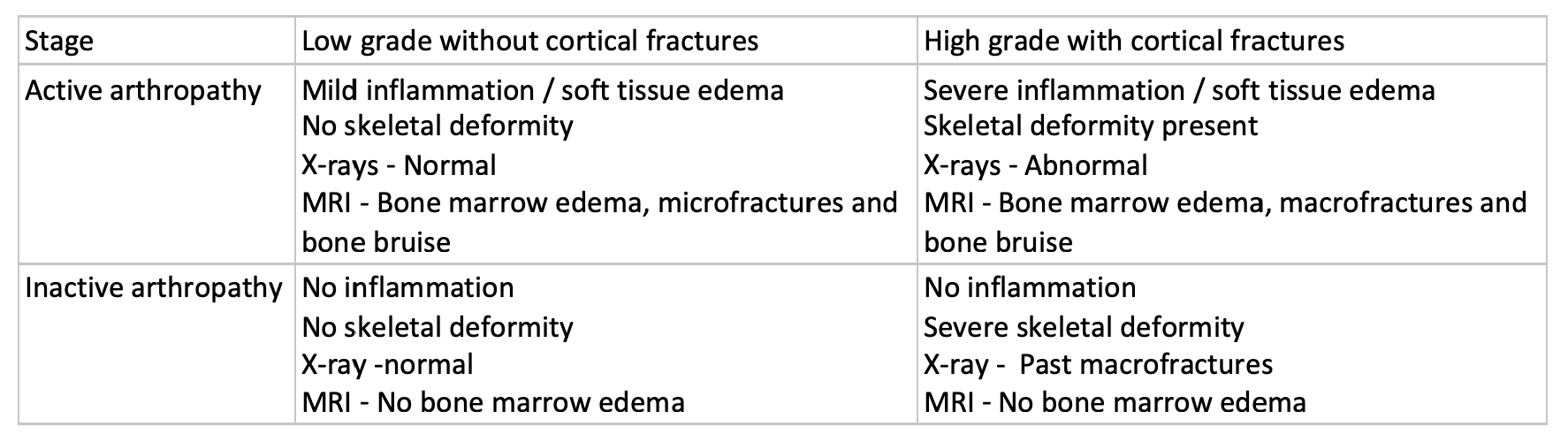
    • There are 3 stages clinico-radiologically.
      • Dissolution stage
      • Coalescence stage
      • Resolution stage
    • Patients present with acute onset unilateral swelling of foot and ankle which may extend up to the knee.
    • Pain is absent in 50% of patients. (Brodsky 1993) 
    • Some patients may complain of mild pain or discomfort.
    • Initial stages show marked inflammation evidenced by erythema, edema, warmth and more than 20C temperature difference when compared to opposite side.
    • Skin temperature measurement using surface temperature sensing devices such as infrared thermometer is useful in assessing severity of inflammation due to neuropathy.
    • Erythema due to CNO will dissipate if the limb is elevated above the level of heart for 10-15 minutes, while erythema due to infection will not.
    • During the coalescence stage, swelling and inflammation begins to dissipate but deformities start developing.
    • During the resolution stage, the signs of inflammation resolves completely and deformities persist.
    • Deformities lead to marked alteration of load bearing pattern of the sole of foot predisposing the high pressure areas to ulceration. 
    • Ulceration lead to infection which may progress to deep infection and osteomyelitis.
    • Deformities affect the forefoot, midfoot, hindfoot or the ankle.
    • Forefoot deformity may involve the first metatarsophalangeal joint in the form of dorsal or plantar dislocation.
    • Mid foot is affected in more than 60% of patients. Patients may develop abduction or adduction deformity at the Lisfranc joint or plantar dislocation of the tarsometatarsal joint leading to classical rocker bottum foot.
    • In the ankle, equinus or calcaneus deformity may develop. 
    • Sagittal instability of foot assessed by Assal and Stern method. The ankle is locked by dorsiflexion, pressure on the forefoot demonstrates instability leading to collapse of longitudinal arch.
    • Contracture of the tendoachilles leads to plantar flexion of the calcaneus and midfoot collapse leads to rocker bottom foot with dorsiflexion of forefoot.  
    • In severe cases the joints may be dislocated and unstable.

    Diagnosis

    • Diagnosis needs establishment of the presence of peripheral sensory neuropathy with reduced pain perception and establishment of arthropathy by clinical findings and imaging studies,
    • Peripheral neuropathy diagnosed by
      • Decreased reflexes, reduced vibration sense and weakness
      • Decreased sensation on Semmes-Weinstein monofilament examination of sensation.
      • Pinprick sensation
      • Neurometer test
      • Electrophysiological studies
    • Diagnosis of osteomyelitis done by
      • Presence of ulceration or history of ulceration or previous amputation.
      • Ulcerations bigger than 2cm2and deeper than 3mm.
      • Probe-to-bone test – Thin probe can be inserted to the level of bone.
      • Leukocytosis, raised ESR, CRP and procalcitonin
      • X-ray showing lytic lesions and periosteal elevation.
      • Scintigraphy
      • MRI
      • Bone biopsy
      • Culture of tissue specimens
    • Diagnosis of vascular occlusion
      • History of claudication
      • Absent or low volume pulse
      • Trophic changes
      • Doppler study
      • Transcutaneous oxygen tension assessment
      • Angiography
    • Diabetic neuropathy starts as small fiber predominant neuropathy which progresses to bilateral distal symmetrical polyneuropathy.
    • Bone biopsy shows increased Howship’s lacunae, increased woven bone and inflammatory infiltrate in the marrow spaces consisting of lymphocytes and eosinophils.
    • Later stages show development of deformities especially rigid flat foot, rocker bottom foot with skin changes and ulcerations.

    Differential diagnosis

    • Cellulitis
    • Abscess
    • Osteomyelitis
    • Acute gout
    • Fractures
    • Complex regional pain syndrome
    • Deep vein thrombosis

    Imaging

    • Basic work up needs weight bearing dorsoplantar view of foot, weight bearing lateral view of foot and ankle and the AP view of ankle.
    • Early stages show soft tissue edema, patchy osteoporosis, small flecks of bone, minor joint incongruence and bone infractions.
    • Bone destruction takes 6-12 months to be visible on the x-rays.
    • Later stage x-rays show fractures, subluxations and dislocations. Typical findings include gross disorganization of joints with osseous debris.
    • More than 60% of patients have involvement of the midfoot.
    • In the rocker bottom foot, plantar flexion of calcaneus, midfoot collapse with plantar subluxation of cuboid and navicular is seen on the weight bearing lateral view.
    • Talo-first metatarsal angle shows negative angle due to dorsal collapse of the forefoot.
    • Dorsoplantar view shows abduction or adduction deformity due to midtarsal malalignment and deformed metatarsals.
    • MRI imaging is very valuable in the early stages when the x-rays are normal as the condition is reversible if treated at this stage.
    • In the early stages, MRI shows periarticular bone marrow edema in 2 or more bones, adjacent soft tissue edema, fluid in multiple tarsal joints and microtrabecular fractures or stress fractures. 
    • 99mTc-MDP three or four phase scintigraphy is highly sensitive but has low specificity.
    • Scintigraphy with 99mTc-WBC nebo 111In-WBC labelled leukocytes is highly sensitive and specific but cannot differentiate between cellulitis and osteomyelitis.
    • PET-CT with fluorine 18 fluorodeoxyglucose (18F-FDG) is 100% sensitive and 93.8% sensitive in differentiating CNO from osteomyelitis. 
    • Patients with CNO show low-intensity diffuse uptake.

    Classifications

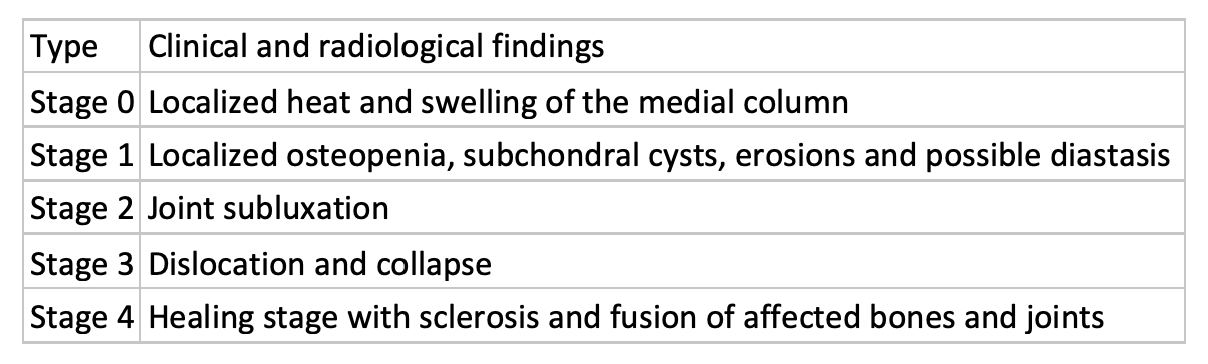
    Eichenholz classification

    Classifies the stage of disease depending on clinical features and radiological findings

    Sanders and Frykberg Classification

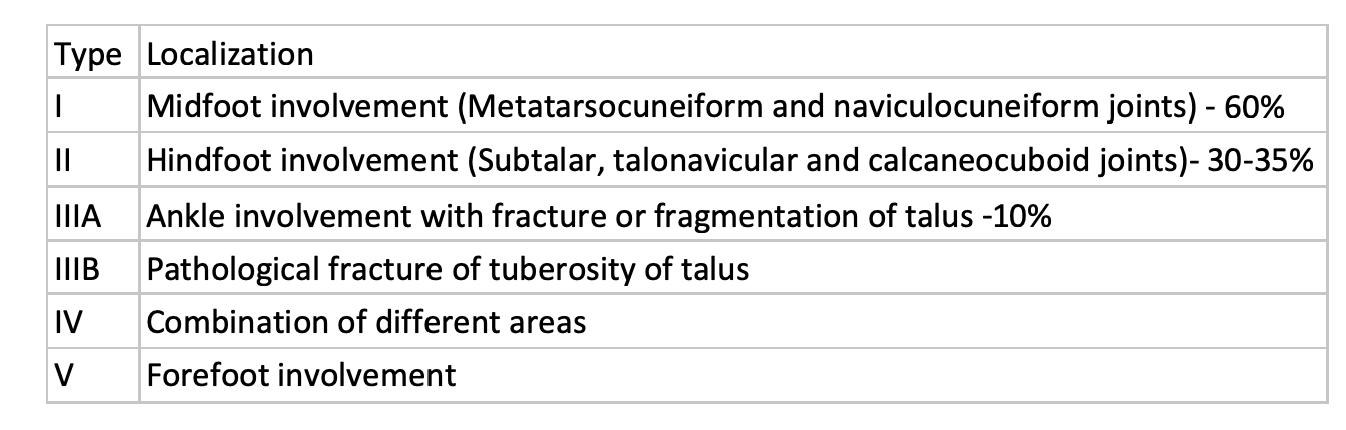
    Classifies according to area of involvement of foot and ankle region.

    Brodsky and Rouse Classification

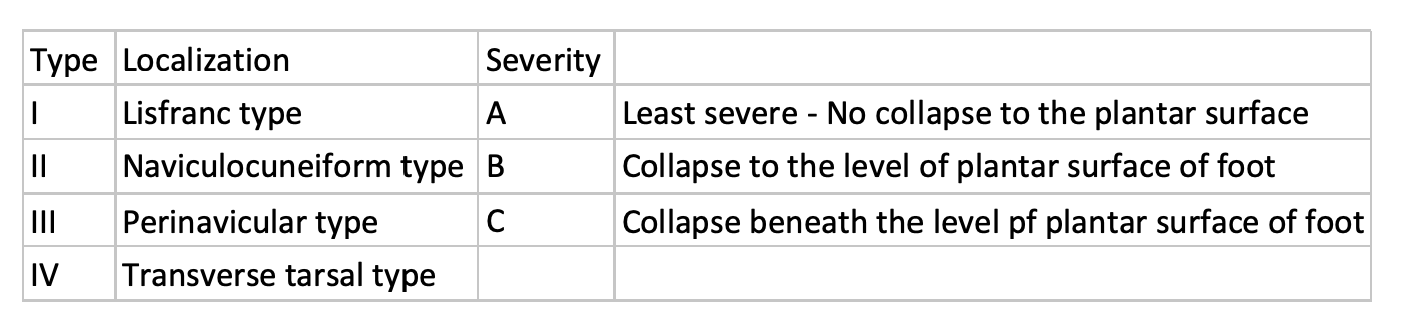
    Schon classification 

    Classifies the area of involvement in the midfoot into four types I to IV. Severity of involvement is classified into three types A to C.

    Sella and Barrette 5 stage classification

    Classifies the midfoot involvement.

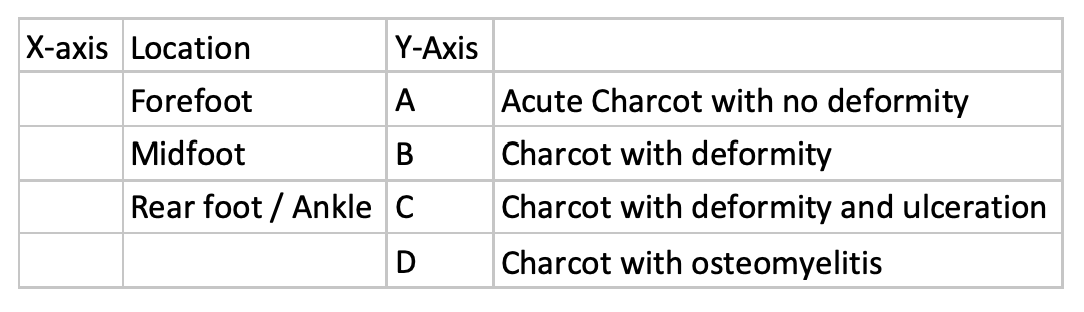
    Rogers and Bevilacqua 2 Axis Classification

    X-axis marks anatomic location. Y-axis describes degree of complication.

    MRI Classification

    Treatment

    • When a patient with diabetes presents with an acute fracture, the sensation should be carefully assessed using Semmes -Weinstein monofilaments to rule out neuropathy. If neuropathy is present, look for early signs of CNO. Rule out peripheral vascular disease. If signs of inflammation are present, rule out infection.
    • Goal of treatment are the following;
      • Structural stability of foot and ankle.
      • Prevention of skin ulceration.
      • Plantigrade foot that can be fitted into prescription foot wear.
    • Treatment is mostly conservative.
    • Mainstay of treatment is immobilization in a total contact cast and offloading of weight till edema and warmth subside and the x-ray shows consolidation of bone.
    • Offloading is the most important aspect of management during the acute active stage.
    • In the active phase, immobilize and advise complete cessation of weight bearing.
    • Immobilization is by total contact cast which is changed after 3 days after first application and then every week.
    • During the dissolution stage, the patient advised to use wheel chair than crutches to prevent overloading and injury to normal limb.
    • Immobilize till the edema subsides and the skin temperature comes to be below 20C of the normal limb.
    • May take 6-12 weeks of immobilization.
    • Then use removable brace or Charcot Restraint Orthotic Walker (CROW) for 4-6 months.
    • In the resolution stage, custom total contact inserts and braces are needed to prevent ulcerations.
    • Bisphosphonates and intranasal calcitonin may be useful in the active stage.
    • Bisphosphonates efficacy has been shown to be not significant.
    • One randomized study showed intranasal calcitonin to be useful.
    • Foot reconstruction indications
      • Stable but nonplantigrade foot
      • Unstable foot
      • Recurrent ulcerations
      • To avoid amputation
    • Contraindications for surgery
      • Infection of bone or soft tissue
      • Eichenholz stage I disease
      • Uncontrolled diabetes or malnutrition
      • Peripheral vascular disease
      • Insufficient bone stock
      • Noncompliant or unreliable patient
    • Goals of surgery
      • Alignment of foot on the leg to provide a plantigrade foot that is stable, braceable and walkable
      • Restoration of stability
      • Clearance of infection
      • Relief of pressure points
      • Contouring of foot to allow fitting of orthosis
    • Surgical options
      • Foot reconstruction
      • Excision of bony prominences
      • Major amputations
    • Resection of bony prominences indications
      • Stable foot with isolated bone prominences causing skin problems
      • Stable foot with inability to fit an orthosis due to bony prominences
      • Resection of infected bone in patients being planned for foot reconstruction.
    • Exostosectomy is useful only in the midfoot.
    • Prerequisites for successful arthrodesis
      • Careful removal of all cartilage and debris
      • Debridement to bleeding bone
      • Reshaping to ensure maximum contact
      • Complete removal of soft tissues
      • Stable fixation
      • Immobilization and bracing till consolidation
    • Major amputation indications
      • Severe peripheral vascular disease
      • Severe bone destruction including osteomyelitis
      • Failed previous surgery
    • Transcutaneous oxygen tension of more than 35mm is successful healing after below knee amputation.
    • If an ulcer is present, first step is to get the ulcer heal by debridement, antibiotics and total contact casting.
    • Super-construction principles for foot reconstruction (Sammarco 2009)
      • Arthrodesis should be extended beyond affected area into neighboring joints.
      • Resection of bone to produce mild shortening to enable foot repositioning without overstretching of soft tissues to avoid tissue hypoperfusion.
      • Use strongest possible implant.
      • Place the implant in a manner that provides maximum mechanical stability.
    • External fixation using circular fixators have the advantage of three dimensional stability, gradual correction of deformity and avoidance of internal fixation that may increase the chance of infection.
    • Indications for external fixation
      • Poor soft tissue envelope
      • Active infection
      • Severe deformity that preclude acute correction
      • Poor bone quality
    • For internal fixation, axial screws are preferable as they provide long working length, better stability and least amount of surgical exposure.
    • Surgery is preferably done in the resolution stage.
    • Indications for surgery in the inflammatory stage. 
      • Severe instability
      • Progression of deformity
      • Prevention of dislocation
      • Failure of conservative treatment
    • Surgery in the acute inflammatory phase may worsen the inflammation and may increase the chance of infection.
    • Foot reconstruction depends on the localization of deformities as per the Sanders and Frykberg classification.
    • Sanders I is usually treated conservatively. If there is first metatarsophalangeal dislocation, arthrodesis using 2 screws or a plantar plate is done.
    • Sanders II is often associated with Sanders III deformity. Sanders II is corrected by resection arthrodesis to correct the abduction or adduction deformity of the forefoot and the dorsal dislocation of the Lisfranc joint.
    • Correction of Sanders III deformity proceeds in a stepwise manner. 
      • First step is correction of hindfoot.
      • Second step is correction of Lisfranc joint.
      • Third phase is correction of Chopart’s joint
      • Last step is insertion of  medial and lateral midfoot bolts
        • Medial bolt inserted from the first metatarsal head into the talus.
        • Lateral bolt inserted through the cuboid in the region of fourth metatarsal into the calcaneum. 
    • Operative treatment by medial or lateral column arthrodesis using large intramedullary bolts is called beaming.
    • Correction of equinus is done by either tendoachilles lengthening or gastrocnemius recession.
    • Gastrocnemius recession – 5 options
      • Silfverskiold -Proximal gastrocnemius recession
      • Baumann- Deep gastrocnemius recession
      • Strayer – Distal gastrocnemius recession
      • Endoscopic gastrocnemius recession
      • Baker – Superficial gastrocnemius recession
    • Sanders IV is treated by ankle and subtalar arthrodesis using external fixator. Severe cases may need talectomy and tibiocalcaneal fusion. Some very severe cases with infection and skin ulceration may need below knee amputation.
    • Sanders V with involvement of calcaneum is the least common. Majority are treated conservatively and some may need subtalar fusion.

    References

    1. M.-W. Sohn, T. A. Lee, R. M. Stuck, R. G. Frykberg, and E. Budiman-Mak, “Mortality risk of charcot arthropathy compared with that of diabetic foot ulcer and diabetes alone,” Diabetes Care, vol. 32, no. 5, pp. 816–821, 2009.
    2. R. Gupta, “A short history of neuropathic arthropathy,” Clinical Orthopaedics and Related Research, no. 296, pp. 43–49, 1993.
    3. J. K. Mitchell, “On a new practice in acute and chronic rheumatism,”The American Journal of theMedical Sciences, vol.8, pp. 55–64, 1831.
    4. J. M. Charcot, “Sur quelques arthropathies qui paraissent dependre d’une lesion du cerveau ou de la moelle epimere,” Archives de Physiologie Normale et Pathologique, vol. 1, article 161, 1868. 
    5. W. R. Jordan, “Neuritic manifestations in diabetes mellitus,” Archives of Internal Medicine, vol. 57, no. 2, pp. 307–366, 1936.
    6. M. Assal and R. Stern, “Realignment and extended fusion with use of a medial column screw for midfoot deformities secondary to diabetic neuropathy,” The Journal of Bone & Joint Surgery—American Volume, vol. 91, no. 4, pp. 812–820, 2009.
    7. S. N. Eichenholtz, Charcot Joints, Charles C. Thomas, Springfield, Ill, USA, 1st edition, 1966.
    8. E. A. Chantelau and G. Grutzner, “Is the Eichenholtz classification still valid for the diabetic Charcot foot?” Swiss Medical Weekly, vol. 144, Article IDw13948, 2014.
    9. C. L. Saltzman, M. L. Hagy, B. Zimmerman, M. Estin, and R. Cooper, “How effective is intensive nonoperative initial treatment of patients with diabetes and Charcot arthropathy of the feet?” Clinical Orthopaedics and Related Research, no. 435, pp. 185–190, 2005.
    10. V. J. Sammarco, “Superconstructs in the treatment of charcot foot deformity: plantar plating, locked plating, and axial screw fixation,” Foot and Ankle Clinics, vol. 14,no. 3, pp. 393–407, 2009.
    11. Tomas Kucera,1,2 Haroun Hassan Shaikh,1 and Pavel Sponer1,2. . Charcot Neuropathic Arthropathy of the Foot: A Literature Review and Single-Center Experience. Journal of Diabetes Research Volume 2016, Article ID 3207043, 10 pages http://dx.doi.org/10.1155/2016/3207043
    12. R. G. Frykberg and R. Belczyk, “Epidemiology of the Charcot foot,” Clinics in Podiatric Medicine and Surgery, vol. 25, no. 1, pp. 17–28, 2008.
    13. A. Folestad, M. ˚ Alund, S. Asteberg et al., “Role of Wnt/𝛽- catenin and RANKL/OPG in bone healing of diabetic Charcot arthropathy patients,” Acta Orthopaedica, vol. 86,no. 4, pp. 415– 425, 2015.
    14. A.Nather,W.K. Lin, Z. Aziz, C. H. J.Ong, B. Feng, and C. B. Lin, “Assessment of sensory neuropathy in patients with diabetic foot problems,” Diabetic Foot & Ankle, vol. 2, article 6367, 2011.
    15. B. C. Callaghan, H. T. Cheng, C. L. Stables, A. L. Smith, and E. L. Feldman, “Diabetic neuropathy: clinical manifestations and current treatments,”The Lancet Neurology, vol. 11,no. 6, pp. 521– 534, 2012.
    16. D. G. Armstrong, W. F. Tood, L. A. Lavery et al., “The natural history of acute Charcot’s arthropathy in a diabetic foot speciality clinic,” Diabetic Medicine, vol. 14, no. 5, pp. 357–363, 1997.
    17. K. T. A. Low andW. C. G. Peh, “Magnetic resonance imaging of diabetic foot complications,” SingaporeMedical Journal, vol. 56, no. 1, pp. 23–34, 2015.
    18. S. E. Sanverdi, F. B. Ergen, and A. Oznur, “Current challenge in imaging of the diabetic foot,” Diabetic Foot and Ankle, vol. 3, 2012.
    19. B. M. Ertugrul, B. A. Lipsky, and O. Savk, “Osteomyelitis or charcot neuroosteoarthropathy? Differentiating these disorders in diabetic patients with a foot problem,” Diabetic Foot and Ankle, vol. 4, Article ID21855, 2013. 
    20. C. L. Ramanujam and Z. Facaros, “An overview of conservative treatment options for diabetic Charcot foot neuroarthropathy,” Diabetic Foot & Ankle, vol. 2, article 6418, 2011.
    21. A. Koller, R. Springfield, G. Engels et al., “German-Austrian consensus on operative treatment ofCharcot neuroarthropathy: a perspective by the Charcot task force of the German association for foot surgery,” Diabetic Foot & Ankle, vol. 2, 2011.
    22. T. E.Milne, J. R. Rogers, E. M. Kinnear et al., “Developing an evidence-based clinical pathway for the assessment, diagnosis and management of acute Charcot Neuro-Arthropathy: a systematic review,” Journal of Foot and Ankle Research, vol. 6, no. 1, article 30, 2013.
    23. Johnson JT. Neuropathic fractures and joint injuries. Pathogenesis and rationale of prevention and treatment. J Bone Joint Surg Am 1967; 49:1–30.
    24. Sanders LJ, Frykberg RG . The Charcot Foot (Pied de Charcot). In: Bowker JH, Pfeifer MA, editors. Levin and O’Neal’s The Diabetic Foot. 7th ed. Philadelphia, PA: Mosby Elsevier; 2008:257–283.
    25. Brodsky JW. Outpatient diagnosis and care of the diabetic foot. Instr Course Lect. 1993;42:121-139. 
    26. Moura-Neto A, Fernandes TD, Zantut-Wittmann DE, et al. Charcot foot: skin temperature as a good clinical parameter for predicting disease outcome. Diabetes Res Clin Pract. 2012;96(2):e11-e14. 
    27. Richard JL, Almasri M, Schuldiner S. Treatment of acute Charcot foot with bisphosphonates: a systematic review of the literature. Diabetologia.2012;55(5):1258-1264. 
    28. Bem R, Jirkovská A, Fejfarová V, Skibová J, Jude EB. Intranasal calcitonin in the treatment of acute Charcot neuroosteoarthropathy: a randomized controlled trial. Diabetes Care. 2006;29(6):1392-1394.
    29. Hoche G, Sanders LJ. On some arthropathies apparently related to a lesion of the brain or spinal cord, by Dr JM Charcot, January 1868. J Hist Neurosci 1992;1:75–87.
    30. Pecoraro RE, Reiber GE, Burgess EM. Pathways to diabetic limb amputation. Basis for prevention. Diabetes Care 1990;13:513–21.
    31. Reiber GE, Vileikyte L, Boyko EJ, et al. Causal pathways for incident lower extremity ulcers in patients with diabetes from two settings. Diabetes Care 1999;22:157–62.
    32. S. E. Johnson-Lynn, A. W. McCaskie, A. P. Coll, A. H. N. Robinson. Neuroarthropathy in diabetes: pathogenesis of Charcot arthropathy. Bone Joint Res 2018;7:373–378.
  • Renal Osteodystrophy

    Bone is composed of cells and extracellular matrix  comprised of a mainly type I collagen matrix impregnated with hydroxyapatite crystals. It is constantly remodelled by the finely balanced dual action of osteoblasts which form bone and osteoclasts which reabsorb bone.  Unbalanced remodelling process leads to osteoporosis. Remodelling occurs on the bone surface and the rate of remodelling is higher in the cancellous bone as it has a larger surface area.

    The incidence of chronic kidney disease (CKD) is increasing worldwide. CKD may be associated with progressive loss of renal function, cardiovascular disease and premature death. Disturbance of mineral metabolism and bone disease are common complications of CKD. The changes in bone and mineral metabolism are attributed to variations in the serum parathyroid hormone (PTH) levels.

    Definition

    At the 2003 National Kidney Foundation Controversies Conference on Mineral Metabolism and Bone Disease in CKD defined renal osteodystrophy as the following. ‘A constellation of bone disorders present or exacerbated by chronic kidney disease that lead to bone fragility and fractures, abnormal mineral metabolism, and extra-skeletal manifestations.’

    Kidney Disease: Improving Global Outcomes (KDIGO), a global collaboration with a stated objective ‘to improve the care and outcomes of kidney disease patients worldwide through promoting coordination, collaboration and integration of initiatives to develop and implement clinical practice guidelines’  has recommended that the term renal osteodystrophy be used exclusively to denote alterations in bone morphology in patients with CKD. KDIGO has recommended the use of the term Chronic Kidney Disease – Mineral and Bone Disorder (CKD-MBD) to describe a broader clinical syndrome that develops as a systemic disorder of mineral and bone metabolism due to CKD, which is manifested by abnormalities in bone and mineral metabolism and/or extra-skeletal calcification. Renal osteodystrophy is one component of CKD-MBD.

    Clinical Features

    • The changes in musculoskeletal system in renal osteodystrophy can be due to secondary hyperparathyroidism(bone resorption, periosteal reactions and brown tumours) osteoporosis, osteosclerosis, osteomalacia and soft tissue and vascular calcification.
    • Bone resorption can be subperiosteal, endosteal, trabecular, subchondral and subligamentous.
    • Osteosclerosis is mainly seen in the axial skeleton.
    • The prevalence of soft tissue calcification increases with the duration of hemodialysis.
    • Other major musculoskeletal abnormalities can be aluminium deposition, amyloidosis, crystal deposition disorders, destructive spondylarthropathy, tendon ruptures and infection.
    •  Hyperparathyroidism is due to inability of kidneys to excrete phosphorus leading to hyperphosphatemia which stimulates parathyroid to secrete parathormone.
    • Disturbance of mineral metabolism and bone disease is associated with morbidity, decreased quality of life, extra skeletal calcification and increased cardiovascular mortality.
    • Increased cardiovascular mortality is probably related to vascular calcification.
    • Osteomalacia causes
      • 1α hydroxylase deficiency
      • Dysfunction of hepatic enzymes
      • Hypocalcimea
      • Inhibition of calcification by acidosis and azotemia
      • Aluminium toxicity
    • Osteoporosis causes
      • Chronic metabolic acidosis
      • Azotemia
      • Hyperparathyroidism
      • Vitamin D deficiency
      • Poor nutrition
      • Steroid treatment

    Diagnosis

    • Bone biopsy, serum markers and imaging are the main tools used for assessment of bone disease in CKD.
    • The initial evaluation should include PTH, calcium (either ionized or total corrected for albumin), phosphorus, alkaline phosphatase (total or bone-specific), bicarbonate, and imaging for soft tissue calcification.
    • Diagnosis of renal osteodystrophy needs bone biopsy and histomorphometry. 
    • Indication for bone biopsy in CKD patients
      • Inconsistencies among biochemical parameters
      • Unexplained skeletal fracture or bone pain
      • Severe progressive vascular calcification 
      • Unexplained hypercalcemia
      • Suspicion of overload or toxicity from aluminum
      • Before parathyroidectomy if there has been significant exposure to aluminum in the past
      • Before beginning treatment with bisphosphonates
    • Histomorphometry was pioneered by Harold Frost in the 1960s.
    • Histomorphometry of biopsied bone samples is considered as the gold standard for the diagnosis for renal osteodystrophy.
    • Bone histomorphometry is defined as a quantitative evaluation of bone microarchitecture, remodelling and metabolism.
    • Histomorphometry evaluates in vivo bone metabolism and microarchitecture.
    • It helps in the diagnosis of metabolic bone disease and in their classification.
    • In osteomalacia, impairment of bone mineralization characterised by increased osteoid thickness, surface and volume can be identified by histomorphometry.
    • Histomorphometry should be reported using standard nomenclature recommended by the American Society for Bone and Mineral Research.
    • Histomorphometry should be reported along with biopsy technique, specimen size, tetracycline protocol, assessment of sample adequacy, tissue area, magnification, minimal osteoid width, and normative data.
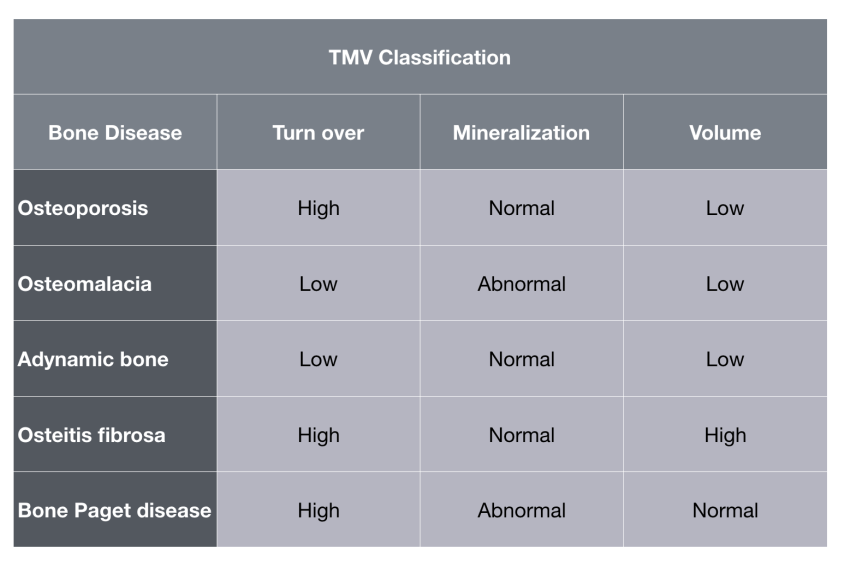
    • Renal osteodystrophy is classified using TMV classification which takes turnover of bone, mineralization and volume into consideration for the classification.
    • Classification is to be used only in adult patients with a glomerular filtration rate <60ml/min/1.73m2 and in paediatric patients with glomerular filtration rate <89ml/min/1.73m2. 
    • TMV Classification
      • Turnover – Low, Normal or High
      • Mineralization– Normal or Abnormal
      • Volume– Low, Normal or High
    TMV Classification
    • Turnover reflects the rate of skeletal remodelling. Bone turnover is affected by hormones, cytokines, mechanical stimuli, and growth factors that influence the recruitment, differentiation, and activity of osteoclasts and osteoblasts. It is assessed by histomorphometry using dynamic measurements of osteoblast function utilising double-tetracycline labelling.
    • Mineralization reflects the level of calcification of bone collagen during the formation phase of skeletal remodeling. Mineralization reflects the level of calcification of bone collagen during the formation phase of skeletal remodeling. Mineralization is assessed by histomorphometry using static measurements of osteoid volume and osteoid thickness and also by dynamic, tetracycline-based measurements of mineralization lag time and osteoid maturation time. Causes of impaired mineralization include vitamin D deficiency, mineral deficiency, metabolic acidosis, or aluminium toxicity.
    • Volume indicates the amount of bone per unit volume of tissue. It is assessed with histomorphometry by measurement of bone volume in cancellous bone. Causes of impaired mineralization include vitamin D deficiency, mineral deficiency, metabolic acidosis, or aluminium toxicity.The initial evaluation should include PTH, calcium (either ionized or total corrected for albumin), phosphorus, alkaline phosphatase (total or bone-specific), bicarbonate, and imaging for soft tissue calcification.
    • Diagnosis of renal osteodystrophy needs bone biopsy and histomorphometry. 
    • Indication for bone biopsy in CKD patients
      • Inconsistencies among biochemical parameters
      • Unexplained skeletal fracture or bone pain
      • Severe progressive vascular calcification 
      • Unexplained hypercalcemia
      • Suspicion of overload or toxicity from aluminum
      • Before parathyroidectomy if there has been significant exposure to aluminum in the past
      • Before beginning treatment with bisphosphonates

    Bone Biopsy

    • Taken by trans-iliac approach or Jamshidi approach.
    • Trans-iliac approach done 2cm below and behind anterior superior iliac spine.
    • A 5 or 8mm trephine used to obtain a core with inner and outer table of iliac crest with intervening cancellous bone.
    • Jamshidi approach which obtains a vertical core from the iliac crest is not used in children as this region contains the physis which may lead to erroneous samples. 
    • Sample processing includes five steps: fixation, dehydration, clearing, impregnation and embedding.
    • Fixation is done by 70% alcohol for a minimum of 72 hours at 5ºC.
    • Dehydration is achieved by increasing the ethanol saturation from 96% to 100% over a period of 24 hours at 5ºC.
    • Clearing is done by replacing alcohol with xylene for 24hours at 5ºC.
    • Impregnation is done in methyl methacrylate for a minimum of 72 hours at-20ºC.
    • Embedding in methyl methacrylate is done at a constant temperature ranging from 5°C up to 10°C.
    • Cutting is performed in a microtome machine with tungsten blade, orienting the sample with the cortical bone perpendicular to the edge of the blade.
    • The cuts should be 5-10µm in thickness.
    • The cut samples are mounted on a slide, followed by 48 hours of pressing at 55ºC.
    • Different staining techniques available depending on the desired target, such as Toluidine Blue, von Kossa, phosphatase acid, Goldner Trichrome, Solochrome Azurine and Perl’s method.

    Tetracycline labelling

    • Tetracycline binds to mineralization fronts of amorphous minerals, labelling them with a yellow-green colour under fluorescent light, thus acting as a marker for bone formation and mineralization. 
    • Tetracycline  taken 21 days before bone biopsy. 
    • Two doses are taken with an interval of 10 days. 
    • This allows the identification of two distinct lines that represent two phases of mineralization. 
    • Tetracycline labelling allows the dynamic assessment of bone metabolism.

    X-ray findings

    • Skull
      • Salt and pepper appearance 
      • Loss of distinction between inner and outer tables
      • Loss of lamina dura of teeth
    • Chest X-ray 
      • Subchondral erosion of sternal end of clavicle
      • Subligamentous erosion of acromioclavicular ligament attachments
    • Hand
      • Tuft erosion
      • Subperiosteal erosion
      • Intracortical tunneling
      • Endosteal scalloping
    • Subperiosteal erosion
      • First described by Camp and Ochsner in 1931.
      • Pathognomonic of hyperparathyroidism.
      • Seen on the radial aspect of middle phalanx of middle and index fingers beginning in the proximal metaphysis .
      • Seen as lace like irregularity which may progress to scalloping and spiculation.
      • Rotting fence post sign – medial femoral neck subperiosteal erosion.
    • Brown tumours
      • More common in primary hyperparathyroidism than secondary hyperparathyroidism.
      • Frequently single.
      • Cause eccentric or intracoortical expansive lyric lesions.
      • Due to replacement of bone by vascularised fibrous tissue.
      • Ribs, pelvis, facial bones and femur are the common sites.
      • After parathyroidectomy, heals by calcification.
    • Rickets radiological findings
      • Delay in bone age
      • Bowing of bones
      • Widening of growth plate
      • Metaphyseal cupping and fraying
      • Scoliosis
      • Biconcave vertebral end plates
      • Triradiate pelvis
    • Loosers zones
      • Transverse psuedofractures due to unmineralized cartilage.
      • Seen at areas of stress or site of entry of nutrient arteries
      • Common sites are pubic rami, medial femoral neck, scapula, ribs, lesser trochanter, ischiopubic rami and long bones.
    • Slipping of epiphysis
      • Seen in children with history of uraemia of >2 years and in those commenced on hemodialysis close to puberty
      • Most common in capital femoral epiphysis 
      • Other sites are proximal humerus, distal femur, distal radius, heads of metatarsals and metacarpals.
    • Soft tissue calcification
      • Due to hypercalcimea, increased calcium-phosphorus product and local tissue trauma or alkalosis.
      • Common if serum calcium-phosphorus product is more than 75mg/dL.
      • Seen in ocular tissues, arteries, subcutaneous and peri articular soft tissues and viscera.
      • Subcutaneous, periarticular and vascular calcification is composed of hydroxy apatite with a molar ratio of Ca-MG-P of 30:1:18.
      • Visceral calcification is amorphous with a molar ratio of Ca-Mg-P of 4.9:1:4.6. 
      • Periarticular calcification are symmetrical, discrete, dense and cloud like opacities. Seen around phalangeal joints, wrist, elbow, shoulder, hips, knees and ankles.
      • Visceral calcification usually not seen radiologically. Most common around heart, lungs, stomach and kidneys.
      • Visceral calcification in the myocardium can lead to conduction abnormalities and death.

    Treatment

    • Correction of hyperphosphatemia and hypercalcimea to slow or halt extra-skeletal calcification is needed for treatment of renal osteodystrophy. 
  • Congenital Dislocation of the Knee

    Definition

    Congenital dislocation of the knee is a condition characterised by hyperextension deformity of knee with varying degrees of pathological anterior displacement of the tibia present at birth.

    History

    • First described by Chenssier in 1812.
    • Subsequently reported by Chatelaine in 1822 and by Bord in 1834.

    Aetiology

    • Three theories have been proposed about the causation. (Elmadag 2013)
      • Mechanical theory – Due to abnormal intrauterine position
      • Primary embryologic theory – Due to embryonic defect
      • Mesenchymal theory – Due to quadriceps contracture
    • The primary cause can be extrinsic or intrinsic.
    • Intrinsic causes are genetic or developmental and extrinsic factors are mechanical factors.
    • Extrinsic causes can be oligohydramnios, multiple pregnancy, intrauterine fetal malposition, quadriceps contracture and birth trauma.

    Epidemiology

    • Majority of cases are sporadic.
    • Incidence is 1 in 100,000 live births. Seen in 1% of patients with DDH
    • Associations
      • Breech presentation – 30%
      • CTEV- 47%
      • DDH- 50%
      • Syndromes
        • Arthrogryposis multiplex
        • Larsen syndrome
        • Ehlers Danlos syndrome
        • Beals syndrome
        • Myelodysplasia

    Classification

    Leveuf and Pais Classification

    Simple hyperextension – 15-200hyperextension, passive flexion up to 900.

    Anterior subluxation – 25-400hyperextension and no flexion.

    Anterior dislocation – No contact between distal femoral and proximal tibial articular surfaces.

    Finder’s Classification (Finder 1964)

    Type I– Physiological hyperextension up to 200is considered normal. Usually disappears by the age of 8 years.

    Type 2– Simple hyperextension that persist into adult life.

    Type 3– Anterior subluxation with hyperextension up to 900. Flexion only to neutral position.

    Type 4– Dislocation of knee with anterior and proximal migration of proximal tibia.

    Type 5– Complex variants associated with syndromes and other congenital deformities. 

    Tarek CDK grading system (Tarek 2011)

    G1– Simple recurvatum. Passive flexion >900. Manage by serial casting.

    G2– Subluxation. Passive flexion 30-900. Manage by percutaneous quadriceps release

    G3– Dislocation. Passive flexion <300. Manage by V-Y Quadricepsplasty.

    Pathology

    • Quadriceps fibrosis and contracture.
    • Tight anterior capsule.
    • Hypoplastic or absent patella.
    • Hypoplastic suprapatellar bursa.
    • Anterior subluxation or dislocation of knee.
    • Transverse anterior skin crease.
    • Round condyles.
    • Increased tibial plateau.
    • Rotatory or valgus deformity of tibia.
    • Hamstrings may be displaced anteriorly and become extensors of knee.
    • Absent or elongated anterior cruciate ligaments (Katz 1967).
    • Lax or displaced cruciate ligaments.

    Clinical features

    • Child born with varying degrees of hyperextension deformity of the knee.
    • Passive flexion of knee limited to varying degrees depending on the severity.
    • May be associated with other musculoskeletal anomalies like developmental dysplasia of hip or congenital talipes equinovarus.
    • Varying degrees of anterior displacement of the tibia in relation to the femur present.

    Diagnosis

    • Prenatal ultrasound may help in diagnosis.
    • X-ray shows deformity with angulation in hyperextension type, anterior translation with variable amount of contact between femur and tibia in subluxation type and total loss of contact between femur and tibia with hyperextension deformity in dislocation type.
    • Ultrasound shows obliteration of  suprapatellar pouch.
    • Arthrogram may be necessary to identify intra-articular pathology.

    How to treat these children?

    When to treat?

    How to do closed reduction?

    How to do a surgical correction?

    To continue click here

    https://learningorthopaedics.com/congenital-dislocation-of-the-knee/

  • Acute Compartment Syndrome of the Leg

    • The muscles and neurovascular structures of limbs are separated into closed noncompliant osteofascial compartments by tough unyielding fascia that limit the ability for volume expansion. 
    • Blood supply to the structures within the compartment depends on the difference between the arterial and venous pressure (pressure gradient) and the local vascular resistance. 
    • Any decrease in the arterial pressure or increase in venous pressure reduces the pressure gradient. 
    • Increase in local vascular resistance decreases the blood flow.
    • When the blood flow cannot meet the metabolic demand of the tissues, first the function ceases, if not corrected the tissue undergoes necrosis.
    • Compartment syndrome develops when increase in the hydrostatic pressure within the compartment decreases the perfusion pressure, that results in cellular hypoxia, tissue ischemia, myoneural damage, muscle necrosis, permanent disability, loss of limb or even death. 
    • Acute compartment syndrome (ACS) is a dreaded complication of musculoskeletal injuries.

    Epidemiology

    • Incidence is 3.1 per 100,000 population in the western world.
    • Male to female ratio is 10:1.
    • Age is the strongest factor with ACS being most common in the 2ndand 3rddecades.
    • Most common site is the leg, followed by the forearm.
    • ACS develops in 11.5% of tibial diaphyseal fractures.

    History

    • First described by Richard von Volkmann in 1869 in the forearm. He described the sequelae and the causative factors in 1881.
    • Bardenheuer first described fasciotomy as treatment in 1906.
    • Rowland attributed raised intracompartmental pressure as the cause of ischemia and its sequelae.
    • Management of ACS first described by Petersen in 1888.
    • Myerson described compartment syndrome of the foot in 1987. (Myerson 1987)

    Etiology

    • Cause may be fractures, soft tissue trauma, bleeding, extravasation or external compression.
    • Up to 30% of cases occur without fracture.
    • Causes may be divided into exogenous or endogenous.
    • Endogenous causes are hemorrhage, edema or perivascular infusions which increase in the volume of contents within the compartment.
    • Exogenous causes may be constricting casts, prolonged lithotomy positioning, drunken stupor, tight dressing etc.
    • Causes
      • Trauma
      • Thermal injuries
      • Constricting casts or dressings
      • Bleeding disorders including anticoagulant therapy
      • Nephrotic syndrome
      • Rhabdomyolysis
      • Accidental extravasation of infusions or drugs such as Propofol, Iohexol etc.
      • Lithotomy positioning during surgery
      • Streptococcal infections

    Pathogenesis

    • Normal interstitial pressure is 8mm of mercury in adults and 10-15mm Hg in children.
    • Trauma leads to inflammation which leads to vasodilation and increased capillary permeability resulting in edema which increases interstitial pressure leading to increased venous capillary pressure. The decreased perfusion pressure leads to ischemia which causes further tissue damage creating a vicious cycle with positive feedback loop.
    • Ischemia leads to hypoxia and depletion of intracellular energy stores. Anaerobic metabolic pathways are activated to compensate leading to acidosis. Further reduction in the ATP production leads to shut down of sodium-potassium ATPase channels that maintain the cellular polarity and osmotic balance. Loss of cellular polarity leads to influx of chloride ions and cellular swelling. Increased cytosolic calcium accumulation causes lysosomal enzyme release and cell lysis.
    • Cell lysis releases intracellular toxins, leading to microvascular damage, inflammation, increased capillary permeability, capillary leakage and increased intra-compartmental pressure. 
    • Ischemia of one hour can lead to neuropraxia and axonotmesis can start developing by 4 hours. Irreversible changes start appearing by 6 hours.
    • Edema is due to increased capillary permeability secondary to injury or reperfusion.

    Vicious Cycle of pathogenesis

    Clinical Features

    • Compartment syndrome should be suspected in awake patients with unrelenting and increasing pain not responding to standard dose of analgesics, pain on passive stretch, paresthesia and paresis.
    • Classically the symptoms are described as 5 P’s. 
      • Pain
      • Pallor
      • Pulselessness
      • Paresis
      • Paresthesia
    • Griffiths described the 4 P’s in 1948; pain, pain on stretch, paresthesia and paresis (Griffiths 1948). Pulselessness and pallor were added later.
    • The classically described pulselessness is absent as the systolic blood pressure usually remains above the compartment pressure even in the late stages.
    • Pain which is persistent and increasing is the earliest and most common sign.
    • Pain on passive stretching of involved muscles is the most sensitive sign.
    • In the leg, anterior compartment is most commonly involved followed by the lateral compartment.
    • In children, the presentation is by 3 A’s
      • Anxiety
      • Agitation
      • Analgesic need that continuously rises
    • Compartment syndrome should be ruled out in unconscious patients with persistent tachycardia if there is no other cause or hypotension.
    • Risk factors that increase the likelihood of ACS are high velocity injury, systemic hypotension, younger age and obtunded patients.
    • Multiple injury patients with hypotension and hypoxia are more susceptible to compartment syndrome.
    • Other injuries more susceptible to compartment syndrome are vascular injuries with peripheral ischemia, high velocity injuries, crush injuries, and comminuted proximal tibial fractures.
    • Patients on anticoagulants are at high risk of ACS after injury.
    • More common in the young due to relatively thick and inelastic fascia.
    • Age between 12-29 years is the strongest predictor for ACS. 
    • Fractures of the tibia and fibula are 4 times more likely develop in comparison to all other fractures.
    • 36% of cases are due to tibial shaft fractures followed by soft tissue injury (23%), distal end radius #s (10%), forearm diaphyseal #s (8%) and crush syndrome (8%). (McQueen 2000)

    Diagnosis

    • Diagnosis may be made by clinical examination or by measurement of compartment pressure or tissue oxygenation.
    • Diagnosis is unconscious patients’ needs compartment pressure monitoring.
    • Compartment pressure measurement by infusion technique was described by Whitesides in 1974 (Whitesides 1974). 
    • Compartment pressure measurement techniques
      • Whitesides infusion technique
      • Matsen’s continuous infusion and monitoring technique
      • Mubarak wick catheter technique
      • Stick technique
      • Fine wire transducer technique
      • Weiner fibro-optic transducer tip catheter technique
    • Some of the available catheters are the following
      • Slit catheter
      • Solid-state transducer intra-compartmental catheter (STIC)
      • Transducer tipped catheter
      • 18G needle with arterial-line transducer
    • Arterial line transducers with side-port needles, slit catheters and self contained measuring systems are most accurate. (Keudell 2015)
    • Monitoring of ICP by slit catheter technique has a sensitivity of 94% and specificity of 98% when pressure gradient (∆P) of 30mm Hg is used for diagnosis.

    Compartment Pressure Measuring Technique

    • Compartment pressure should be measured within 5 cm of the fracture and pressure within all 4 compartments of the leg should be measured. 
    • Proper technique which includes proper positioning of the catheter within the compartment, proper setup of devices, proper zeroing is essential for correct measurement of intra-compartmental pressure. Otherwise catastrophic errors are likely. 
    • The landmarks for insertion of needle for compartment pressure measurement are as follows.
      • Superficial posterior compartment- In the posterior midline of calf.
      • Deep posterior compartment- 1 cm posterior to posteromedial border of tibia.
      • Anterior compartment- 2 cm lateral to the tibial crest.
      • Lateral compartment- Directly over the fibula.
    • Diagnosis is made if the difference between compartment pressure and diastolic pressure (∆P) is less than 30mm (McQueen 1996) or if the intra-compartmental pressure is above 30mm of Hg (Whitesides 1975).
    • Recently 35% false positive rate was reported when compartmental pulse pressure of <30mm Hg on single measurement was used in patients with acute fractures with no clinical evidence of compartment syndrome. (Whitney 2014)

    Treatment

    • Timely diagnosis and dermatofasciotomy is essential to ensure optimum outcomes.
    • Initial treatment consists of removal of circumferential dressings and elevation of the limb to the level of heart.
    • The limb should not be elevated in impending compartment syndrome as it further reduces pressure gradient.
    • Techniques of fasciotomy
      • Dermatofasciotomy
      • Percutaneous fasciotomy
    • Percutaneous fasciotomy is contraindicated in trauma patients
    • Techniques of dermatofasciotomy
      • Mubarak’s 2-incision, 4-compartment fasciotomy
      • Matsen’s parafibular 4-compartment fasciotomy
      • Fibulectomy-fasciotomy
    • Fibulectomy-fasciotomy is contraindicated in trauma patients.
    • Mubarak’s 2-incision, 4-compartment fasciotomy of leg
      • Medial incision for release of deep and superficial posterior compartments made 2 cm posterior to the posteromedial border of tibia. Incise from proximal tibia to the musculotendinous junction of Achilles tendon. Protect saphenous nerve and vein. Incise fascia to release superficial posterior compartment. Elevate the soleus from the medial border of tibia to expose the deep posterior compartment and release the fascia.
      • Lateral incision for release of anterior and lateral compartments made 2 cm anterior to the fibular head. Incise from fibular head to the distal fibula Protect superficial peroneal nerve distally. Elevate the anterior flap. Incise fascia to release anterior compartment anterior to the anterior intermuscular septum. Elevate the posterior flap, incise the fascia along the posterior border of fibula to release the lateral compartment.
    • Matsen’s parafibular dermatofasciotomy.
    • After fasciotomy, the viability of the muscle should be ascertained by the 4 C’s: Color, Consistency, Contractility and Capacity to bleed.
    • The wound left open and spring sutures placed to progressively close the wound.
    • Patient returned to operation theatre at 48 hours to reassess the wound. 
    • Fasciotomy increases the duration of hospital stay, escalates the costs, increases the chance of infection and interferes with fracture healing.
    • Recently the need for release of all four compartments in all patients have been questioned and an algorithmic approach consisting of selective release of compartments have been put forward. (Tornetta 2016)
    • Tornetta 2016 algorithm advises measurement of diastolic BP preoperatively, measurement of ICP, fasciotomy of anterior and lateral compartments, measurement of ICP of posterior compartments and medial incision if the pressure difference with diastolic BP (∆P) is less than 30mm Hg and to avoid release if ∆P is more than 30mm Hg. Close post-operative monitoring by clinical examination every 2 hours is necessary. They did not recommend this algorithm in centres with no facility to monitor the intracompartmental pressure in the post-operative period. 

    Complications

    • Delayed or missed diagnosis may lead to complications such as renal failure, ischemic contractures and limb loss.
    • Cause of delayed or missed diagnosis
      • Unconscious or inebriated patients
      • Regional or general anesthesia
      • Polytrauma
      • Soft tissue injuries
      • Inexperience
      • Over-reliance on clinical symptoms and signs
    • Complications of delayed or missed diagnosis
      • Muscle necrosis and contractures
      • Permanent neurological deficit
      • Infection
      • Chronic pain
      • Amputation
      • Death
    • The side effects or complications of fasciotomy are muscle weakness, chronic venous insufficiency, adherent scars, impaired sensation, ulceration, increases in duration of hospitalization and costs and the delay in definitive treatment.

    Recent Advances

    • Newer diagnostic tools include the following.
      • Near-infrared spectroscopy (NIRS) uses differential light reflection and absorption characteristics to estimate the proportion of hemoglobin saturated with oxygen 2-3 cm below the skin. It is currently FDA approved for noninvasive continuous monitoring of pressure in the intracranial and somatic tissues. Skin pigmentation and thickness of subcutaneous fat may interfere with NIRS. 
      • Radio-frequency identification implants are minimally invasive devices with sensors to measure pressure, oxygenation etc. that are microfabricated into silicon substrate.  It uses RFID technology to transmit the data collected.
    • Newer methods to reduce pressure
      • Methods to decrease intramuscular pressure
        • Anti-inflammatory drugs like indomethacin
        • Ultrafiltration catheters as treatment- Tissue ultrafiltration by insertion of small diameter hollow fibers into the compartment, connected to suction to remove interstitial fluid to reduce compartment pressure.
        • Foot pumps
        • Mannitol
        • Diuretics
        • Decompression by dorsal skin fenestration or pie crusting in compartment syndrome of foot.
      • Improving tissue oxygenation
      • Free radical scavengers 
      • Small-volume resuscitation with hypertonic saline.

    References

    1. von Keudell AG, Weaver MJ, Appleton PT, et al. Diagnosis and treatment of acute extremity compartment syndrome. Lancet. 2015;386:1299–1310.
    2. McQueen MM, Duckworth AD, Aitken SA, et al. The estimated sensitivity and specificity of compartment pressure monitoring for acute compartment syndrome. J Bone Joint Surg Am. 2013;95:673–677. 
    3. Sanjit R. Konda, Benjamin S. Kester, Nina Fisher, BS, Omar A. Behery, Alexander M. Crespo, Kenneth A. Egol. Acute Compartment Syndrome of the Leg. J Orthop Trauma 2017;31:S17–S18. 
    4. Whitesides TE, Heckman MM. Acute compartment syndrome: update on diagnosis and treatment. J Am Acad Orthop Surg. 1996;4:209–218.
    5. Manjoo A, Sanders D, Lawendy A, et al. Indomethacin reduces cell damage: shedding new light on compartment syndrome. J Orthop Trauma. 2010;24:526–529.
    6. Bariteau JT, Beutel BG, Kamal R, et al. The use of near-infrared spectrometry for the diagnosis of lower-extremity compartment syndrome. Orthopedics. 2011;34:178.
    7. Volkmann R: Die Krankheiten der Bewegungsorgane [Diseases of the musculoskeletal system], in von Pitha FR, Billroth T, eds: Handbuch der allgemeinen und speziellen Chirurgie. Stuttgart, Germany: Ferdinand Enke, 1865, vol 2, pp 234–920.
    8. Volkmann R: Krankenheiten der Bewegungsorgane. In Pitha, Billroth (eds): Handbuch der Chirurgie, Erlangen, 1869:846.
    9. Volkmann R: Die ischaemischen Muskellahmungen and Kontrakturen, Zentralb Chir 8:801-803, 1881.
    10. Bardenheuer L: Die ischamische Kontraktur und Gangran als Folge der Arterienverletzung, Leuthold’s Gedenkscrift 2:87, 1906.
    11. Rowland SRP: Volkmann’s contracture, Guys Hosp Gaz 24:87, 1910.
    12. Whitesides TE, Haney TC, Morimoto K, Harada H: Tissue pressure measurements as a determinant for the need of fasciotomy. Clin Orthop Relat Res 1975;113:43-51.
    13. McQueen MM, Court-Brown CM: Compartment monitoring in tibial fractures. The pressure threshold for decompression. J Bone Joint Surg Br 1996;78(1):99-104.
    14. Whitney A, O’Toole RV, Hui E, et al: Do one-time intracompartmental pressure measurements have a high false-positive rate in diagnosing compartment syndrome? J Trauma Acute Care Surg 2014;76(2):479-483.
    15. Paul Tornetta III, Brian L Puskas, Kevin Wang. Compartment syndrome of the leg associated with fracture: An algorithm to avoid releasing the posterior compartments. 
    16. Arvind G von Keudell, Michael J Weaver, Paul T Appelton, Donald S Bae, George S M Dyer, Marilyn Heng, Jesse B Jupiter, Mark S Vrahas. Diagnosis and treatment of acute extremity compartment syndrome. Lancet 2015; 386: 1299–1310.
    17. McQueen MM, Gaston P, Court-Brown CM. Acute compartment syndrome. Who is at risk? J Bone Joint Surg Br 2000; 82: 200–03.
    18. Myerson M. Acute compartment syndromes of the foot. Bull Hosp Jt Dis Orthop Inst. 1987;47:251–261.
    19. Griffiths DL. The management of acute circulatory failure in an injured limb. J Bone Joint Surg Br. 1948;30:280–298.
    20. Cascio BM, Wilckens JH, Ain MC, Toulson C, Frassica FJ. Documentation of acute compartment syndrome at an academic health-care center. J Bone Joint Surg Am. 2005;87:346–350.
    21. Whitesides TE, Jr., Haney TC, Harada H, Holmes HE, Morimoto K. A simple method for tissue pressure determination. Arch Surg. 1975;110:1311–1313.
    22. Matsen FA 3rd: Compartmental Syndromes, Orlando, Fla, Grune & Stratton, 1980. 
    23. Mubarak SJ, Hargens AR, Owen CA, et al: The wick catheter technique for measurement of intramuscular pressure: a new research and clinical tool, J Bone Joint Surg Am 58:1016-1020, 1976. 
    24. Weiner G, Styf J, Gershuni D: Effect of ankle position and a plaster cast on intramuscular pressure in the human leg, J Bone Joint Surg Am 76:1476-1482, 1994.

    Further Reading

    1. Crespo AM, Manoli A III, Konda SR, Egol KA: Development of Compartment Syndrome Negatively Impacts Length of Stay and Cost After Tibia Fracture. J Orthop Trauma 2015;29(7):312-315.
    2. O’Toole RV, Whitney A, Merchant N, et al: Variation in diagnosis of compartment syndrome by surgeons treating tibial shaft fractures. J Trauma 2009;67(4):735-741.
    3. Boody AR, Wongworawat MD: Accuracy in the measurement of compartment pressures: A comparison of three commonly used devices. J Bone Joint Surg Am 2005;87(11):2415-2422.
    4. Large TM, Agel J, Holtzman DJ, Benirschke SK, Krieg JC: Interobserver variability in the measurement of lower leg compartment pressures. J Orthop Trauma 2015;29(7):316-321.
    5. Tharakan SJ, Subotic U, Kalisch M, Staubli G, Weber DM: Compartment pressures in children with normal and fractured forearms: A preliminary report. J Pediatr Orthop 2015.
    6. Mubarak SJ, Owen CA: Double-incision fasciotomy of the leg for decompression in compartment syndromes. J Bone Joint Surg Am 1977;59(2):184-187.
    7. Poon H, Le Cocq H, Mountain AJ, Sargeant ID: Dermal fenestration with negative pressure wound therapy: A new technique for managing soft tissue injuries associated with high-energy complex foot fractures. J Foot Ankle Surg 2016;55(1):161-165.
    8. Odland RM, Schmidt AH: Compartment syndrome ultrafiltration catheters: Report of a clinical pilot study of a novel method for managing patients at risk of compartment syndrome. J Orthop Trauma 2011;25(6):358-365.
  • Legg Calve Perthes Disease

    Legg Calve Perthes disease (LCPD) is a self-limiting condition caused by temporary interruption of blood supply to the growing proximal femoral epiphysis leading to necrosis, collapse and revascularization. Though the cause of vascular occlusion is not yet known, it leads to morphological and developmental changes in the proximal femoral head, femoral neck and acetabulum. The resultant irreversible deformation of femoral head, growth retardation, shortening of femoral neck, coxa vara and joint subluxation results in articular incongruity, altered joint mechanics predisposing the hip to premature osteoarthritis.

    History

    1905-         Kohler described radiographic changes of a patient similar to LCPD

    1909-         Henning Waldenström described it as a benign form of tuberculosis.

    1909-         Independently described by Arthur Thornton Legg from USA, Jacques Calve from France and George Perthes from Germany. 

    1921-         Phemister described histologic findings suggestive of osteonecrosis in the specimens of a patient treated by curettage. He described creeping substitution during reconstitution phase.

    1926-         Konjetzny first showed interruption of vascular supply.

    1952-         Varus containment osteotomy described by Soeure of Belgium.

    1962-         Salter described innominate osteotomy.

    Epidemiology

    Reported incidence range from 0.2 to 19.8 per 100000 population per year. Age of presentation of active disease range from 2 years to 11 years, but most commonly occur between 4-8 years of age. Boys are 4-5 times more commonly affected than girls. 10-15% of cases have involvement of opposite hip either simultaneously or at a later age. Boys 5 times more commonly affected than girls. Bilateral involvement is more common in girls.

    Aetiology

    Vascular occlusion leading to osteonecrosis in the growing epiphysis is the pathophysiologic pathway of LCPD. LCPD results from repeated episodes of vascular occlusion and hypercoagulable states may play a role in the pathogenesis. Vascular occlusion may be extrinsic or intraluminal. Vascular occlusion may be arterial or venous. Veins of proximal femur are susceptible to occlusion because of very thin walls, low flow rates, tortuous course around arteries and low pressure. Venous occlusion can lead to increased intraosseous pressure, reduced arterial blood flow, hypoxia and ischemic necrosis.

    The exact cause of occlusion is not yet identified. The proposed mechanisms include trauma, genetic mutations, hypercoagulable states and transient synovitis. 

    Higher incidence of factor V Leiden mutation, protein S deficiency, elevated factor VIII, and prothrombin G20210A mutation are reported especially in males. These conditions may result in thrombophilia or hypofibrinolysis. Multifactorial origin acting through a single shared common pathway is the currently favored model. Recently a single missense mutation of COL2A1 gene for type II collagen leading to replacement of glycine with serine at the codon 1170 have been reported in Asian families with multiple affected members.

    A recent study reported coagulation anomalies in 75% of cases. The anomalies were protein C deficiency, protein S deficiency, elevated lipoprotein A and hypofibrinolysis. Other studies failed to demonstrate a similar finding.

    Pathogenesis

    Vascular occlusion leads to ischaemic necrosis. Ischaemic necrosis has biological and mechanical effects. Biologic consequence is a period of softness of head making it vulnerable for deformation and cessation of epiphyseal growth. Growth arrest can lead to femoral neck shortening and coxa vara. Greater trochanteric overgrowth of varying severity is seen in over 90% of patients with LCPD which can lead to Trendelenburg limp. Mechanical weakening leads to collapse due to repeated mechanical stresses. Mechanical effects are due to lose of sphericity of femoral head.

    Biological effects are due to vascular compromise leading to cell death, followed by vascular ingrowth and bone resorption, finally ending with new bone deposition. Mechanical effects are due to softening, subchondral fracture, collapse, loss of sphericity, lateral extrusion, superolateral hinging, labral tear, stress concentration, articular cartilage degeneration and osteoarthritis. 

    Ischaemic damage is followed by invasion of dead trabeculae by neovascularization, removal of dead trabeculae by osteoclasts followed by reossification by creeping substitution or repair by fibrovascular tissue which leads to weakening of femoral Head. Weakened femoral head collapses leading to flattening and deformation of head. Superolateral part of deformed head gets extruded outside the confines of acetabulum. Progressive deformation leads to lateral subluxation, articular incongruity and impingement. Altered joint forces leads to early arthritis in adulthood. 

    The disease process evolves through the stages of avascular necrosis, fragmentation, reconstitution and healing. Extrusion of femoral head is the most important factor in deformation of femoral head. It occurs during the latter part of fragmentation stage. The final outcome is coxa magna (enlarged head and neck), coxa breva (shortened neck) and coxa plana (flattened head) with femoroacetabular impingement.

    Associations

    LCPD is associated with delayed skeletal age and low birth weight. Cranial structures are relatively spared from growth retardation than caudal structures with the foot showing greatest growth retardation. Low socioeconomic status is a strong association pointing towards environmental factors. Low concordance in identical twins is an evidence against genetic factors. Inguinal hernia, genitourinary malformations, undescended testes are reported associations. 

    Clinical Features

    Patients may present in childhood, adolescence or in adulthood. Usually asymptomatic initially till collapse or subchondral fracture develops. Child presents with painless limp and later complains groin pain or knee pain. Groin pain and lateral hip pain are the most common presentations. Lateral pain may be due to abductor insufficiency, trochanteric bursitis or trochanteric impingement. Groin pain may be due to impingement, instability or arthritic changes. Posterior pain is usually due to impingement.  

    Gait may be antalgic or Trendelenburg type. Lumbar lordosis may be exaggerated due to flexion deformity. Anterior superior iliac spine may be at a higher level in presence of adduction deformity. There may be wasting of thigh and gluteal muscles. Tenderness over the anterior and posterior joint line may be present. Greater trochanter is usually thickened and elevated. Prominence of greater trochanter is due to lateral subluxation, muscle wasting, coxa vara and relative overgrowth of greater trochanter. Limitation of range of movements especially abduction and internal rotation seen. Fixed flexion deformity is seen. In the normal hip, rotations are more in 90 degree flexion than extension, called differential limitation of rotations. In LCPD, rotations are more limited in flexion than extension. Those children on skin traction may show near normal range of movements.

    In adolescence, the hip is in healed stage and the physical findings depends on the amount of incongruity, impingement and femoral neck shortening. Residual deformity can cause intra-articular and extra-articular impingement. Many patients present with pain due to impingement. Shortening of variable degree is present. Adults present with pain and limitation of movement due to early onset osteoarthritis. Limitation of movements affects abduction and internal rotation, but other movements are affected as per severity of degenerative changes. External rotation deformity is seen in those with advanced degenerative changes. Flexion deformity and adduction deformity also is seen in those with severe incongruity or osteoarthritic changes.

    Imaging

    Diagnosis is usually made with the conventional x-rays, but radiological changes usually appears late. Hence recent trend is to rely on advanced imaging modalities such as perfusion MRI using gadolinium.

    A correctly positioned AP view, false profile view of acetabulum and frog leg lateral view (Lowenstein view) should be taken in all patients suspected to have LCPD. AP view is taken in 15 degrees of internal rotation with the beam centred over a point midway between the superior margin of pubic symphysis and a line connecting both ASIS. If properly positioned the ilium, tear drop, obturator foramen should be symmetrical, the tip of coccyx should be in the midline in line with pubic symphysis and the distance from tip of coccyx to symphysis pubis should be within 2cm. 

    The AP radiograph is used to measure the following radiographic parameters: lateral center edge angle, acetabular index, Shenton’s line and femoral head extrusion index. Look for the head at risk signs. Initial x-rays may be normal. Radiographic changes appear about 6 months after the first infarction has occurred. Earliest radiologic sign is a relatively smaller size of ossific nucleus of the involved head of femur.

    Widening of medial joint space is found early seen (Waldenström sign). Widening of joint space due relative smaller size of ossific nucleus, lateral subluxation and thickening of articular cartilage.

    Later the ossific nucleus becomes progressively sclerotic. Subchondral fracture may be seen. Subchondral fracture is called Caffey’s sign. Fragmentation and collapse leads to progressive deformation of femoral head. Lateral extrusion of head occurs with flattening of epiphysis. Shenton’s line shows superolateral migration of femoral head. Shenton’s line is considered to be broken if there is a step off of more than 5mm. Although changes are more noticeable in the proximal femur, acetabular changes are frequently present. Osteoporosis of acetabular roof, alterations in contour and change in dimensions is often seen. Acetabulum may show bicompartmentalization, ischium varum and early closure of triradiate cartilage. Acetabulum becomes shallow and misshapen. 

    False profile view is taken with the patient standing and the body tilted 65 degrees to the x-ray beam, with the uninvolved side forward. On the false profile view of acetabulum measure the vertical centre edge angle. 

    Catterall has described several radiographic findings as head-at-risk signs as indicators of poor prognosis. These are lateral extrusion, calcification lateral to the epiphysis, poorly ossified lateral part of epiphysis (Gage sign- Described by Courtney Gage in 1933), diffuse metaphyseal reaction (described by Smith in 1982) and horizontal growth plate. 

    Measure the Heyman Herdon acetabular head index, Dickens and Menelaus femoral head extrusion index and Reimer migration index.

    If containment surgery is planned, x-rays are repeated in hip abduction and in abduction-internal rotation to assess containment. Arthrography through an anterolateral or subadductorl access is an important adjunct to preoperative assessment as it visualizes the contour of articular cartilage and allows dynamic assessment of hip joint congruity. On the arthrogram assess the presence or absence of impingement, amount of subluxation manifested by medial clear space, presence or absence of hinged abduction and containment of femoral head within the confinements of acetabulum.

    Bone scan findings precedes radiographic signs by 3 months. It is rarely used due to risk of radiation. CT is almost never used in children, but can be of use in adults to study impingement or to assess adequacy of columns before total hip replacement. 

    Conventional radiography and x-ray based classifications have the limitation of inability to visualize the shape and deformation of cartilage. In addition, radiographic changes are present only in later stages of the evolution of LCPD. MRI has the advantage of visualization of cartilage and allows early detection of osteonecrosis. It is useful in detection of full extent and exact location of osteonecrosis, visualization of physis, chondral pathology and labral lesions. Epiphyseal changes are not associated with growth arrest in 76% of cases, but physeal and metaphyseal changes are associated with growth arrest.

    MRI avoids ionizing radiation and is noninvasive. However, unenhanced MRI may fail to show changes in early stages of disease. Perfusion of the head can be studied using dynamic gadolinium enhanced subtraction MRI. MR perfusion index has been described as a measure of epiphyseal perfusion using digital image analysis of gadolinium enhanced subtraction MR images. It has been shown to correlate with femoral head deformity measured using conventional follow up x-rays. Necrosis extension, lateral extrusion, and the extent of physeal and metaphyseal involvement on MRI are important predictors of outcome. Horizontalization of labrum can also be identified on MRI which is indicative of significant femoral head deformation. Metaphyseal changes have been shown to be important predictors of physeal involvement and prognosis.

    Classification

    Classification can describe the extent and severity of disease at the time of presentation or its outcome. Classification help in predicting prognosis, deciding on treatment, comparison of treatment.

    Waldenström Staging (1938)

    Necrosis stage– Small sclerotic head with increased medial joint space.

    Fragmentation stage– Epiphysis sclerotic, fragmented and collapsed.

    Re-ossification stage– Reossification proceeding from lateral to medial and posterior to anterior

    Healed stage– Density returned to normal with residual changes in shape and size of head.

    Elizabethtown Classification

    4 stages 

    1. Sclerotic 
      1. Without loss of height
      1. With loss of height
    2. Fragmentation
      1. Early
      1. Late
    3. Healing
      1. Peripheral – <1/3rd>1/3rd
    4. Healed

    Catterall Classification (1971)

    Group 1– <25% involvement. Anterior epiphysis only involved. No collapse, no metaphyseal involvement. Usually revascularised.

    Group 2– Up to 50% involved. Collapse present. Central segment fragmentation and collapse. Necrotic portion appears sclerotic. Epiphyseal height maintained. Necrotic portion separated from viable portion on the lateral view in a characteristic ‘V’.

    Group 3– >50% but not total involvement. Anterior, central and lateral involvement. Posterior part of head remains viable. Head-within-head appearance. Collapse present. Extensive metaphyseal changes with broadening of neck.

    Group 4– Whole epiphysis affected. Collapse present. Mushroom shaped head. Extensive metaphyseal changes.

    Described 4 “head-at-risk signs”

             1, Lateral subluxation

             2, Calcification lateral to the epiphysis

             3, Gage sign- Inverted V shaped defect laterally)

             4, Horizontal growth plate

             5, Diffuse metaphyseal reaction described by Smith in 1982

    Salter Thomson Classification (1984)

    It can be applied only in presence of subchondral fracture. Extent of subchondral fracture correlates with extent of subsequent collapse.

    Group A– Subchondral fracture extent <50% of epiphysis.

    Group B– Extent of subchondral fracture >50% of head.

    Herring Lateral Pillar Classification (1992)

    Done in the fragmentation stage. Epiphysis divided into lateral, central and medial pillars on the true AP view. Lateral pillar is the lateral 5-30% of epiphysis depending on the location of lucent line that separates it from the central necrotic area. If lucent line is absent, take the lateral 25% as lateral pillar. Maximum reduction in the height of lateral pillar measured in relation to normal side.  It is difficult to apply in bilateral cases and in the very young.

    Group A– lateral pillar height fully maintained

    Group B– Lateral pillar height >50% of normal. Good outcome if age is <9 years.

    Group B/C– Lateral pillar height 50%, but poorly ossified. Added in 2004.

                                B/C1– Only 2-3mm width

                                B/C2– Minimum ossification

                                B/C3– Lateral pillar more depressed that central pillar

    Group C– Lateral pillar height <50% of normal

    All group A have good result. 2/3 of group B have good results. Only 25% of group B/C have good result. Only 1 in 8 with group C have a good result. 

    Difficult to classify very young children. Needs about 7 months for proper classification. About 30% needs upgrading and only 4% remain in group A on subsequent follow up. Difficult to classify in bilateral cases.

    Mose Classification

    Done to assess outcome. Done on x-rays taken after 16 years of age. Classified into 3 types by placing Mose template with concentric circles at 2mm increments. Assess the sphericity of head.

    Spherical

    Nonspherical

    Spherical but crescent shaped

    Fasting scintigraphy classification(1980)

    Grade 1– Decreased activity in <25% of head

    Grade 2– Decreased activity in 50% of head

    Grade 3– Decreased activity in 75% of head

    Group 4– Decreased activity in whole of head

    Conway Scintigraphy Classification (1992)

    2 tracks. Track A of recanalization and Track B of neovascularization.

    4 stages in each track.

    Track A- 

             Whole head

             Lateral column

             Anterior and medial extension

             Complete

    Track B

             Whole head

             Base filling

             Mushrooming

             Complete

    Stulberg Classification 1982

    Head shape divided into spherical (I or II), ovoid (III) or flat (IV or V). Subdivided according to coxa magna, steep acetabulum, short neck, 

    I-      Normal

    II-      Spherical – Within the circle by <2mm in both AP and lateral views. Coxa magna, short neck, acetabulum steep.

    III-    Ovoid head. Out of shape by >2mm on either AP or lateral views

    IV-    Aspherical congruency– Aspherical. Congruent.

    V-      Aspherical incongruency– >1cm flattening on the superolateral weight bearing area. Incongruent.

    I and II are spherical congruency, III and IV are aspherical congruency and V is aspherical incongruency.

    Laredo Arthrographic Classification

    Nature and extent of femoral head deformation and the severity of lateral extrusion are the most important factors that determine the prognosis. Radiographs show only the ossific portion proximal femoral epiphysis and may not represent the anatomical reality of the femoral head acetabular congruence. The understanding of the status of the cartilaginous portion is important especially in presence of persistent restriction of motion. However, it is an invasive procedure and difficult to repeat. Horizontalization of labrum is an important finding suggestive of deformation of head and it can be quantified by measuring the labral angle.

    Group I – Normal hip

    Group II

    Femoral head larger than normal but spherical

    Extrusion present at the neutral position and absent at 30 degrees’ abduction and slight internal rotation.

    Group III

    Femoral head larger than normal and ovoid

    Extrusion present at neutral position and in 30 degree abduction and slight internal rotation.

    Group IV 

    Femoral head larger than normal and flattened

    Extrusion is present at 30 degrees’ abduction and slight internal rotation 

    Labrum loses its concavity and becomes elevated and straightened Hinged abduction present.

    Group V

    Femoral head larger than normal and saddle shaped

    Extrusion is present at neutral position and in 30 degrees’ abduction and slight internal rotation.

    Labrum is elevated and sometimes everted, with abnormal pooling of contrast medium at the saddle deformity area. 

    Sphericity Deviation Score

    Mark the medial and lateral edge of primal femoral growth plate on the AP and lateral views. Draw the maximum inscribed circle (MIC) touching these points without extending outside the femoral head. Mark the centre of the circle. Draw a second concentric circle as the minimum circumscribed circle (MCC) without extending inside the femoral head. Measure the difference between the radii of MIC and MCC (roundness error) on both AP and lateral views. Measure the difference between radii of femoral head on the AP and lateral views (ellipsoid deformation). The sum of roundness error on the AP and lateral views and the ellipsoid deformation is the Sphericity Deviation Score. SDS of normal hip is 0-3.8. If SDS at healing is less than 10, then the chance of hip having Stulberg I or II is high. If SDS is more than 20, then the hip is likely to have higher Stulberg grades at maturity.

    Prognosis

    60-80% of patients with LCPD have good outcome but it deteriorates on long term follow up. At a mean age of 45 years, 86% percentage of hips were found to be functioning and only 8% were found to have arthroplasty. But another report published later on the same group of patients at an average age of 53 years found that 40% of hips were replaced, 40% had functioning hips and 20% had osteoarthritic symptoms.  

    Long term sequelae of LCPD are due to nonspherical head, short and broad neck, greater trochanteric overgrowth and labro-acetabular changes. Severity of these changes depends on the age of onset, gender, extent of femoral head necrosis, severity of femoral head deformation and method of treatment.

    Age at onset between 5-7 years do better than those with age at onset more than 8-9 years. Catterall group III and IV patients with age at onset younger than 6 years may have poor outcome. In the multicenter study by Legg Perthes study group 59% of those aged less than 8 years at onset had a Stulberg II outcome while only 39% of those aged more than 8 years had a Stulberg II outcome. According to a study by Wiig from Norway 59% of those aged less than 6 years had a Stulberg I or II outcome and 38% of those above 6 years had a similar outcome.  

    Age at the time of healing considered to be more important than age at onset. Age at follow up is also important with 86% having osteoarthritis at 65 years of age. About 50% of patients will ultimately need a total hip arthroplasty.

    Lateral pillar classification also is helpful in prognosis determination. Stulberg I to II outcome found in 70-100% of lateral pillar A hips, 51-62% of lateral pillar B hips, 28% in B/C borderline hips and 13-30% of C hips.

    Caterall grading also is significant in prognosis. 84% of Catterall 1 and 2 have a Stulberg I or II outcome and only 44% of Catterall 3 or 4 have a Stulberg I or II outcome.

    Girls have poor outcome when compared to boys of same age due to more advanced skeletal age. Outcome is poor especially in girls aged more than 8 years. Overweight, longer duration for healing, persistent restriction of motion found to be associated with poor outcome.

    Radiologically the following are important; extent of epiphyseal involvement, extent of metaphyseal changes, extent of lateral extrusion >20% and height of lateral pillar <50%. 

    Method of treatment has a bearing on outcome in those aged more than 8 years with lateral pillar B or B/C with 73% of lateral pillar B treated by surgery having Stulberg I or II outcome while only 44% of those treated nonoperatively have a similar outcome. Greater trochanteric overgrowth is more common in lateral pillar C (44%) than in type B and B/C groups.41

     3 points from the Perthes Study Group regarding prognosis

    1, Children with onset at less than 8 years are likely to have better outcomes. Generally lower age at onset have a better prognosis, but only half of those with age less than 5 years at onset with lateral pillar C have a good outcome.

    2, Children more than 8 years at onset, if at least 50% of lateral pillar height maintained have better results if treated by surgery.

    3, Outcome in Type C hips with less than 50% lateral pillar height is generally poor irrespective of treatment method.

    Treatment

    ”TO BE CONTINUED”

  • Brachial Plexus Injuries in Adults

    Introduction

    The brachial plexus prone for injury because of following reasons.

    • The upper limb is connected to the axial skeleton mainly by the soft tissues, with the only bone connection of upper limb to axial skeleton being the clavicle.
    • Supraclavicular portion of brachial plexus is relatively superficial.
    • The shoulder girdle has a wide arc of movement.

    These factors increases the risk  injury especially to the brachial plexus.

    History

    Homer described brachial plexus injury in the duel between Hector and Teucrus in Iliad.

    1947- Seddon described nerve grafting.

    1961- Yeoman and Seddon described intercostal nerve transfer.

    1966- SICOT congress in Paris reached a consensus to discourage surgery for BPI due to discouraging results.

    1970s- Work by Millesi in Vienna and Narakas in Lausanne demonstrated the utility of brachial plexus reconstruction

    Anatomy

    • Dorsal roots (sensory) and ventral roots (motor) unite to form the spinal nerve.
    • The spinal nerve divides into dorsal and ventral rami. Dorsal rami supply the muscles and skin of paravertebral region.
    • The ventral rami of C5-C8 and T1 merge and decussate to form the brachial plexus with variable contribution from C4 and T2 between the anterior and middle scalene muscles. The brachial plexus can be divided to roots, trunks, divisions, cords and individual nerves.
    • Trunks are formed in the interscalene triangle. Cords are formed distal to the outer margin of first rib. Cords are named according to their relationship to the second part of axillary artery situated posterior to the pectorals minor.
    • C5 and C6 ventral rami unite to form the upper trunk (C5-6). C7 continues as middle trunk  (C7). C8 and T1 unite to form the lower trunk (C8-T1).
    • Each trunk divides into anterior and posterior divisions. The anterior divisions of upper and middle trunk unite to form the lateral cord (C5,6,7). The anterior division of lower trunk continue as medial cord (C8-T1). Posterior divisions of upper, middle and lower trunks unite to form the posterior cord.
    • Individual nerves may arise from the roots, trunks or cords of brachial plexus.
    • No nerves arise from the divisions of brachial plexus.
    • The phrenic nerve, long thoracic nerve and dorsal scapular nerve arises from the roots.
    • Long thoracic nerve arises from C5, C6 and C7 roots and supplies the serratus anterior.
    • Dorsal scapular nerve arises from C5 root and supplies the levator scapulae and the rhomboids major and minor.
    • The nerve to subclavius (C5) and suprascapular nerve (C5,6) arise from the upper trunk.
    • Suprascapular nerve (C5,6) supplies the supraspinatus, infraspinatus and teres minor.
    • Lateral cord (C5,6,7) gives rise to lateral pectoral nerve, musculocutaneous nerve  and lateral root of medial nerve (Mnemonic- LML).
    • Medial cord (C8,T1) gives rise to medial cutaneous nerve of arm, medial cutaneous nerve of forearm, medial root of median nerve, medial pectoral nerve and ulnar nerve (Mnemonic- MMUMM).
    • Posterior cord gives rise to subscapular nerve, thoracodorsal nerve, axillary nerve  and radial nerve (Mnemonic- STAR).
    (more…)
  • Plantar Plate Insufficiency or Rupture (Turf Toe)

    Anatomy

    • During normal gait, MTPJ has to sustain more than 40 to 60% off bodyweight, during normal athletic activities this increases to 2-3 times the bodyweight. During running jump MTPJ sustains eight times the body weight.
    • Metatarsophalangeal joint (MTPJ) is statically stabilised by the plantar plate and the collateral ligaments.
    • Dynamic stability for the first MTPJ is provided by the short flexor complex, which is composed of medial and lateral bellies of flexor hallucis brevis, adductor hallucis and abductor hallucis muscles and the medial and lateral sesamoid bones and their ligaments.
    • Plantar plate is the trapezoid shaped thickening of the MTPJ capsule at the weight bearing plantar aspect.
    • It is a fibrocartilaginous structure that resists hyperextension and provides stability to the MTPJ.
    • It is the major stabiliser of the MTPJ.
    • It provides a smooth gliding surface for the flexor tendons inferiorly and metatarsal head superiorly.
    • Proximally it is inserted into the metatarsal neck.
    • Distally to the base of proximal phalanx by medial and lateral longitudinal bundles.
    • It receives attachment from collateral ligaments, deep transverse metatarsal ligaments and vertical fibers of plantar aponeurosis.

    Pathology

    • Degenerative or traumatic rupture of plantar plate is an under-recognised cause of metatarsalgia.
    • Degenerative rupture of plantar plate especially in the second MTPJ can lead to metatarsalgia with synovitis, which if untreated progresses to hammer-toe, claw-toe or crossover-toe deformity.
    • In 2/3rd of cases the second toe is commonly involved as it tis the longest.
    • Long term use of high heel foot wear may be a cause in older women as it causes chronic
    • Lesions can cause metatarsalgia, instability, deformity and dislocation.
    • Deformity may be in the sagittal plane such as hammertoe and claw toe or coronal plane such as crossover toe..
    • During the heel-off and toe-off of stance phase of gait, the MTPJ becomes dorsiflexed. Dorsiflexion is passively resisted by the plantar plate and actively by the intrinsic musculature.
    • With insufficiency of plantar plate, dorsal subluxation of MTPJ occurs. The interossei is displaced dorsally leading to hyperextension of MTPJ. The medially located lumbrical causes adduction deformity. Attenuation of collateral ligaments also contributed to the development of coronal plane deformity.
    • Majority of cases have an insidious onset and is seen in sedentary older women.
    • It can be seen in young athletic males after trauma.
    • It can also be seen as a secondary deformity in association with hallux valgus, hallux varus, pes planus and hallux rigidus.
    • The term Turf Toe introduced by Bowers and Martin in 1976 for injuries of the plantar plate of first metatarsophalangeal joint (MTPJ) of great toe seen in athletes playing on artificial turfs using lighter and flexible shoes.
    • Coughlin coined the term ‘second crossover toe’ in 1987 to describe the coronal plane deformity.
    • Hyper-dorsiflexion of the MTPJ is the most common mechanism of injury.
    • Causes distractive forces on the plantar plate, sesamoid complex and toe flexors.
    • In the big toe, the plantar plate rupture occurs distal to the sesamoids.
    • Rarely tissue disruption occurs through the sesamoids producing sesamoid fracture.
    • Injury may be partial or complete. It may extend to the collateral ligaments in presence of varus or valgus moment.
    • Hyper-plantarflexion injury is called Sand Toe as it is common in beach volleyball.

    To read the complete article

    https://learningorthopaedics.com/plantar-plate-insufficiency-or-rupture-turf-toe/

    (more…)

  • Femoroacetabular impingement

    Definition Early pathological contact between bony prominences of femur and acetabulum during hip motion due to a variety of morphological conditions leading to pain and chondrolabral damage predisposing the patient to early osteoarthritis of hip.

    Introduction

    • First described in 2003 by Prof Reinhold Ganz from Bern Hip Group, Switzerland.

    • Impingement may be intra-articular or extra-articular.

    • Intra-articular impingement may be of 3 types

    ○ Cam

    ○ Pincer

    ○ Combined-86%

    • Abnormal morphology and / or motion is required for clinically relevant impingement to occur.

    • In addition a subluxating impingement also has been described by Leunig in 2001 in patients with shallow and dysplastic acetabulum.

    Cam type impingement

    • Loss of normal head neck offset is the underlying cause.

    • The hump at the femoral head neck junction and the loss of normal concavity of the superior border of neck of femur is called pistol grip deformity.

    • Anterior hump causes outside-in abrasion of labrum and cartilage in the anterosuperior part of acetabulum on flexion and internal rotation.

    • Mismatch between femoral head and acetabulum leads to abutment of aspherical head and acetabulum rim leading to shear stresses which causes injury to the labrum and cartilage.

    • Chondrolabral separation, cartilage delamination and chondral defects develop leading to osteoarthritis.

    Pincer type impingement

    • Acetabular overcoverage is the underlying cause.

    • Overcoverage may be localized or generalized.

    • Overcoverage may be due to increased acetabular depth, abnormal version of acetabulum or localized bone overgrowth.

    • Leads to labral damage, ossification of labrum and cartilage damage over a circumferential narrow strip at the rim of acetabulum.

    • Impingement may lead to subluxation of head in the opposite direction leading to contre-coup cartilage lesions.

    Clinical assessment

    • Young in their 20-40s.

    • Presents with groin pain in the sitting position.

    • Pain during or after sports activities

    • Internal rotation and flexion are typically limited.

    • Anterior impingement test- Groin pin on forced internal rotation and adduction in 90 degrees of  flexion.

    • Posterior impingement test- Pain on hyperextension and external rotation of hip.

    • Drehmann’s sign- Unavoidable passive external rotation on flexion (axis deviation) due to anterior impingement.

    Imaging

    • Anteroposterior and lateral views of the pelvis with both hips are taken.

    • Identify the abnormal morphology of acetabulum and femur.

    • Identify labral and cartilage damage.

    • Herniation pits or Pit’s pits are seen in FAI.

    • In cam impingement, the characteristic chondrolabral damage is seen in the anterosuperior part of acetabulum.

    • In pincer impingement chondrolabral damage is seen posteroinferiorly.

    • Quantify the degree of osteoarthritic changes

    ○ As positioning for x-rays can alter the measurements first ensure proper positioning of x-rays.

    ○ Acetabular coverage- CE angle, Acetabular index, Extrusion index

    ○ Acetabular depth- Kohlers line

    ○ Acetabular version

       § Posterior wall sign- Posterior margin of acetabulum lies medial to the centre of femoral head.

       § Cross over sign- Posterior margin of acetabulum crosses the anterior margin and the inferior part of posterior margin lies medial to the anterior margin.

       § Ischial spine sign- Prominent ischial spine projecting medial to the pelvic brim is a sign of retroversion of acetabulum

      ○ Femoral head neck asphericity.

       § Alpha angle- Described by Notzli. <50 degrees. >55 degrees indicates loss of femoral head neck offset. Measured ideally on the radial slices taken along the axis of femoral neck. Angle between the axis of femoral head and neck and the line drawn between center of femoral head and the head neck junction.

       § Head neck offset less than 10mm.

      ○ Femoral neck shaft angle

    • Varus and valgus deformity of proximal femur may also may contribute to the development of impingement.

    • Torsional deformity especially of the acetabulum is an important cause of impingement.

    • Conventional MRI with orthogonal slices cannot fully visualize the labral and chondral lesions of FAI.

    • MR Arthrography with radial slices is the gold standard for assessment of FAI.

    • Delayed Gadolinium-enhanced MRI of cartilage (dGEMRIC) allows quantitative assessment of chondrolabral damage.

    Treatment

    • Depends on the age and activity profile of the patient.

    • Asymptomatic individuals generally doesn’t need treatment.

    • If significant osteoarthritic changes are present then total hip replacement is the treatment of choice.

    • In the absence of OA changes; treatment depends on the type of impingement, location of impingement and degree of acetabular and femoral version.

    • Aim of treatment in cam impingement is restoration of sphericity of the femoral head by reshaping the head neck junction.

    • Cam impingement is treated by osteochondroplasty.

    • Isolated anterosuperior cam impingement can be treated by arthroscopy.

    • Cam impingement close to the site of entry of epiphyseal vessels, posterior cam and multiple pathologies need open treatment by safe surgical dislocation.

    • Safe surgical hip dislocation is the gold standard in the treatment of FAI.

    • Lateral approach through the Gibson interval between gluteus medius and gluteus maximus utilized.

    • Z- capsulotomy with preservation of labrum, short external rotators, pyriformis and the medial circumflex artery.

    • Anterior limb of capsulotomy is close to the femoral attachment of capsule and the superior limb is at the acetabular attachment of capsule.

    • Aim of treatment in pincer impingement is to reduce acetabular overcoverage.

    • Pincer impingement needs careful assessment of acetabular version.

    • Severe retroversion of acetabulum needs periacetabular osteotomy to restore normal anteversion of acetabulum.

    • If acetabular version is normal then pincer impingement is treated by rim trimming and labral reattachment.

  • Basics of radiation safety for the orthopaedic surgeons

    Use of c-arm is now an essential part of orthopaedic practice.  Use of C-arm fluoroscope in orthopaedics has improved patient outcomes by improving precision in surgery and by reducing surgical trauma by permitting minimally invasive techniques.


     Radiation Physics


    Within the x-ray source an electrically heated filament produces electrons. These electrons are accelerated by a high voltage towards an anode made of high atomic weight elements such as tungsten. When the high energy electrons hit the tungsten and gets decelerated a small number of x-ray photons are emitted and the rest is converted to heat. The number of electrons depends on the strength of the electric current in milliamperes (mA). The maximum kinetic energy of the electrons is expressed as kilovolts peak (kVp). Higher mA produces more x-ray photons and higher kVp produces higher energy x-ray photons with greater penetrability. Higher mA increases the brightness of the image. Higher kVp may reduce the contrast of the image.

    As the beam leaves the x-ray tube the rays diverge leading to reduced radiation with increasing distance. As the relationship between radiation and distance is by inverse square law; even small increase in distance can reduce radiation by a large percentage.


    Fate of x-ray within the human body


    When x-rays are beamed towards the human body they may three outcomes depending on the tissue electron density, tissue thickness and the x-ray beam energy.

    1. Completely penetrate the body and emerge at the opposite end to be detected by the film or detector. (1% of the beam during fluoroscopy)
    2. Completely absorbed by the tissue.
    3. Scattered by the tissue.

    History


    After the discovery of xrays by Roentgen in 1895, its potential benefits in the medical field was immediately recognised but the identification of its deleterious effects took a longer time. Radioactivity was discovered in the same year by Becquerel and its usefulness in the treatment of malignancy was recognised early due to its deleterious effects. In the year 1900, Albers Schonberg advised reduced frequency of exposure, use of lead shielding, gap of more than 30 centimetres from source as safety measures when working with radiation. In 1928, roentgen was accepted as the quantitative measurement for radiation exposure. International X-ray and Radium Protection Committee was formed in 1928.  It was renamed later as International Commission on Radiological Protection (ICRP). Its aim is to advance the science of radiation protection. It has published several guidelines for radiation protection.


    C-Arm


    C-arm is an x-ray unit that allows alteration of angle and rotation of X-ray source and detector to permit imaging without changing the position of the patient. It was introduced in 1955. It is comprised of an X-ray generator and a image intensifier. The X-rays strike a fluorescent screen which glows according to the strength of the radiation. C-arms use caesium iodide for the fluorescent screen which converts the X-ray photons into photons in the visual spectrum by its luminescence property. A photocathode made of an antimony caesium compound situated beneath the fluorescent screen captures the glow and amplifies the luminance. In C-arms with flat panel detector the X-Rays are converted digitally into a visible spectrum.


    Risks of ionizing radiation


    Ionising radiation is potentially hazardous to the personnel and patient. Ionising radiation is classified as a carcinogen by the World Health Organisation. X-ray photons absorbed are a source of injury to the patient and the scattered rays is a potential source of injury to the personnel.

    Risk of radiation injury is increased with higher doses and longer exposure times. The harmful effects may be for the individual or his descendants. They may be classified as somatic or genetic. Biological effects of radiation are classified into stochastic effects and deterministic effects. Stochastic effects may be malignancy or genetic defects. Stochastic effects like cancer and genetic defects can occur at any dosage levels. Deterministic effects occur when the threshold level is exceeded and their severity depends on the dosage. Deterministic effects are due to excessive cell death and can be erythema, epilation, skin necrosis or cataract formation.


    Radiation Protection Principles


    The radiation protection guidelines assume that the health risk of radiation increases with the dose which is called linear no-threshold hypothesis. This has lead to the formulation of ALARA (As Low As Reasonably Achievable) principle as the key to radiation safety guidelines.

    As per current laws, the hospital is responsible for the protection of those exposed to ionising radiation within the hospital premises including the patients, personnel and the public. Medical procedures that need use of ionising radiation should be justifiable, safe and should be performed by trained person using appropriate equipments and methods. Any breach of safety regulations prescribed by laws is an offence.

    There should be protocols and training of personnel to ensure radiation safety. Dosage restrictions should be stipulated and appropriate monitoring badges should be provided. An audit of the use of ionising radiation, compliance with safety protocols and exposure dosage monitoring is required as per the guidelines. Exposure time should be recorded in the patient case sheet. As the hazards are not immediately evident and also due to ignorance, the compliance with the safety measures is often alarmingly low.

    The three basic factors that determine the safety are the exposure time, distance from source and shielding. In simple terms; reduce the exposure time, increase the distance from the source and use appropriate shielding. The exposure to the surgical team is actually greater than in conventional radiography due to the reduced distance, less shielding and exposure time especially during difficult procedures. Lead aprons, thyroid shields and leaded eyewear are a must for personal protection. Though heavier, wraparound aprons are better.

    Exposure time and X-ray field size should reduced to the the maximal extent possible. X-ray beam should be well collimated. Simulated skin entrance and exit exposure levels and the scatter radiation levels should be measured by a qualified physicist at all occupied areas around the c-arm to determine the type, number and location of the personal radiation monitors to be used. Ideally a whole body monitor badge should be worn under the lead apron and a badge should be worn outside the thyroid shield. A wrist badge should be worn on the hand closest to the beam to monitor the extremity exposure.

    The exposure to the patient is determined by distance from the source, thickness of the patient, kV, mA and the exposure time. Thicker the patient more is the exposure. The closer to the source greater is the exposure. Patient exposure can be reduced by reducing the duration of exposure, increasing the distance from the source and reducing the field size.


    Practical Steps to improve radiation safety


    X-ray source
    • The X-ray source should be kept as far away from the patient as possible. If the source is closer to the patient the beam is concentrated on a small area increasing the chance of injury.
    • The source should be kept below the operation table whenever possible. The main source of radiation to the personnel is scattering of beam by the patient. When the source is kept below the radiation is scattered on to the ground.
    • When taking lateral or oblique view keep the source away from the personnel. The image intensifier should be towards the personnel.
    • Collimate down to the area of interest. This will decrease the amount of tissue irradiated and the scattering.
    Image intensifier
    • Keep it as close as possible to reduce the scattering, to reduce the patient dosage and to obtain a larger field of view.
    • Personnel should stand on the side of image intensifier to reduce exposure to scatter rays.
    Technique
    • Use the lowest mA possible  as the higher tube current increases the dosage.
    • Larger kVp increases the penetrability of beam allowing the use of a lower mA. But large kVp may reduce contrast.
    • Reduce the exposure time to the minimum. Normal mode fluoroscopy produces 1 to 10 R/min (0.01 to 0.1 Gy/min). HI or boost mode produces 10 to 20 R/min (0.1 to 0.2 Gy/min).
    • Avoid pulse mode and continuous mode.
    • If needed. use pulse mode than continuous mode. Continuous mode increases the dose exponentially. Radiation is 10-20 times more during continuous mode.
    • When using pulse mode, use a lowest frequency possible.
    • Reduce the magnification to the minimum as both digital and geometric magnification increases the dosage. Dose increases at the rate of square of magnification.
    • Radiation is higher in larger patient as a bigger mA increasing the dosage and scatter.
    Personnel

    Remember that scatter rays are the main source of radiation to the personnel. Injury from scatter rays can be reduced by use of shields and by increasing the distance from the source. Remember that the lens of the eye and the thyroid are most vulnerable to radiation injury.

    • Use protective aprons, thyroid shields and lead goggles.
    • Exposure from a radiation source decreases by the inverse of the distance squared. Hence stay as far away as possible from the X-ray source.
    • Stand on the side of image intensifier as far as possible.
    • Use dose monitors.
    • Use portable shields if available.
    • Preoperative planning an careful checking of the previous images can help to reduce the number of exposures.
    • Annual dosage limit for hospital workers is 500 mrem for the whole body, 1500 mrem for the eyes and 5000 mrem for all other organs. Dosage limit for pregnant women is no more than 500 mrem (5 mSv) during the entire gestational period and no more than 500 mrem in a month.
    Protective shielding
    • Full wrap around type protective gowns are recommended.
    • It should have 0.50 mm Pb in the front panels and 0.25 mm Pb in the back panels.
    • Use protective  thyroid shields with an equivalent of 0.50 mm Pb.
    • Use of leaded glasses to protect the eyes.
    • Protective gloves should have at least a 0.25 mm Pb equivalency. But remember that these gloves do not protect the hands if placed within the primary beam.
    • They should be checked yearly for efficiency.
    • After use the protective aprons and thyroid shields should be stored properly to prevent damage.
    • Lead aprons and thyroid shields with 0.5mm lead thickness provide 85%–95% attenuation of scattered x-rays.


    Terminology


    Absorbed dose- The total amount of radiation energy absorbed per volume of tissue exposed.

    Effective dose- Depends on the proclivity of tissue or organs exposed to develop stochastic effects and the type of radiation involved.

    Tissue-weighting factors is high for breast tissue and ovaries as they are more prone for stochastic effects.

    Entrance surface dose

    Dose-area product

    Collective dose

    Background effective dose (BRE) is the radiation from natural sources in the general population. In the United States is approximately 3.1 mSv per year. It is up to 70 mSv per year in Kerala, India due to the naturally occurring thorium coated monazite sand. A pelvic radiograph has an effective dose of ~0.6 mSv hence the BRE = 71 days.

    kVP – Kilovolt peak

    mA- Milliampere

    As per the newer guidelines  gray (Gy) replaces roentgen (R) for exposure. The  gray (Gy) replaces the  rad (rad) as the unit of absorbed dose. And the  sievert (Sv) replaces the  rem (rem) as the unit of equivalent dose.

  • Gout

    • Gout is an inflammatory arthritis caused by deposition and accumulation of monosodium urate crystals in tissues, mainly synovium, cartilage and skin with or without symptoms as a result of long standing hyperuricemia.
    • 90% of gout is due to under excretion and 10% is due to increased synthesis.
    • The stages of gout are hyperuricemia, asymptomatic gout, acute gout, inter-critical gout and chronic gout.
    • It is often associated with metabolic syndrome with insulin resistance, hypertension and diabetes mellitus.
    • Gout and asymptomatic hyperuricemia is associated with significantly elevated risk of chronic lifestyle diseases such as obesity, hypertension, ischaemic heart disease, type 2 diabetes, chronic kidney disease etc.
    • Nephropathy and disorders associated with increased cell turnover can be associated.

    Metabolism


    • Uric acid is the end metabolite of purine metabolism in humans.
    • In other species, presence of the enzyme called uricase converts uric acid into highly water soluble allantoin.
    • In humans, the uricase gene is inactivated by the presence of 2 mutations.
    • The level of uric acid in humans is 10 times higher than other species due to the absence of uricase.
    • It is a weak acid and at the physiologic pH exists in the ionic form called urate.
    • Uric acid levels depend on the dietary intake, synthesis and excretion.
    • The limit of solubility of urate is 6.8mg/dL.
    • When exceeded, urate crystal deposition occurs in tissues.
    • Solubility of urate is determined by the following factors
      • pH
      • Body temperature
      • Level of hydration
      • Presence of nucleation factors
      • Concentration of cations

    Clinical Features


    • Episodic urate crystal induced acute inflammation of joints, tendons and bursa is the classic picture of acute gout.
    • Acute attack which peaks within just 6–12 hours with overlying erythema is highly suggestive of crystal inflammation though not specific for gout.
    • In recurrent podagra with hyperuricemia, a clinical diagnosis is reasonably accurate but not definitive without crystal confirmation.
    • Lower limbs are more commonly affected than upper limbs.
    • Peripheral joints are more commonly affected than central joints.
    • First metatarsophalangeal joint is the site of presentation (Podagra) in more than 50% of cases. Other sites of first attack are the tarsal joints ankle and knee.
    • More than 80% of the site of first episode is in the lower limbs.
    • The first episode is monoarticular in 90%.
    • Polyarticular onset is seen in less than 1%.
    • Olecranon bursa is the commonest site of first attack in the upper limb.
    • First metatarsophalangeal joint is affected in more than 80% of patients with uncontrolled or untreated gout.
    • Acute attacks are preceded by prodromal symptoms such as mild pain, limitation of motion and discomfort.
    • Acute attacks have an abrupt onset with rapid development of acute inflammation with excruciating pain during the first 24-48 hours.
    • Provocative factors for acute attacks include severe dietary restriction, high purine diet, local trauma and initiation of treatment.
    • Sudden drop in uric acid level results in disintegration of solid aggregations leading to local inflammation.
    • Macroscopic collections of urate crystals is called tophi. More commonly seen in areas subjected to pressure or friction.
    • Limitation of joint movement is due to accumulation of tophaceous deposits in the joints and periarticular tissues.
    • Intraarticular tophi may present with mechanical symptoms mimicking meniscus tear or loose body.
    • Rupture of intradermal tophi may mimic pustules.
    • Persistent joint swelling is called chronic gouty arthritis. It is due to chronic granulomatous inflammation induced by urate crystals. X-rays usually show only minimal destruction, but MRI or USG show extensive soft tissue deposits.

    Natural history of untreated gout


    • More than 75% develop subsequent acute attacks.
    • Frequency of attacks increase in 50%.
    • Severity of attack increases in 30%.
    • Polyarticular involvement develops in 40%.
    • Tophaceous burden increases.

    Investigations


    Diagnostic investigations are done for

    o          Confirmation of gout.

    o          Determination of burden of disease.

    o          Identification of complications.

    o          Identification of other associated rheumatic conditions.


    Confirmation of diagnosis

    • Demonstration of MSU crystals in synovial fluid or tophus aspirates is the gold standard for the diagnosis of gout.
    • Synovial fluid should be send for total count, differential count, analysis, gram stain, bacterial culture and biochemical analysis.
    • MSUC are water soluble and is dissolved if preserved in formalin, hence tissue samples to be examined for urate crystals should be fixed in 100% alcohol.
    • In all synovial fluid samples obtained from inflamed joints for diagnosis, search for MSU crystals.
    • During the intercritical period, definite diagnosis can be made by identification of MSU crystals in the asymptomatic joints.
    • Gout and sepsis may coexist, hence do gram staining and culture
    • Serum uric acid levels alone do not confirm or exclude gout, as many with hyperuricemia do not develop gout, and the serum levels may be normal in many with acute attack.
    • In those with a family history of young onset gout, onset of gout under age 25, or with renal calculi determine the renal uric acid excretion.

    Determination of burden of disease

    • Number of acute exacerbations.
    • Number and location of joints ever involved by acute attacks.
    • Presence, size, and location of superficial tophi.
    • Persistence of pain, joint swelling, limitation of motion, and deformities.
    • Short 4-joint USG of both knees and first metatarsophalangeal joints.

    Look for comorbidities such as obesity, hyperglycaemia, hyperlipidaemia and hypertension.


    Imaging


    • Conventional x-ray
    • Ultrasonography
    • Three-dimensional (3D) multislice imaging via computed tomography (CT),
    • Dual-energy computed tomography (DECT)
    • Magnetic resonance imaging (MRI)

    Radiography

    • Radiographs are not useful in confirming the diagnosis of early or acute gout.
    • Play a minor role in diagnosis.
    • Nonspecific initially.
    • Acute gout attack produces soft tissue swelling.
    • Asymmetric erosive arthropathy especially of the first MTPJ is the characteristic appearance of chronic gouty arthritis.
    • Gouty deposits cause well corticated erosions with typical overhanging margins.
    • New bone formation can be seen in the form sclerosis, osteophytes, bony spurs and, rarely, periosteal deposition and ankylosis.

    CT Scan

    • Multislice helical CT scanning can show tophaceous deposits with a typical density of 160–170 Hounsfield units. They are found close to the erosions extending into the soft tissues.

    Dual Energy CT

    • Uses 2 X-ray tubes arranged perpendicular to each other using different voltages. It has the potential to detect intra-articular and extra-articular urate crystals which would have been otherwise undetectable.

    High resolution ultrasound scan.

    • Serial high resolution ultrasound may be used to assess response to treatment.
    • Highly sensitive for detection of erosions.
    • Double contour sign seen

    Diagnosis Criteria


    Rome criteria – 1963

    (2 of 4 required for diagnosis)

    • Serum uric acid > 7mg/dl in males and >6mg/dl in females
    • Tophus
    • Urate crystals demonstrated in the synovial fluid
    • History of recurrent attacks of joint swelling of abrupt onset which resolves within 2 weeks.

    New York criteria – 1968

    • Demonstration of urate crystals in the synovial fluid or tissue.

    OR

    More than 2 of the following criteria.

    • Tophi
    • History or observation of podagra.
    • History or observation of at least 2 attacks of painful limb swelling of abrupt onset which resolves within 1-2 weeks.
    • History or observation of good response to colchicine within 24 hours.

    (more…)

  • Haemophilia for the orthopaedic surgeons

    Haemophilia is an X-linked genetic coagulation disorder due to deficiency of either coagulation factor VIII or IX. About 80% is due deficiency of factor VIII (Haemophilia A), 15% is due to deficiency of factor IX (Haemophilia B, Christmas disease) and the rest is due to von Willebrand disease. Haemophilia A & B are inherited as X-linked recessive and von Willebrand disease as autosomal dominant inheritance.

    heemophilia types

    About 400,000 people are affected across the world. Incidence is 1 per 5000 male live births. Mortality rate in haemophiliacs exceed that of normal population by 2.6 times. 2/3rd have family history but 1/3rd of cases are due to new mutations.

    Clotting factor VIII is also known as anti-haemophilic factor or globulin. It is encoded by the f8 gene in the long arm of X chromosome (Xq28). It is synthesized by the sinusoidal cells of liver and by the endothelial cells of the body. In the blood, it circulates in an inactive form bound to von Willebrand factor. When activated it separates from von Willebrand factor and plays a key role in the intrinsic coagulation pathway.


    History

    • Hopff in 1828 coined the term haemophilia.
    • Wright first described the prolonged clotting time.
    • Patek and Tailor isolated Factor 8.
    • It is called the royal disease as Queen Victoria (1819-1901) was a carrier who passed on the X-linked gene to 2 out of her 4 daughters as carriers and one of her 5 sons died of haemophilia. One of her grandsons, Alexei born to the Russian tsar Nicholas II also died of the disease.

    Milestones in the treatment

    1840s – Whole blood transfusion

    1923- Plasma transfusion

    1950s- Fresh frozen plasma

    1960s- Cryoprecipitate

    1970- Freeze dried clotting factors

    1980s- Transfusion related HIV/AIDS

    1990s- Transfusion associated HCV infections

    1987- Heat treated factor VIII to reduce HIV

    1989- Genetically engineered Factor VIII

    2000- Genetically engineered Factor IX

    2011- Gene therapy human trials started for Factor IX deficiency using viral vehicle Adeno Associated Virus 8 (AAV8)

    2013- First extended half-life clotting factors approved by FDA


    (more…)

  • Ward Rounds- A recently neglected part of inpatient care


    More than two decades back when I did my house surgeoncy, I had tough time with the length of ward rounds. Ward rounds started at 7:45AM and it would continue beyond 12noon without a coffee break. My feet ached, mind was numb with hypoglycemia. In those moments I used to think why rounds can’t be faster and why it was taking so much of time. But later with a personal experience, that impression changed.

    During my early PG days, my grandmother got admitted in the pay ward with a minor surgical problem in the busiest surgical unit. Each day I noticed that she was waiting for the time of rounds. One day, on the operation day of the unit; rounds was not taken till afternoon. My grandmother was unhappy and was wondering why no one has come so far for rounds. I tried to console her by informing her that it was the operation day. Initially she was comforted but soon she started grumbling. Soon it was a full blown tantrum and she refused lunch.

    The time flew past the afternoon to evening, I did my best to comfort her without any response. I tried to contact the members of the concerned unit. They were held up in the OT. I gave up the hope of pacifying her and told her that probably there won’t be any rounds as it was already very late. She remained inconsolable. Then there was a knock on the door and the unit chief was standing outside the door. He peeped inside without even stepping in and asked “How are you grandmother? Are you better enough to go home? My grandmother was beaming and became an unrecognisably different person.

    From that day I understood the psychological importance of ward rounds to the patient. But it is important for the treating team as well. It helps to establish a rapport with the patient, helps in early detection of complications and often saves one from embarrassment or even legal proceedings.

    Over the years I have noticed that doctors as a community have become unaware of the importance of rounds. Rounds is often delegated to junior colleagues and many regard it as a nuisance. The patient is forgotten and more attention is given to the case sheets, investigation reports and the x-ray or MRI images. Some even think it is the best time to catch up with missed calls, emails, Facebook or Whatsapp messages.

    To continue…..

    http://learningorthopaedics.com/wardrounds/

  • Meniscus Lesions Tied to Neuropathic Pain in Knee OA

    zedie's avatarARYAN'S BLOG

    Meniscal extrusion on MRI significantly associated with increasing pain scores in knee osteoarthritis.

    Meniscus lesions, specifically extrusions, were a risk factor for neuropathic pain in patients with knee osteoarthritis (OA), results of a pilot study suggested.

    The presence of meniscal extrusion on MRI, in both medial (P=0.006) and lateral (P=0.023) compartments, was significantly associated with increasing neuropathic pain (NP) pain scores in knee OA patients, according to Camille Roubille, MD, of the University of Montreal Hospital Research Center in Quebec, and colleagues.

    The presence of meniscal tears in the lateral compartment (P=0.011) was also significantly associated with pain scores, they wrote online in Arthritis Research and Therapy.

    “Our finding of an association between NP and lateral meniscal tear is somewhat unexpected as literature indicates that meniscal tears are not usually associated with symptoms,” the authors wrote.

    The multicenter, cross-sectional, observational study included 50…

    View original post 552 more words