Category: Topics

  • Coronal fractures of the articular surface of distal humerus

    Isolated capitellar fractures are rare. It accounts for only 1% of all elbow fractures and 3-4% of distal humeral fractures. These fractures are almost exclusively seen in those older than 12 years of age. The annual incidence is reported to be 1.5 per 100 000 population, and the incidence is highest in women over the age of 60. Capitellum fracture was first described in 1841 by Cooper. Reports by Hahn in 1853, Kocher in 1896, Steinthal in 1898 and Lorenz in 1905 lead to better understanding of the pathoanatomy.

    The commonest cause of this injury is a fall on the outstretched hand with an extended or semi flexed elbow from the standing height. Young males may present with high velocity injury like fall from height or motor vehicle accidents. The most accepted mechanism is the transmission of an axial force through the radius head and lateral ridge of trochlea. As the center of rotation of the capitellum is 12–15 mm anterior to the humeral shaft, it is vulnerable to shearing fractures in the coronal plane. Most series report a female preponderance of 4:1. This may be due to the increased carrying angle and hyperextension in females which could lead to greater contact force transmission to the lateral column.

    Clinical Features

    Patients clinically present with pain, minimal swelling and tenderness on the lateral side of the elbow. Elbow movements and forearm rotation will be limited due to pain. Capitellum fractures may occur in isolation or may be associated with elbow dislocation, ligament injury or fractures such as radial head.

    Imaging

    The diagnosis is confirmed by the lateral view of the joint, which will show the semilunar fragment displaced anteriorly and superiorly. Careful look at the x-ray is necessary for diagnosis which is missed many a time. The AP view may appear normal. On the AP view if the subchondral line is traced from medial to lateral, it will show haziness or discontinuity in the lateral portion. In case of type 4 fractures in which the fragment has capitellum and the lateral half of trochlea, “Mckee’s double arc sign” is seen. The two arcs are due to the subchondral bone of capitellum and trochlea.

    Fractures that appear to involve the capitellum alone are often in reality much more complex. Plain radiographs often underestimates the true extent of the injury and computed tomography with 3D reconstruction is a great tool for better understanding of the injury pattern. CT scans with three-dimensional reconstruction help in assessment of the size and the orientation of the fracture fragment and in guiding the preoperative planning.

    Classification

    Bryan and Morrey classification

    Type I (Hahn-Steinthal fracture) – Shear fracture involving a large osseous portion of the capitellum in the coronal plane and less than half of the lateral part of the trochlea.

    Type II (Kocher-Lorenz fracture) – Fracture involves a shell of the articular cartilage with a thin layer of bone.

    Type III – Comminuted fractures.

    Type IV (McKee modification) – Hahn-Steinthal type fracture that includes more than the lateral half of the trochlea.

    The type I fracture is typically associated with the anterior displacement of the fracture fragment and the type II fracture fragment is usually displaced posteriorly.

    AO classification

    Distal humeral articular fractures are grouped as B3 (distal humerus, partial articular, and frontal)

    B3.1 – Capitellar fractures

    B3.2 – Trochlear fractures

    B3.3 – Capitellar and trochlear fractures.

    Ring Classification

    According to this classification, fractures of the distal humeral articular surface which do not involve the medial and lateral columns are often more extensive than is evident from plain radiographs. According to them, the distal humeral articular fractures have five anatomic components:
    The capitellum and the lateral aspect of the trochlea .
    The lateral epicondyle.
    The posterior aspect of the lateral column.
    The posterior aspect of the trochlea.
    The medial epicondyle.

    Type 1 – A single articular fragment that includes the capitellum and the lateral portion of the trochlea.

    Type 2 – Type-1 fracture with an associated fracture of the lateral epicondyle.

    Type 3 – Type2 fracture with impaction of the metaphyseal bone behind the capitellum in the distal and posterior aspect of the lateral column.

    Type 4 – Type-3 fracture with a fracture of the posterior aspect of the trochlea.

    Type 5– Type-4 fracture with fracture of the medial epicondyle.

    Dubberley Classification

    Classified capitellum fractures into three types and each of these types into A & B subtypes.

    1- Fracture of capitellum with or without lateral trochlear ridge
    A- Without posterior condylar comminution
    B- With posterior condylar comminution

    2- Fracture of capitellum and trochlea as one piece
    A- Without posterior condylar comminution
    B- With posterior condylar comminution

    3- Fracture of capitellum and trochlea as separate pieces
    A- Without posterior condylar comminution
    B- With posterior condylar comminution

    Fractures with extensive posterior comminution of the distal humeral columns require bone-grafting alone or in combination with additional fixation.

    Treatment

    The short-term complications of these fractures are joint stiffness and instability and the long-term complication is post-traumatic osteoarthritis. In spite of limited soft-tissue attachment to the fracture fragments, osteonecrosis is reportedly rare. For prevention of complications and to maximise the functional outcome the fracture should be anatomically reduced and rigidly internally fixed so that mobilisation can be started early. Different treatment options are available ranging from closed reduction and immobilisation, excision of fragment and open reduction and internal fixation.

    Type II lesions may be difficult to fix as the fragment has only a thin shell of bone. In type II lesions, fixation by headless screws may be done if feasible, otherwise excision may have to be done. Type III lesions may be difficult to reduce anatomically and may need excision. Type I Hahn-Steinthal lesions should be anatomically reduced and rigidly internally fixed so that mobilisation can be started early. Typically few soft-tissue attachments remain on the fragment, making closed manipulation and reduction difficult and almost impossible to achieve. In addition, closed manipulation may lead to comminution and may worsen damage to articular cartilage. Hence open reduction and internal fixation is the method of choice for treatment of these difficult fractures.
    The surgical approach most commonly used is extended lateral approach, but in case of large trochlear fragment, trans-olecranon osteotomy may be needed.

    Extensile Lateral Exposure

    Anaesthesia– General or regional with pneumatic tourniquet.

    Position– Supine with the arm supported on a hand-table.

    Incision– Lateral skin incision centred over the lateral epicondyle or a midline posterior incision with development of lateral flaps.

    Surgical plane – In many patients the lateral collateral ligament is injured and the elbow may be opened like a book hinging on the ulnar collateral ligament for the exposure of the articular surface. If LCL is intact, then dissection should be anterior to the LCL. Kocher approach uses the plane between the extensor carpi ulnaris and the anconeus and the Kaplan approach uses the plane between the extensor digitorum communis and the extensor carpi radialis longus and brevis. In those patients with a fracture of the lateral epicondyle, the fractured lateral epicondyle can be mobilised and was retracted distally along with the attached common extensor origin and LCL. The extensor carpi radialis longus and brevis are elevated from the lateral supracondylar ridge to improve proximal and anterior exposure. The lateral portion of triceps may be elevated if posterior exposure is needed.

    Procedure– The fracture fragments were identified, reduced, and provisionally fixed with smooth 0.045 or 0.062-in (0.889 or 0.157-cm) K wires. Internal fixation of capitellum fractures requires near anatomic reduction and compression at the fracture site. Many methods of fixation have been described including the use of 4mm partially threaded screws, headless screws, bone pegs, Kirschner wires and reabsorbable pins. Depending on the stability of fixation and in the absence of other injuries that preclude early mobilisation, mobilisation can be started to avoid problems of prolonged cast immobilisation.

    Kirschner wires will not provide strong compression and as the fixation is not stable, prolonged immobilisation may be needed which may lead to joint stiffness. Fixation by partially threaded screws provide strong interfragmentary compression and stable fixation which allows early mobilization.

    The posterior-to-anterior screws have been found to be biomechanically superior to anterior-to-posterior screws. This is because countersinking needed with AP screws damage the subchondral bone and compromise the stability. PA screws also have the advantage of leaving the articular cartilage intact. Fixation by variable pitch headless screws such as Accutrak is biomechanically superior to PA lag screws.

    The major advantage of all headless screws, is that the screw is placed within the bone without any outside prominence, avoiding impingement. As these screws are cannulated and use alignment jigs, precise placement of the screw is possible.

    Further reading

    Bryan RS, Morrey BF. Fractures of the distal humerus. In: Morrey BF, editor. The elbow and its disorders. Philadelphia: WB Saunders; 1985. p 325-33.

    McKee M,Jupiter JB,Bamberger B.Coronal shear fractures of the distal end of the humerus. JBone Joint Surg Am 1996;78 (1):49-54.

    Ring D, Jupiter J, Gulotta L. Articular fractures of the distal part of the humerus. J Bone Joint Surg Am. 2003;85:232-8.

    Elkovitz SJ, Polatsch DB, Egol KA, Kummer FJ, Koval KJ: Capitellum fractures: a biomechanical evaluation of three fixation methods. J Orthop Trauma 2002;16 (7):503-6.

    Dubberley JH, Faber KJ, Macdermid JC, Patterson SD, King GJ. Outcome after open reduction and internal fixation of capitellar and trochlear fractures. J Bone Joint Surg Am. 2006;88:46-54.

    Boyd HB. Surgical exposure of the ulna and proximal third of the radius through one incision. Surg Gynecol Obstet. 1940;71:86-8.

    Kocher T. Operations at the elbow. In: Kocher T, editor; Stiles HJ, Paul CB, translators. Textbook of operative surgery. 3rd ed. London: Adam and Charles Black; 1911. p 313-8. 28.

    Kaplan EB. Surgical approach to the proximal end of the radius and its use in fractures of the head and neck of the radius. J Bone Joint Surg. 1941;23:86-92
  • Coronoid Fractures

    Coronoid fractures were once thought to be inconsequential. But they have been recognised to be of great importance as minor incongruity of the anteromedial facet have been shown to lead to elbow arthrosis and in presence of other fractures and elbow dislocation they have been shown to lead to poor results. When olecranon or coronoid fracture is associated with elbow dislocation, restoration of trochlear notch is required for ulnohumeral stability.

    Applied Anatomy

    The proximal ulna has 2 articular facets. The trochlear notch (incisura semilunaris) articulates with the trochlea and the lesser sigmoid notch articulates with the radial head. Trochlear notch forms an arc of 190 degrees. The central part of the notch is devoid of articular cartilage and olecranon osteotomy is ideally done through this area.

    The coronoid consists of an anterior projection and an medial projection. The anterior projection of coronoid makes it a key stabiliser of ulnohumeral joint by helping it resist the posteriorly directed forces. The medial projection forms sublime tubercle which supports the anteromedial facet. Anteromedial facet also helps in resisting varus forces. The anterior bundle of ulnar collateral ligament is attached to the anteromedial facet.

    The distal articular surface of the humerus is tilted anteriorly by 30 degrees, and the trochlear fossa is tilted posteriorly by 30 degrees. This helps in increasing the degree of flexion and also helps in increasing the height of coronoid process which deepens the trochlear notch increasing the stability of elbow. Trochlea is spool shaped with wide transverse width and a deep central groove. Trochlear notch covers 180 degrees of trochlea. Ulnohumeral joint is the most important stabiliser of elbow in varus stress. It also contributes significantly to anteroposterior and rotatory stability.

    Biomechanics and Pathoanatomy

    The function of elbow is to alter the distance between the trunk and hand by flexion-extension. It also allows rotation of the forearm. Elbow is one of the most stable joints of the body. Stability is provided by the osteoarticular structures and capsuloligamentous structures. Capsuloligamentous structures provide 50% of the mediolateral stability. Osteoarticular components that provide stability are deep trochlear notch with a prominent coronoid process, presence of a ridge in the trochlear notch with a corresponding groove in the trochlea, interlocking of olecranon and coronoid into corresponding fossae in the humerus and provision of lateral stability by the intact radial head.

    Valgus stability is due to intact lateral radiocapitellar articulation and the ulnar collateral ligament (UCL). UCL has a thin posterior and transverse bundles and a thick anterior bundle. Anterior bundle provides 30-50% of valgus stability. It is attached proximally to the central 2/3rd of the anteroinferior surface of the medial epicondyle. Distally it is attached 18mm posterior to the tip of coronoid, to the sublime tubercle at the base of the coronoid. Thus anterior bundle is dysfunctional in fractures involving the base of the coronoid. The brachialis insertion extends distal to the coronoid and hence not involved in coronoid fractures. The anterior bundle of the UCL, lateral ulnar collateral ligament, anterior capsule of elbow and a part of brachialis muscle insert on the coronoid process and are often disrupted by elbow dislocation and coronoid fracture.

    Clinical features

    Patients present with history of elbow injury. Careful elicitation of history will help in the identification of the exact mechanism of injury and the magnitude. As these injuries are often due to high velocity injuries, associated injuries are common. Look for life threatening and limb threatening injuries.

    Imaging

    Usually AP and lateral views of the elbow are sufficient for emergency management. If there is a dislocation, it should be reduced by closed manipulation and stability after reduction should be assessed in the flexion and extension in supination. If unstable assess stability in pronation. If again unstable, assess stability in flexion. Take post-reduction x-rays. Ensure that the elbow is concentrically reduced and take special care to confirm anatomical reduction of radial head. Look for any loose fragments and subtle signs of subluxation. Look for other associated fractures. Coronoid fractures may be confused with radial head fragments.

    Commonest mechanism of injury to the elbow is a fall on the outstretched hand leading to compression, external rotation and supination of the forearm at the elbow leading to posterolateral rotatory instability of elbow. But an uncommon injury pattern is compression, internal rotation and varus leading to posteromedial rotatory instability of elbow characterised by fracture of the facet of coronoid. These fractures are different from classical transverse fracture as they are vertical or oblique with only subtle findings on the x-ray. Anteromedial facet fractures often show only subtle narrowing of joint space on the medial part of ulnohumeral joint on the AP view and also a double shadow for the articular surface. CT with 3D reconstruction is a must for proper evaluation of coronoid fractures. Often what appears as a small fragment on the x-ray will be revealed to be a large fragment on CT.

    Classification

    Regan and Morrey classification

    Type I- Fracture of the tip. Suggestive of elbow dislocation. Soft tissue injury more than bony injury.

    Type II- Upto 50% of coronoid involved. Ulnohumeral joint may or may not be unstable. If unstable fixation is required.

    Type III- Fracture of more than 50% of coronoid. Usually not comminuted. Needs ORIF.
    Size of the fragment cannot be used as a guideline for fixation. Fixation is indicated if the elbow is unstable and if more than 50% of the height of coronoid is involved.

    O’Driscoll Classification

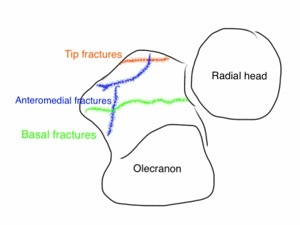
    Tip fractures

    Subtype 1 – ≤2 mm of coronoid height
    Subtype 2 – >2 mm of coronoid height

    Anteromedial fractures

    Subtype 1 – Fracture of the anteromedial rim
    Subtype 2 – Fracture of the anteromedial rim and tip
    Subtype 3 – Fracture of the anteromedial rim and sublime tubercle

    Basal fractures

    Subtype 1 – Fracture of the coronoid body (at least 50% of the height of the coronoid)
    Subtype 2 – Associated with olecranon fractures

    20130418-233857.jpg

    Treatment

    The main indication for coronoid fixation is presence of varus or valgus instability. The method of treatment is determined by the following factors.

    Presence or absence of ulnohumeral subluxation.
    Presence or absence of radial head fracture.
    Size and location of fragment.

    If there is persistent ulnohumeral subluxation or instability, if the fragment is small; repair the lateral collateral ligament and reattach the anterior capsule. Large coronoid fragment needs open reduction and internal fixation.

    Displaced radial head fracture should be fixed or replaced and if the fragment is small; repair the lateral collateral ligament and reattach the anterior capsule. Large coronoid fragment needs open reduction and internal fixation. Coronoid fracture is fixed first through the lateral approach followed by radial head and ligament repair.

    Biggest challenge in fixation of coronoid fracture is adequate surgical exposure. As the coronoid process is deep to the common flexor origin, exposure from medial side is difficult and limited. Anterior exposure carries the risk of injury to brachial artery and median nerve. Exposure from posterior aspect provide only limited visualisation.

    Medial approach may be done through FCU-Split approach or extended medial approach describe by Hotchkiss. Both approaches can be done through a global posterior approach or a medial incision.

    FCU-split approach is done by isolating the ulnar nerve, retracting it posteriorly and then separating the humeral and ulnar heads of flexor carpi ulnaris. Gently elevate the FCU and FDS from the proximal ulna in a distal to proximal direction to expose the coronoid. Anterior bundle of UCL should be carefully preserved. The flexor-pronator muscle belly is retracted anteriorly and the ulnar nerve is retracted posteriorly.

    Extended medial approach of Hotchkiss utilises the plane between the FCU and the humeral head of FDS. In presence of terrible triad of elbow (elbow dislocation with radial head and coronoid fracture) coronoid can be exposed from the lateral aspect through a modified Kocher approach by retracting the ruptured lateral collateral ligament. In comminuted fractures of the coronoid base, exposure may be an anterior approach.

    Fractures of the coronoid may occur in following situations, and their management differs.

    As an isolated fracture.
    As a part of fracture dislocation of elbow.
    As a part of comminuted fractures of proximal ulna.

    Isolated coronoid fractures usually involve the tip only. Most of these fractures have associated collateral ligament injury and careful assessment often reveal that there was an associated dislocation of the elbow at time of injury, which got reduced spontaneously. Type 1 coronoid fractures have very small fragments. Isolated tip fractures can be left alone if the elbow is stable and if there is no mechanical block to movement. Instability and anteromedial facet fractures are treated by surgery. Driscoll type 1 fractures are fixed with small screws, cerclage, suture anchor or K wires. Driscoll type 1 fractures are fixed with small screws, cerclage, suture anchor or K wires. If fragments are very small then Lasso type sutures are passed a through the attached anterior capsule around the fractured fragment and brought out through drill holes made from the posterior cortex of ulna and tied. TIbial ACL jig or Herbert screw jig may be utilised for making the drill holes. An important part of surgical treatment is reattachment of anterior capsule and repair of lateral collateral ligament.

    A variant is a fracture involving the anteromedial facet, which is now considered to be posteromedial rotatory instability. O’Driscoll Type 2 anteromedial facet fractures are vertical or oblique fractures. They can be treated by screw fixation or mini fragment buttress plating. Specialised coronoid plates may be used for this purpose. Anteromedial facet fractures are fixed by medial plating through FCU-Split or Hotchkiss approach. An important part of surgical treatment is reattachment of anterior capsule and repair of lateral collateral ligament.
    O’Driscoll type 3 fractures require fixation using plates, screws and occasionally hinged external fixation. Screws may be directed from posterolateral to anteromedial direction if a posterior approach is utilised.

    In simple elbow dislocations without fracture, after reduction most joints are stable allowing early mobilisation. Simple elbow dislocations can be treated with closed reduction and early controlled mobilisation. If one of the bony components that contribute to stability is fractured then the chance of instability and recurrent dislocation increases. In complex fracture dislocations, the stability of elbow depends on the size and location of coronoid fracture, degree of comminution of radial head, severity of associated ligamentous injury and interposition of soft tissue or bone fragments.
    Treatment of elbow dislocation depends on the bony and ligamentous injuries. In complex fracture dislocations of the elbow, a structured protocol based treatment is necessary. Successful functional outcome can be achieved with stable fixation of the fracture and early elbow mobilisation. Nonoperative treatment, is associated with high rate of early arthritis, recurrent dislocation, unstable elbow, post-traumatic joint stiffness, and nonunion. Hence coronoid fractures combined with elbow dislocation must be treated surgically.

    Further reading

    Ablove RH, Moy OJ, Howard C, Peimer CA, S’Doia S. Ulnar coronoid process anatomy: possible implications for elbow instability. Clin Orthop Relat Res 2006;(449):259-6.

    Regan W, Morrey B. Fractures of the coronoid process of the ulna. J Bone Joint Surg (Am) 1989;71:1348–54.

    O’Driscoll SW, Jupiter JB, Cohen MS, Ring D, McKee MD. Difficult elbow fractures: pearls and pitfalls. Instr Course Lect 2003;52:113-34.

    Ring D. Fractures of the coronoid process of the ulna. J Hand Surg [Am] 2006;31:1679-89.
    Doornberg JN, Ring DC. Fracture of the anteromedial facet of the coronoid process. J Bone Joint Surg (Am) 2006;88(10): 2216–24.

    Pugh DM, Wild LM, Schemitsch EH, King GJ, McKee MD. Standard surgical protocol to treat elbow dislocations with radial head and coronoid fractures. J Bone Joint Surg [Am] 2004;86:1122-30.

  • Superior labrum anterior-to-posterior (SLAP) lesions

    Tears of the superior labrum were first reported by Andrews in 1984. The term Superior Labrum Anterior and Posterior (SLAP) was coined by Snyder in 1990 to describe injuries of the superior labrum and biceps anchor. It may be associated with rotator cuff tears and other labral lesions. In those under 40 years, SLAP lesions are associated with shoulder instability and Bankart lesions and in those over 40 years of age, they are associated with rotator cuff tears. It may be due to acute trauma or chronic repetitive trauma.

    Anatomy

    The superior part of glenoid is covered by hyaline cartilage and the superior part of labrum is attached to its rim. Superior labrum is a triangular structure composed of fibrocartilage. About 73% of patients normally have a sublabral recess separating the labrum from the glenoid rim and it should not be confused with a SLAP tear. The tendon of long head of biceps inserts directly into the superior labrum and the supraglenoid tubercle.

    The function of superior labrum is not clearly understood. Along with contraction of long head of biceps, It also is thought to counter the proximal migration of humeral head produced by contraction of short head of biceps

    Three normal variants may be confused with SLAP tears.
    1, Sublabral foramen – 3-12%
    2, Sublabral foramen with cord like middle glenohumeral ligament (MGHL)- 9%
    3, Cord like MGHL with completely absent anterosuperior labrum (Buford complex)- 1.5%

    Pathomechanics

    The mechanism of injury is unknown, it may either be due to acute trauma or chronic repetitive trauma. Three mechanisms have been proposed. According to Andrews, a pull-off mechanism or the tensile force on the superior labrum generated by eccentric contraction the biceps tendon during overhead activity is the mechanism of injury. According to Snyder, compression loading when the arm is abducted and flexed is the cause. Burkhart proposed a a peel-off mechanism when the arm is rotated when the shoulder is in maximum abduction and external rotation, such as during the late cocking phase of throwing is the cause. Another mechanism is that the lesion may be secondary to shoulder instability.

    Classification

    Snyder classification

    I- Fraying and degeneration of the superior labrum with intact biceps attachment
    II- Bucket handle tear of superior labrum and biceps anchor. Most common type – 55%
    III- Bucket handle tear of superior labrum with intact biceps labrum- 9%
    IV- bucket handle tear of superior labrum that extends into the biceps tendon- o10%.
    Type I is typically associated with rotator cuff tears and type III and IV with traumatic shoulder instability.

    Maffet added four more types

    V- Tear of anteroinferior labrum that extends into the superior labrum
    V- Biceps tendon avulsion with associated unstable flap tear of labrum.
    VII- Biceps and superior labral tear extends beneath the middle glenohumeral ligament.

    Recently Nord and Ryu has added 3 more types

    VIII- Superior labral tear with extension to posterior labrum
    IX- Superior labral tear with the tear extending to the entire labrum
    X- Superior labral tear with a reverse Bankart lesion
    Morgan subclassified type II into A- Anterior B- Posterior and C- Combined.

    Clinical features

    History should be taken carefully to identify the mechanism of injury. Patients present with vague shoulder pain. There may be associated snapping which gets aggravated by overhead activities. If tear extends to the anterior labrum there may be associated instability. Nocturnal exacerbation is seen in presence of associated rotator cuff lesions. Patient should be asked about the precipitating traumatic event. Functional limitation should be assessed by asking about the ability to perform overhead activities and throwing. Many tests have been described for the diagnosis.

    Numerous tests are available, but they are of 2 types; active tests which try to recreate the torsional traction force that caused the injury or passive tests that exert compressive stress on the labrum. O’Brien test is an active test and crank test is a passive test.

    O’Brien’s test (Active compression test)

    Patient position- Standing.

    Examiner position – By the side with one hand on shoulder and other hand on the distal forearm.

    Joint position- Forward flexion of shoulder to 90, adduction of 10-15, fully internally rotated. Elbow straight. Thumb pointing down.

    Procedure- Elevate against resistance. Repeat with shoulder in external rotation.

    Interpretation – Pain in internal rotated position and absence of pain in external rotation suggestive of SLAP lesion. Ask about the location of pain, if it is over the acromioclavicular joint then the test is negative.
    Sensitivity- 90%
    Specificity- 98%

    Crank test(Compression rotation test)

    Patient position – Supine

    Joint position- Shoulder in 160 abduction, 30 forward flexion. Elbow flexed

    Procedure- Stabilise scapula with one hand, grasp the elbow with the other hand. Axially load and rotate externally and internally.

    Interpretation- Pain and reproduction of patient’s symptoms indicate labral pathology

    Reliability – 91% sensitive, 93% specific, 94% positive predictive value, 90% negative predictive value.

    Resisted supination external rotation test

    Patient position- Supine.

    Joint position- Shoulder 90 abducted, elbow 70 flexed, forearm semipronated.

    Procedure- Externally rotate the shoulder and ask the patient to supinate the forearm against resistance.

    Interpretation- Pain indicative of SLAP lesion.

    Anterior slide test

    Patient position – Standing.

    Joint position – Hand on hips with thumb pointing posteriorly.

    Procedure – Apply forward and axial pressure over the elbow and ask the patient to resist.

    Interpretation – Pain indicate superior labral pathology.

    Reliability – 78% sensitive and 90% sensitive for type II SLAP lesion.

    Diagnosis

    MR arthrogram is the most reliable method to confirm the diagnosis. Contrast extending into the substance of superior labrum is suggestive of SLAP lesion. Arthroscopy is the gold standard for diagnosis. But differentiation from normal variants may be difficult. Fraying of labrum, associated synovitis, abnormal laxity of labrum of >5mm, associated chondral lesions of glenoid or humeral head superiorly often help in confirming the diagnosis.

    Treatment

    A complete arthroscopic examination of the shoulder is performed through the posterosuperior and anterosuperior portals. Look for widened rotator interval, drive-through sign, labral lesions, Bankart lesions, rotator cuff tears and impaction fracture of humeral head. Probe the biceps anchor and superior labrum looking for laxity, detachment, and fraying.

    The portals used depend on the type of SLAP tear identified. The treatment in young patients may be debridement, SLAP repair or biceps tenodesis and in the older patients by biceps tenotomy. pThe technique of repair depends on the type of tear. For the commonest type II tear posterosuperior, high rotator interval and midlateral portals are used. First mobilise the biceps- labral complex. Then prepare the bony bed for reattachment till bleeding bone is exposed. SLAP Lesions can be reattached using suture anchors, trans-glenoid sutures or staples. Torn biceps and superior labrum is commonly reattached using one-anchor-2-suture technique or two-anchor technique.

    Type III tears are treated by debridement of the bucket handle portion. Type IV tears treated by debridement or repair of bucket handle labral tear and biceps tendon tenodesis or tenotomy. Type V tears are treated by reattachment of SLAP tears and Bankart lesion using suture anchors. Type VI tears are treated by debridement of flap tear and reattachment similar to type II tears. Type VII tears are treated by repair of superior labrum like in type II and repair of MGHL. Type VIII are treated by repair of superior labrum similar to type II and reattachment of posterior labrum.

    Postoperatively limb is immobilised in an arm pouch for 3 weeks. Physiotherapy started in the 4th week with advice to avoid movements beyond 90 degree abduction, 70 degree adduction and 0 degree external rotation till the 7th week after which no movement restriction is necessary.

    Outcome

    Excellent results are reported in 15-30%, ‘good to excellent’ results in 40-94% after SLAP repair. The best candidates for repair of SLAP lesions is young patients with type II lesions, acute trauma, positive clinical tests and MR arthrogram and intact biceps anchor.

    References

    Andrews JR, Carson WG. The arthroscopic treatment of glenoid labrum tears in the throwing athlete.Orthop Trans.1984;8:44

    Snyder SJ, Karzel RP, Del Pizzo W, Ferkel RD, Friedman MJ. SLAP lesions of the shoulder. Arthroscopy. 1990;6:274-279

    Maffet MW, Gartsman GM, Moseley B. Superior labrum-biceps tendon complex lesions of the shoulder.Am J Sports Med. 1995;23:93-98.

    Morgan CD, Burkhart SS, Palmeri M, Gillespie M. Type II SLAP lesions: three subtypes and their relationships to superior instability and rotator cuff tears.Arthroscopy. 1998;14:553-565.

    Scott E Powell, Keith D Nord, Richard KN Ryu: The diagnosis, classification and treatment of SLAP lesions. Oper Tech Sports Med 12: 99-110, 2004

    Joseph P. Burns, Michael Bahk, Stephen J. Snyder: Superior labral tears : reapir versus biceps tenodesis. J Shoulder Elbow Surg (2011)20,S2-S8

    O’Brien SJ, Pagnani MJ, Fealy S, et al: The active compression test: A new and effective test for diagnosing labral tears and acromio-clavicular joint abnormality. Am J Sports Med 26: 610–613, 1998

    Parentis MA, Mohr KJ, ElAttrache NS: Disorders of the superior labrum: Review and treatment guidelines. Clin Orthop 400: 77–87, 2002.

  • Alternative bearing surfaces- Ceramic on Ceramic (CoC) Hip Replacement

    Major Points

    Ceramic on ceramic articulation has 200 times less wear than metal on polyethylene coupling.
    Improvements in taper technology, ceramic quality, quality control has lead to greater confidence among surgeons.
    Ceramics are biologically inert
    Two types of ceramics available are alumina and zirconia.
    Alumina most commonly used.
    Accepted only in the hip replacement.

    Introduction

    Total hip replacement is the treatment of choice in advanced hip arthritis. Ceramics was introduced in the 1970s as an option for THR. Boutin implanted the first ceramic prosthesis in 1970. But poor quality of taper design, surface finish and ceramic grade resulted in unsatisfactory outcome with early designs. The huge success of metal on polyethylene designs combined with poor outcome with early ceramic implants soon made them unpopular. Metal head on polyethylene cup was the first bearing surface combination to prove successful. But subsequently polyethylene wear leading to osteolysis and component loosening was identified as the major cause of failure on long term follow up. This lead to the search for alternate bearing surfaces and the redesigned and upgraded ceramics reentered as an alternative.

    Advantages

    Advantage of ceramics is their excellent biocompatibility, hardness, wear resistance and lubrication properties. The bulk material as well as particles of ceramic have excellent biocompatibility. Hardness of the ceramic gives it high abrasion and scratch resistance. Surface tension gives it excellent lubrication properties. Ceramic on poly shows lower wear rates than metal on poly and ceramic on ceramic show very low rates of wear. Lower wear rate and biocompatibility leads to lower wear rate which in turn lead to better long term survival of components.

    Disadvantages

    Disadvantages of ceramics are component fracture, squeaking and unreliable fixation of ceramic to bone. Component fracture reported with earlier designs were as high as 15%. But with the present generation of implants it has come down to 0.02%. As the ceramic cannot be reliably fixed to bone; ceramic liners are fixed to metal cups in the acetabular side and inserted on the metal stems on the femur side.

    Another problem noted is chipping of the rim of acetabular liner during the insertion. This complication has come down with careful surgical technique. This is thought to be a design specific problem. It is also due to different mechanical properties of acetabular shell and liner. As ceramic is harder than metal, during insertion the cup may expand and this may lead to unsatisfactory locking of liner to the shell.

    Another disadvantage of ceramic on ceramic coupling is squeaking, which is unique to hard on hard bearings. It is reported in 1-10% of cases. Squeaking is thought to be due to 1) mismatch between liner and head 2) insufficient lubrication 3) due to debris and 4) due to stripe wear. The causes and implications of squeaking is not yet determined. All patients should be counselled regarding squeaking prior to surgery.

    Another disadvantage of ceramic is that due to manufacturing process constraints, only a one to two liner options are available for each size of head. These leads to reduced ability to customise to the patient on the table. According to many experts this is probably the single most important disadvantage of ceramic on ceramic.

    Another important issue is revision. Revision of liner alone may not be possible as removal of liner may lead to damage to the locking mechanism. Hence the shell as well as liner should be exchanged. In case failed ceramic bearing surface, total synoviectomy should be done as ceramic wear particles are hard and may lead to accelerated wear of revised bearing couple if left behind.

    Types of Ceramics

    Two types of ceramics are available, alumina and zirconia. Alumina is the most popular. The latest generation of ceramics such as Biolox Delta have a mixture of alumina and zirconia. Alumina has several advantages. It is harder than metal; resulting in remarkably less wear and resistance to third body wear. The wear rate of alumina is 0.001mm/year which is significantly less than alumina on polyethylene (0.1mm/year) and metal on polyethylene (0.2mm/year). It has high density which allows very good surface finish. It is hydrophilic leading to better lubrication. Main defect of alumina is its brittleness or low ability to withstand deformation. Zirconia is tougher but it has low thermal stability and cannot be coupled with itself.

    Recent Advances

    The recent advances in ceramics are smaller grain size which is 3 times less than early designs, better design of Morse taper decreasing risk of fracture, Other modifications are clean room processing, hot isostatic pressing (HIP), laser marking instead of engraving earlier and improved sintering techniques. Another improvement is quality control by 100% proof test; which is a nondestructive overload testing of all ceramic components to identify defects.
    Ceramic can be used as a ceramic head on ceramic acetabular cup or as ceramic head on polyethylene cup. At present one million total hip replacements are done worldwide, of these about 25% are ceramic on polyethylene and another 10% is ceramic on ceramic.

    At present ceramics are used only in the hip because hip components have simple design and shape; there is minimal dimensional mismatch between the head and cup and there is no translational movement. Hip designs can withstand large loads as they have an axial symmetric structure of spheres and cones leading to very favourable contact conditions in spherical hinges and conical couplings. Kinematics of knee is translational and rotational, hence the design is complex. Hence ceramics is knee is still in the experimental stage.

    Present recommendations in technique of ceramic arthroplasty

    The modifications in technique include more horizontal (<45 degree) placement of cup to prevent edge loading, and the anteversion should be 20deg to compensate for lack of elevated posterior rim. Any anterior osteophytes present be removed to prevent impingement.

    To download a presentation visit

    https://m.box.com/view/f_7028120552

    Copyright @Dr Rajesh Purushothaman, Associate Professor, Government Medical College, Kozhikode, Kerala, India

  • Acetabular labral tears

    Labrum increases the stability of hip, increases the surface area for weight bearing and provides proprioception. It increases stability by deepening the acetabulum and also by acting as a seal to maintain negative intra-articular pressure. Acetabular labral tears are associated with capsular laxity, femoro-acetabular impingement (FAI), acetabular dysplasia and chondral lesions. They are seen in 90% of patients with mechanical hip symptoms on arthroscopy. The cause of labral tears is not clearly defined, but femoroacetabular impingement is the predominant cause in nondysplastic hips. Impingement may result from abnormal transition between femur head and neck, overgrowth of bony acetabulum, acetabular retroversion or a combination of these abnormalities.

    Anatomy

    Hip joint capsule is reinforced inferiorly by the pubofemoral ligament, posteriorly by the ischiofemoral ligament and anteriorly by the iliofemoral ligament. They tighten in extension and relax in flexion. Iliofemoral ligament tightens in external rotation and adduction, pubofemoral ligament in external rotation and abduction and ischiofemoral ligament in internal rotation and abduction. Ligamentum teres runs from the acetabular notch to the fovea capitis of femur. it tighens in flexion, adduction and internal rotation.

    Pathoanatomy

    Labral traumatic tears occur due to shearing forces generated during pivoting, twisting and falling. In Asians, tears are most commonly located posteriorly and occur due to hyperflexion or squatting. In North American population, tears are most commonly located in the anterosuperior aspect and occur due to pivoting and twisting. Labral tears can lead to capsular laxity and abnormal motion which in turn can lead to labral fraying and chondral degeneration.

    Pathogenesis

    Femoroacetabular impingement (FAI) occurs when there is reduced clearance between the acetabulum and the femoral head. There are two types, cam type and pincer type. Cam type occurs when the diameter of the femoral head is abnormally large and the normal spherical transition between femur head and neck is abnormal leading to impingement between femur head and acetabular rim particularly during adduction and internal rotation. Cam impingement leads to anterosuperior labral and chondral lesions. Pincer impingement occurs when the coverage of femur head by acetabulum is excessive. There are two types of overcoverage; coxa profunda with generalised coverage and local anterior due to acetabular retroversion which results in contre-coup posteroinferior chondral lesions. Pincer impingement is more common in middle aged females and cam impingement is more common in young athletic males. FAI can lead to labral lesions, chondral lesions and progressive degenerative changes leading to osteoarthritis.

    Hip capsule laxity is a recently recognised pathology. It can either be generalised due to disorders like Marfan syndrome, Ehlers Danlos syndrome etc, it can be focal rotational most commonly due to forceful external rotation leading to iliofemoral ligament insufficiency. Labral tear may also cause capsular laxity.

    Lesions of ligamentum teres are the third most common lesion found on arthroscopy in athletes.
    Developmental dysplasia of hip is associated with shallow acetabular socket. This leads to reduced anterior and superior coverage. This leads to excessive dependence on the anterior capsule which may lead to hypermobility and labral tears. Labral tears may also be due to Perthes disease or slipped capital femoral epiphysis.

    Classification

    There are four types of labral tears;
    Radial flap tears
    Radial fibrillated tears
    Longitudinal peripheral tear
    Abnormally mobile labrum

    Discontinuity in the peripheral rim of labrum is called radial flaps and they are the most common. Fraying of free rim called radial fibrillated tear is seen with degenerative changes. Longitudinal tears are the least common. Labral tears are most common in the anterior and anterosuperior area.

    Clinical Features

    Patients may present with pain mainly in the groin, clicking, locking, giving way and stiffness. Inguinal clicking is associated with high incidence of labral tears. Clicking due to labral tears are more often felt during internal and external rotation of hip, in contrast to clicking during flexion seen in extra-articular causes of snapping hip.

    Clinical examination should include tests to detect signs of generalised ligament laxity, assessment of range of movement, tests to detect intra-articular pathology, capsular laxity and impingement tests. Tests for intra-articular lesions include FABER test, scour test and Stinchfield test (resisted SLR test).

    Test for generalised ligamentous laxity.

    Tests to assess generalised ligament laxity utilises Bird criteria or Beighton criteria(elbow and knee hyperextension, thumb opposition, hyperextension of fifth metacarpophalangeal joint and ability to place the palm on the floor with knee in extension.

    Tests for impingement

    FABER (Flexion Abduction External Rotation) test is done by moving the hip into flexion, abduction and external rotation and then pushing it into extension. Ask for the site of pain. Posteriorly felt pain is due to sacroiliac pathology and groin pain is due to hip disease. Scour test is done by moving the hip in an arc involving flexion-adduction and extension-abduction. During this movement apply axial load and rotate into external and internal rotation. Pain and limitation of movement suggest intra-articular pathology. Stinchfield test (Resisted SLR test) is done by asking the patient to actively flex the hip to 30 degrees while keeping the knee in extension and to hold the position. Apply resistance just proximal to the knee. Pain felt in the groin is suggestive of intra articular pathology.

    Anterior impingement test is assessed by forcing the hip into combined flexion, adduction and internal rotation. Posterior impingement test is assessed by bringing the patient to the distal edge of the table to allow maximum extension and then taking the hip to maximum combined extension and external rotation. Log roll test is done to assess hip joint capsule laxity. The hip is kept in neutral flexion-extension and neutral abduction-adduction and the limb is passively rolled into full internal and external rotation while assessing the range of movement and any associated pain and clicking.

    The most common causes of groin pain in athletes are hernia, adductor tendinopathy and labral tears.

    Investigations

    The best investigation to identify labral tears is Gadolinium enhanced magnetic resonance arthrography.

    Radiological investigations should include anteroposterior and lateral views of the hip. Look for abnormalities suggestive of femoroacetabular impingement such as lack of head neck offset at the head neck junction, acetabular retroversion, osteophytes, and joint space narrowing suggestive of femoroacetabular impingement. Evaluate the following measurements on the x-ray.

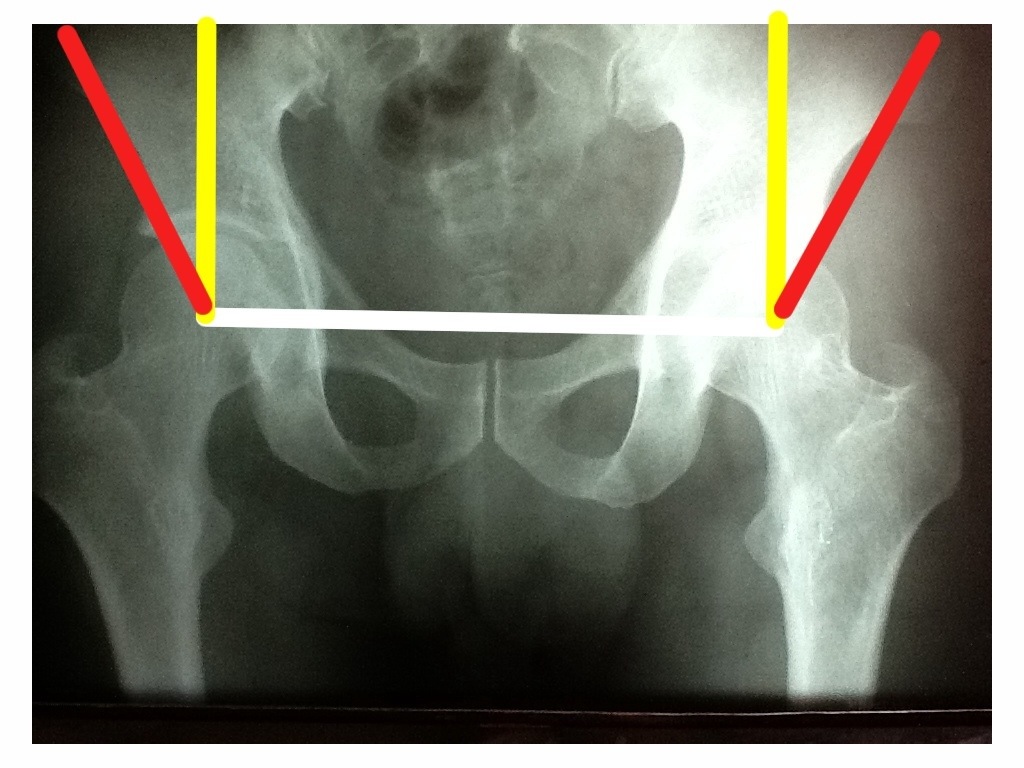
    Center edge angle of Wiberg

    Mark the centre of femoral head on both sides, draw a horizontal line connecting them. Draw a vertical line perpendicular to this line from the centre of head. Draw an oblique line from the centre of femoral head to the lateral edge of acetabulum. Measure the angle between the vertical and oblique lines.

    Normal > 25°
    Borderline 20°–25°
    Dysplasia <20°

    20130317-232425.jpg

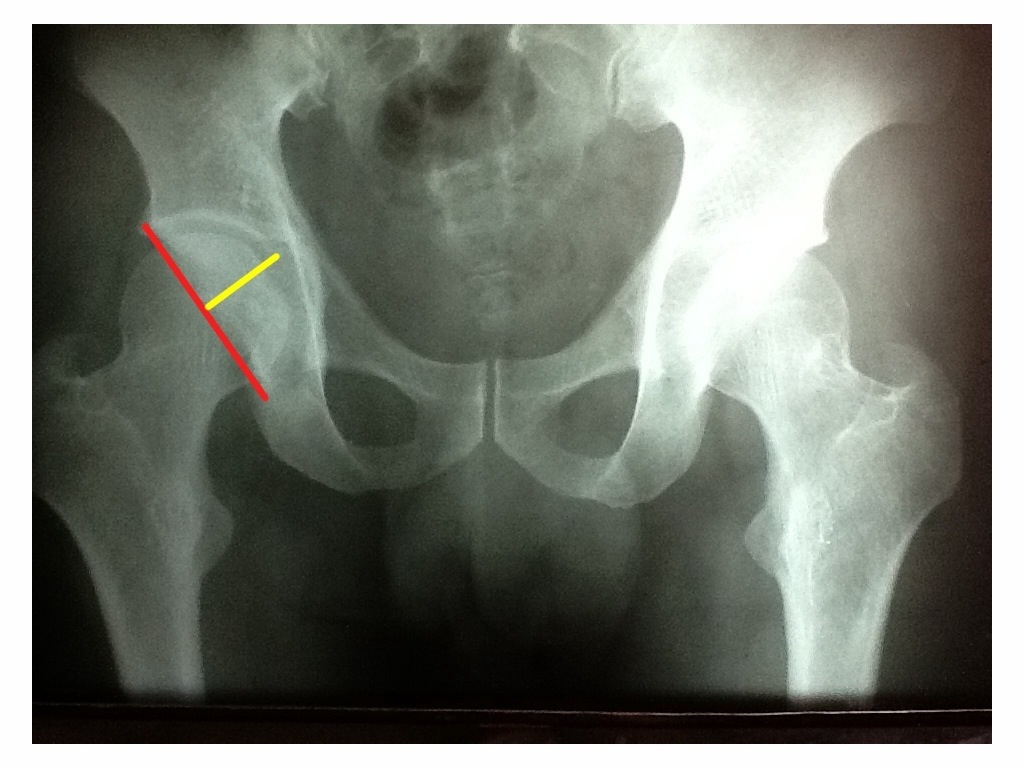
    Acetabular depth to width index

    Draw a line connecting the superolateral edge and the inferomedial edge of the acetabulum and measure. From this line draw a perpendicular line to the deepest part of acetabulum. Calculate the percentage of depth to the width.

    Normal > 38%
    Abnormal <38%

    20130317-232727.jpg

    Femoral head extrusion index

    Normal 25%

    Acetabular index of elevation

    Identify the acetabular sourcil, which is the sclerotic eyebrow like line at the superolateral weight bearing dome of acetabulum. Draw a horizontal line at the medial end of sourcil. Draw another line connecting the lateral and medial ends of sourcil. Measure the angle between the two lines.
    Normal 10°. Seen in dysplasia.

    Femoral head lateral subluxation

    Draw 3 vertical lines. One at the most medial and another at the most lateral points of femoral head and measure the distance. Draw the third line at the lateral edge of acetabulum and measure the distance between the line at the lateral edge of acetabulum and lateral edge of femoral head. Express the lateral extrusion as a percentage of femoral head width or in millimetres.
    Normal <8 mm

    Femoral head superior subluxation

    Draw two horizontal lines, one at the inferior end of tear drop and another at the most inferior part of femoral head and measure the distance between them.
    Normal ❤ mm

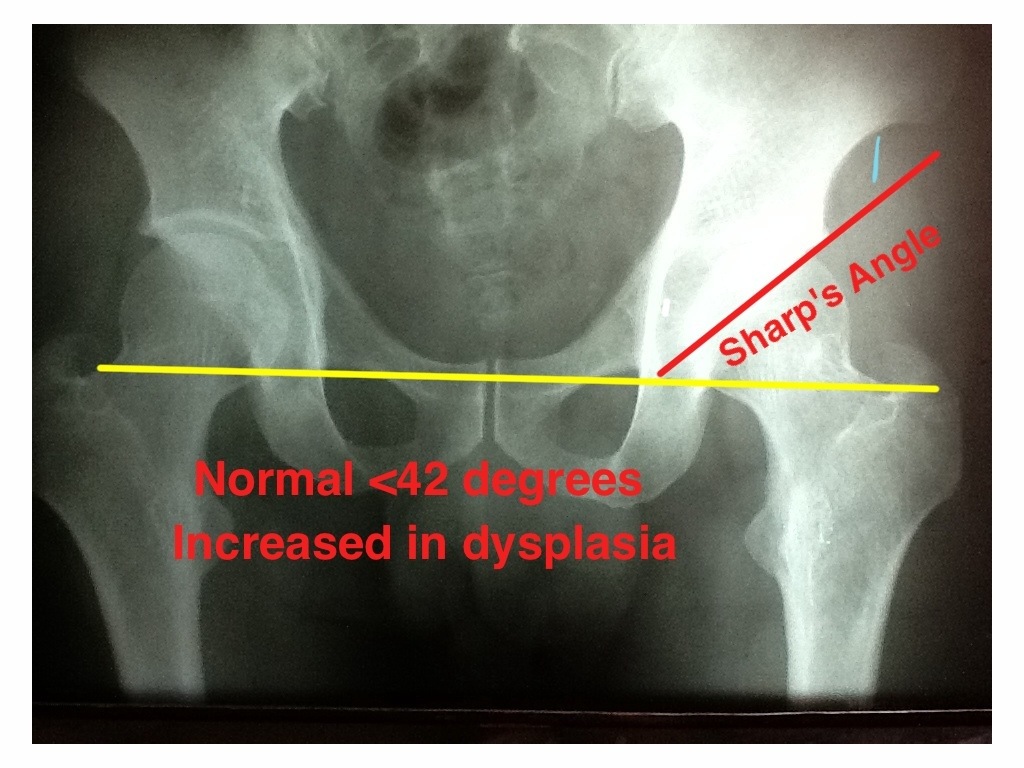
    Sharp’s angle

    Draw a horizontal line connecting the inferior end of tear drop. Draw another line from inferior end of teardrop to the lateral end of acetabulum and measure the angle between these lines.
    Normal <42°

    20130317-233135.jpg

    Shenton’s line

    Normal hips display a continuous, intact line:
    –Intact line = curve was intact and continuous.
    –Disrupted line = curve was continuous but there was a minor
    disruption.
    –Noncontinuous line = curve was neither continuous nor intact, with
    gross disruption.

    Femoral neck shaft angle

    Normal 125°–135°

    Crossover sign

    Trace the anterior and posterior lips of the acetabulum from the superolateral edge of acetabulum downwards. Normally the acetabulum is anteverted; hence the posterior border is lateral to the anterior border. If acetabulum is retroverted; the anterior border crosses the posterior border producing a figure of 8 pattern (Crossover sign).
    Normal; crossover sign negative.

    Posterior wall sign

    Normally the centre of femoral head is lateral to the posterior wall of acetabulum. If it is medial then the posterior wall sign is positive and is suggestive of pincer type of impingement.

    Femoral neck offset

    Draw the long axis of the neck and head on the lateral view. Normally it is close to 0°. It will increase as the femoral neck’s width disproportionately increases in the superior portion of the neck, seen in cam type of impingement due to abnormal head neck transition.

    Treatment

    A careful evaluation of the x-ray and other imaging modalities should be done before treatment. Look for any signs of impingement on the x-ray. Look carefully for acetabular retroversion. Look for signs of osteoarthritis. Carefully study the MRI for any chondral or labral lesions. Chondral and labral lesions indicate poor prognosis for treatment methods that address labral lesions alone. Severe acetabular retroversion should be corrected by periacetabular osteotomy in addition to treatment of labral lesions. In presence of impingement, identify the type of impingement whether cam, pincer or combined.

    Cam type impingement is treated by safe surgical dislocation described by Rienhard Ganz and open femoral osteochondroplasty. Osteochondroplasty removes the abnormal bone that is present at the femur head neck transition zone. It can also be done by hip arthroscopy. Pincer type impingement is corrected by safe surgical dislocation of hip and debridement of the acetabular rim.
    Associated chondral lesions are debrided and treated by microfracture if necessary. Labral lesions can either be debrided or repaired. Longitudinal tears are treated by suturing and abnormal capsular laxity can be addressed by thermal capsular shrinking or open imbrication.

    Prognosis

    Prognosis is poor if the patient already has osteoarthritic changes or if there are extensive chondral lesions.

  • Clinical Examination of Lower Limb Deformity

    When a child is born, it has 10-15 degrees of physiological genu varum, 5 degree internal tibial torsion and external rotation contracture of the hip. It reaches the maximum by about 9-12 months. This usually gets corrected to neutral by the age of 18-24 months then the limb develops a valgus angulation, which reaches the maximum of about 12 degrees by the age of 3-4 years. This physiologic valgus usually gets corrected to the adult value of 7 degrees of valgus by the age of 8 years. Physiologic valgus is bilateral and symmetrical; less than 15 degrees and the inter-malleolar distance doesn’t exceed 8 centimetres.

    Tibial torsion is the angle between the transverse axis of the knee and the transmalleolar axis. The tibia is internally rotated at birth. Internal tibial torsion is 5 degrees at birth and gets corrected to neutral by 4-5 years of age. The tibia then gradually becomes externally rotated and reach the adult value of 20-25 degrees of external rotation by the age of 8 years.

    Femoral anteversion is the angle between the transcondylar axis and the longitudinal axis of the femoral neck in the horizontal plane. Femoral anteversion is 40 degrees at birth and reaches the adult value of less than 15 degrees by the age of 8 years. It produces intoeing gait which gradually increases during the first five years of life due to summation of deformities. It gets corrected by 8 years of age.

    Deformity is defined as a deviation from normal structure or function which may be symptomatic or has the potential to produce symptoms.

    Goals of deformity assessment

    The goal of deformity assessment is to answer the following questions.

    1. Is there a deformity?

    One should be able to differentiate between physiological and pathologic malalignment.

    2. What is the deformity?
    Identify the name of the deformity.

    3. Where is the deformity?
    Identify the site of deformity whether it is at the joint level or in the bone. If in the bone, then it is in the epiphysis, metaphysis or diaphysis. Deformities due to tilting of the joint line becomes less when the joint is flexed. This is because the area of contact between the articular surfaces is altered during flexion.

    4. Which is the plane of deformity?
    Identify the alteration produced by the deformity in all three planes and any associated limb length discrepancy as well. Thus a deformity may have a component of flexion or extension in the sagittal plane, varus or valgus in the coronal plane, internal or external rotation in the axial plane; in addition there may be shortening or lengthening as well.

    5. How severe is the deformity?
    Identify the severity of deformity in each plane and also the severity of limb length discrepancy. Assess how much of passive correction of the deformity is possible.

    6. Why there is a deformity?
    Identify the cause of deformity. Identify whether it is a localised problem or part of a systemic disease. Try to detect whether it is due to soft tissue contracture, muscle paralysis or spasm or rupture, joint dislocation or subluxation or malformation and lastly bony malunion or nonunion or deformation.

    7. Are there any consequences of the deformity?
    Identify whether there are any compensatory malposition of neighbouring joints and secondary effects such as osteoarthritis on the concave side or laxity of ligaments on the convex side. Assess whether it is associated with any secondary joint instability such as patellofemoral instability in genu valgum. Identify how it is affecting the gait or joint function.

    8. When does the deformity occur?
    Identify whether it is a static or dynamic deformity.

    History

    From the history try to understand the relevant details about the deformity, look hints that help identify the cause and understand the secondary effects of the deformity and its impact on function. History should start with the following questions.

    • How long the deformity is present?
    • How did it start?
    • How is it progressing?
    • Any associated symptoms?
    • Is there any history of trauma or infection?
    In children get perinatal history
    • Did the mother take any drugs during pregnancy especially in the first trimester?
    • Did the mother have any infections especially in the first trimester?
    • Did the mother have any history of substance abuse?
    • Is there any maternal health problems?
    • Did prenatal ultrasounds show any abnormality?
    • Was there any abnormality in previous pregnancies?
    Get a natal history in appropriate case.
    • Was it a full term delivery?
    • What was the type of delivery?
    • What was the type of presentation at birth?
    • What was the birth weight?
    • Was there any delay in first cry?
    • Were there any complications during delivery?
    Get details of nutrition to assess the chance of nutritional deficiencies like rickets.
    • Vegetarian or non-vegetarian
    • Calorie intake
    • Food fads
    • Exposure to sunlight
    • Whether diet is balanced or not
    Family history
    • H/o similar or other deformities

    Developmental history
    • When did social smile appear?
    • When did the child achieve
    • Neck steadiness
    • Sitting
    • Standing
    • Crawling
    • Walking
    • Stair climbing and descending
    • Hand to hand transfer

    General Examination

    In general examination look for features of generalised ligamentous laxity, general manifestations of rickets or known dysplasias.

    Inspection

    Inspect the patient in standing, sitting, walking and in the supine position. Inspect from the front, back and both sides. Look for any asymmetry in size, shape and function.
    Look at
    • Head tilt and rotation
    • Level of shoulders, scapula and iliac crests
    • Look for spinal deformity such as scoliosis or kyphosis
    • Look for lumbar lordosis suggestive of flexion deformity of hip when the patient is supine on a hard surface
    • Look for knee deformity in all three planes
    • Look for ankle equinus or calcaneus deformity from the side
    • Look for any hindfoot varus or valgus from the back
    • Look for any forefoot or toe deformity

    Palpation

    Palpate the bone, soft tissues and joint. Look for change in temperature; limb with post-polio residual contracture is cold. Look for any tenderness and note the site of tenderness. When palpating bony and soft tissues; look for any asymmetry, thickening, swelling or defect.

    Movements

    Assess the active and passive movements of spine, hip, knee and the foot and ankle. Record the range of movement. Look for restriction of range of movement, pain during joint movement, ligamentous laxity, joint instability and any abnormal sounds during joint movement. While moving the joint passively, watch out for muscle spasm. Movement should be assessed in all three planes depending on the normal movement for that particular joint.

    Measurements

    Measurement is done to detect any limb length discrepancy, to assess degree of muscle wasting. Limb length discrepancy may be true or functional. True LLD is due to real shortening or lengthening. Functional LLD is due to abnormal joint positioning such as adduction contracture of hip. Girth of the thigh is measured 15 cm above the knee joint line and girth of the calf is measured at the bulkiest area.

    In addition measure intercondylar distance between medial femoral condyles in the standing position for genu varum. In cases of genu valgum measure the intermalleolar distance in the standing position.

    Torsional profile of the lower limb

    Torsional abnormalities may be in the femur, tibia or foot. Torsional abnormalities lead to either in-toeing or out-toeing. Intoeing is more common. Commonest cause of intoeing in children below one year is metatarsus adductus, commonest cause from 1-3 years is internal tibial torsion; and after 3 years of age excessive femoral anteversion is the commonest cause. It is identified by assessment of foot progression angle. Foot progression angle is the angular difference between the direction of walking and the long axis of the foot. If the foot is externally rotated then the angle is positive and if internally rotated then the angle is negative. Normal value for children and adolescents is 10 degrees.

    Femoral anteversion is assessed by doing the Craig’s test. It is done in the following method.

    Patient position – Prone
    Joint position – Knee flexed to 90 degrees.
    Procedure- One hand of the examiner is placed flat on the greater trochanter. Hold the leg and gently rotate the hip in both directions till the greater trochanter is maximally prominent. The amount of internal rotation needed to make the greater trochanter maximally prominent is the degree of anteversion.

    In addition the range of rotational movement of the hip is also recorded. The patient is made prone and the pelvis is made level. Then rotate the hip internally and externally to the maximum point to which it is maintained by gravity alone. In patients with excessive femoral anteversion, the range of internal rotation is increased and external rotation is diminished. In femoral retroversion, the external rotation is increased and internal rotation diminished.

    Tibial torsion is assessed by the thigh foot angle or angle of the transmalleolar axis.

    Thigh foot angle is assessed by the following method.

    Patient position – Prone
    Joint position – Knee flexed to 90 degrees, ankle in neutral position.
    Procedure – Measure the angle between the thigh axis and the foot axis. Angle is negative if internally rotated and positive if externally rotated. Normally the angle is 10 degrees in adults. In the newborn, there is 5 degrees internal tibial torsion normally.

    If the foot is not normal, then measure the angle of the transmalleolar axis.

    Patient position – The patient is asked lie prone on a couch with the knee flexed to 90 degrees.
    Procedure – The centre of each malleoli are marked. Connect these points by a line across the plantar surface of the sole. Draw a line perpendicular to it.
    Interpretation – The angle between the thigh axis and a line perpendicular to the transmalleolar axis is measured, which is equal to the tibial torsion.

    Torsional deformity of the foot is assessed by heel bisector line. Heel bisector line divides the heel into two equal halves in the longitudinal axis. In the normal foot it passes through the second toe. If it passes medial to the second toe, forefoot is abducted and if it passes lateral to the second toe, the forefoot is adducted. If it passes through the third metatarsal, adduction deformity is mild, through fourth metatarsal is considered moderate and through fifth metatarsal is considered to be severe metatarsus adductus.

    In newborn feet, V- finger test is done to assess the forefoot adduction. The heel of the child is placed in the second interdigital cleft of the examiner. Normally the lateral border of foot is straight and will be in contact with the examiners finger. If the lateral border of the foot beyond the fifth metatarsal base is not in contact with the examiner’s finger due to medial deviation, then there is metatarsus adductus deformity.

    Angular profile of the lower limb

    Angular deformities may be physiological or pathological. It is more likely to be pathological if it is unilateral; asymmetrical; painful or if progressive.

    Ask the patient to stand with his feet and knee touching each other while the patella is facing forwards. When inspected from the front, there will be a gap between the knees in patients with genu varum. In patients with genu valgum, the ankles will be kept apart. Inspect from the side, specifically looking for equinus or calcaneus deformity of ankle, flexion deformity or hyperextension deformity of knee.

    Ask the patient to lie supine on a hard couch and look for any lumbar lordosis suggestive of fixed flexion contracture of hip. If present do the Thomas test to assess the severity of flexion deformity.

    Thomas well leg raising test

    Patient position- Supine
    Examiner position – Stand on the right side of the patient with one hand under the lumbar spine of the patient. With the other hand hold the unaffected side.
    Procedure- Flex the unaffected knee fully, then flex the unaffected hip till the excessive lumbar lordosis disappears. Measure the angle between the thigh of the affected side and the couch to assess the angle of fixed flexion deformity of the hip.

    Intercondylar distance is measured to assess the severity of genu varum deformity. Ask the patient to stand with his medial malleoli touching each other and then measure the distance between the medial femoral condyles. Intermalleolar distance is measured in patients with genu valgum deformity. Ask the patient to stand with his medial femoral condyles touching each other and the foot should be in neutral rotation, measure the distance between the medial malleoli. Both these measurements have the disadvantage of being influenced by the size of the patient. In this situation, measurement of the tibiofemoral angle using a goniometer is essential. This is measured in the standing position. Lateral thigh leg angle is measured by keeping the arms of the goniometer on the lateral surface of thigh and leg and the hinge of the goniometer at the level of knee. Other method is by keeping the arms of goniometer on the anterior surface of the thigh and leg and the hinge of goniometer over the centre of patella.

    In patients with genu valgum one should do the Ober’s test to rule out ITB contracture and assess the patient for patellofemoral instability. Measure the standing height, sitting height and arm span of the patient.

    Assessment of lower limb length discrepancy

    Limb length discrepancy(LLD) may be true or functional. True limb length discrepancy is due to shortening or lengthening of bone or joint dislocation. Functional LLD is due to abnormal joint positioning such as pelvic obliquity due to adduction contracture or flexion deformity of knee.

    LLD may be due to abnormal pelvic height, femoral length, tibial length or foot height. LLD may lead to abnormal gait, cosmetic problem, osteoarthritis due to abnormal weight transmission or low backache. LLD up to 2 cm at skeletal maturity is considered physiological as only about 25-30% of normal population have equal limb length. Left lower limb is longer than the right in a ratio of 3.5:1.

    When the patient is standing; assess whether the shoulder, iliac crest and the popliteal and the gluteal creases are at the same level. Look for compensatory scoliosis, which will disappear if the patient is made to sit. LLD may be masked by flexion of opposite knee and plantar flexion of ankle.

    LLD is best measured using blocks of known height under the foot of the affected side; till the pelvis is level and the compensatory lordosis disappears. Lower limb length measurement includes measurement of the whole lower limb and measurement of length of individual limb segments. Whole length measurement is done either by placing blocks of known thickness under the shorter limb till the pelvis is level or by measuring using a measuring tape.

    With measuring tape; measure both the true length and apparent length. Apparent length is measured from the xiphisternum or umbilicus to the inferior tip of the medial malleolus when the limbs are kept parallel. To measure the true length, both the limbs should be kept in an identical position. Hence if there is a fixed adduction deformity of hip; first make the pelvis level by adducting the affected hip till both the anterior superior iliac spines (ASIS) are at the same level. Measure the true length if the affected limb from the inferior edge of ASIS to the inferior edge of medial malleolus. Now keep the opposite hip also in an identical degree of adduction and then measure the other side as well.

    The lower limb has 4 segments; supratrochanteric (pelvic), infratrochanteric (femur), tibial and foot segments. Infratrochanteric segment is measured from the tip of greater trochanter to the lateral joint line of knee. Tibial segment is measured from the medial joint line of knee to the tip of medial malleolus.

    Supratrochanteric segment is measured by drawing the Bryant’s triangle, Nelaton’s line or Shoemaker’s line. Bryant’s triangle is drawn by drawing three lines in the supine position. First line from the inferior edge ASIS vertically down towards the examination table. Second line is drawn from the ASIS to the tip of greater trochanter. Third line is from tip of trochanter to the first line. Measure each sides of the triangle and compare with the other lower limb. Difference in the length of third line suggests supratrochanteric shortening. Supratrochanteric shortening may be due to hip arthritis, hip dislocation, fracture neck of femur or coxa vara.

    Galeazzi test or Allis test

    Patient is supine on the table. Flex both the hip and knees and place both the feet together. Note the level of knee. In case of LLD the levels will be different. Now look from the side. If the shortening is in the femoral segment; the level of knee will be proximal to the other knee and if shortening is in the tibial segment, knee will be distal to other knee.

    Cover-up test

    Done between the ages of 1-3 years. The child is either standing or lying supine. The part of tibia distal to the proximal third is covered by a hand and observe the angular relationship between the thigh and proximal tibia. If in neutral or valgus, no need to observe for tibia vara. If in varus then observe to rule out tibia vara.

    Suggested reading

    1. Pauwels F. Biomechanics of the locomotor apparatus. New York: Springer Verlag, 1980.
    2. Chao EYS, Neluheni EVD, Hsu RWW, Paley D. Biomechanics of malalignment. Orth Clin N.A. 25: 379-386, 1994.
    3. Moreland JR, Bassett LW, Hanker GJ. Radiographic analysis of the axial alignment of the lower extremity. J. Bone Joint Surg, 69A: 745-749, 1987.
    4. Andriacchi TP. Dynamics of knee malalignment. Orth Clin N.A., 25: 395 406, 1984.
    5. Paley D, Tetsworth K. Malalignment and realignment of the lower extremity. Orth Clin N. A., 25:355-367, 1994.
    6. Paley D,Herzenberg JE,Tetsworth K et al. Deformity planning for frontal and sagittal plane corrective osteotomies. Orthop Clin North Am. 1994;25:425-465
    7. Salenius P, Vankka E. The development of the tibiofemoral angle in children. J Bone Joint Surg Am 1975;57:259-61
    8. Bruce RW Jr. Torsional and angular deformities. Pediatric Clinics of North America 1996:43:867-81.
    9. Staheli LT, Corbett M, Wyss G, King H. Lower extremity rotational problems in children. Normal values to guide management. J Bone Joint Surg Am 1985;67:39-47


    Posted by Dr Rajesh Purushothaman, Associate Professor, Government Medical College, Kozhikode, Kerala, India

  • Osteoporosis

    Osteoporosis is a systemic bone disease, characterized by low bone density and micro-architectural deterioration of bone that lead to increased bone fragility and increased risk of fractures. It is the most common metabolic bone disease. In those aged more than 50years, 1 in 2 of women and 1 in 5 of men eventually will have osteoporotic fractures. It is a preventable but neglected and under treated disease mainly because it is clinical silent till an insufficiency fracture occurs. Only less than on third of those who sustain a fragility fracture are diagnosed and treated for osteoporosis.

    WHO Definition

    Bone mineral density or BMD is a measure of amount of minerals mainly Calcium and Phosphorus in a cubic centimeter of bone. It is used as an indirect indicator of osteoporosis and fracture risk. BMD varies depending on the age, sex, anatomic region and type of bone tissue. Average BMD is 1500kg/m3, for the spine region it is 1000-1200kg/m3, for cortical bone 1900kg/m3 and for forearm is 700-800kg/m3. BMD measurement at the lumbar spine and proximal femur using dual energy X-ray absorptiometry (DEXA) is the current gold standard for the diagnosis of osteoporosis. Definition of osteoporosis by the WHO is based on the BMD data in young white women.

    Standard score in statistics means how many standard deviations a person’s individual measurement is above or below the mean for the population. It is derived by subtracting population mean from an individual’s measurement and dividing that value by standard deviation of the population. It is expressed in standard division units.

    T score is expressed in standard deviation units from a given mean for the population. It is obtained by subtracting mean BMD of young white women at peak bone mass from BMD of an individual, and then divided by standard deviation of measurement in the young white women. It gives an idea regarding the BMD of and individual in comparison to BMD of young white women when they have peak bone mass. It is used to detect osteoporosis in post-menopausal women and men over 50 years. It should not be used in premenopausal women and men below 50 years. In premenopausal women and in men below 50 years, Z score should be used for diagnosis of osteoporosis and should not be based on densitometry criteria alone. Z score is adjusted for the age, sex and ethnicity. It gives an idea about the BMD of an individual in comparison with the mean BMD of individuals of same sex, age and ethnicity. Z scores -2 or lower is reported as below expected range for age & ethnicity and Z scores above -2 is within expected range for age and ethnicity.

    As per WHO definition of osteoporosis in post-menopausal women and men over 50 years
    Normal – T scores of -1 standard deviations or higher
    Osteopenia – T scores between -1 and -2.5 standard deviations
    Osteoporosis – T scores of -2.5 or lower standard deviations
    Established osteoporosis – T scores of -2.5 or lower standard deviations with fracture

    It is a good predictor of fracture risk with each standard deviation decline increasing the fracture risk one fold. But approximately half the fractures occur in the osteopenic group; hence diagnosis and treatment should not be based on BMD measurements alone. In addition DEXA is limited in availability and costly. Hence other methods such as fracture risk assessment (FRAX) tool has been developed by the WHO based on clinical risk factors.

    Normal Bone Metabolism

    The mechanical property of bone is determined by the composition and architecture of bone. Bone is composed of cells and extracellular matrix. Types of bone cells are osteoblasts, osteocytes and osteoclasts. Extracellular matrix is formed by mineralized and non-mineralized components. Collagen framework of bone provides tensile strength and mineralized matrix provides the compressive strength. The composition of cancellous bone and cortical bone are same, but the architecture is different.

    Bone is continuously being formed and removed in a finely balanced and orderly fashion called remodeling. Remodeling occurs at discrete areas and bone resorption and formation are coupled. Bone is formed by the osteoblasts and removed by the osteoclasts, these cells are interdependent. Osteoblasts mature into osteocytes. Osteoblasts are derived from haemopoetic cells and osteoclasts are derived from mesenchymal cells.

    Final common pathway of bone remodeling at the molecular level is the RANKL/RANK/OPG system. RANKL or receptor activator of nuclear factor-kappa B ligand is produced by osteoblasts which bind to RANK or receptor activator nuclear factor-kappa B cytokine in osteoclasts. OPG or osteoprotegerin is a soluble decoy receptor that binds and sequesters RANKL to inhibit the RANKL/RANK system.

    Each year 25% of cancellous bone and 3% of cortical bone is recycled. Osteoclasts take few weeks to remove bone, but osteoblasts take many months to form new bone. The bone mineral density of an individual increases each year till peak mineral density is achieved in the third decade, and then it comes down each year. The peak mineral density is influenced by heredity, gender, physical activity levels and nutrition. After menopause the decrease in bone mineral density accelerates in females.

    Pathophysiology of osteoporosis

    Decreased bone mass is the hallmark of osteoporosis. It may be due to failure to achieve peak bone mass or loss of bone mass. Loss of bone mass may be due to increased resorption or decreased formation of bone. Aging and sex hormone level decrease are the most important causes of osteoporosis. Senile osteoporosis of aging is due to decreased bone formation and postmenopausal osteoporosis due to estrogen deficiency is due to increased bone resorption. Women lose 30-40% of their cortical bone and 50 % of their cancellous bone over their life when compared to lifetime loss of 15-20% of cortical bone and 25-30% cancellous bone in men. 60% of extracellular matrix is formed by minerals and 40% by organic molecules mainly collagen. In osteoporosis the mineral to organic ratio is normal. But in osteomalacia, mineral content is low.
    Estrogen deficiency in postmenopausal women leads to increased RANKL release and decreased osteoprotegerin release by the osteoblasts; which lead to up-regulation of bone resorption due to increased osteoclasts. Estrogen sensitizes the bone to the effects of parathormone. In addition estrogen increases transforming growth factor-beta production which increases apoptosis of osteoclasts. In the absence of estrogen, T cells increase osteoclasts by osteoclast recruitment, differentiation and prolonged survival through interleukin 1(IL 1), interleukin 6 (IL6) and tumor necrosis factor alpha (TNF). T cells also inhibit osteoblast formation and increases osteoblast apoptosis.

    Calcium deficiency and vitamin D deficiency leads to secondary hyperparathyroidism which leads to bone loss. Vitamin D3 and parathormone act on the osteoblasts through the RANKL/RANK pathway. Osteoclasts do not have PTH or vitamin D3 receptors.

    In osteoporosis, bone strength is decreased below the fracture threshold. Insufficiency fractures or fragility fractures occur due to low energy trauma. This is mainly seen in the vertebral bodies, proximal femur and distal radius. These areas are rich in trabecular bone or cancellous bone. Trabecular bone has vertical trabeculae to support compressive forces. The ability of vertical trabeculae to withstand compressive stresses is increased by the presence of interconnected horizontal trabeculae called horizontal trabecular cross bracing system. Osteoporosis increases fracture risk due to decreased bone mass and decreased interconnectivity of trabeculae.

    To read further please visit my post in
    http://orthoconsult.in/?p=110

    Copyright @Dr Rajesh Purushothaman, Associate Professor, Government Medical College, Kozhikode, Kerala, India

  • Kienbock’s disease

    Robert Kienbock; a Viennese radiologist described 16 cases of avascular necrosis of lunate in 1910. Similar changes of lunate in anatomical specimen was reported by Peste in 1843, but Kienbock’s report was the first clinical report.

    Etiology

    The cause of Kienbock disease is thought to be due to mechanical or vascular causes. Negative ulnar variance was identified by Olle Hulten in 1927 as a predisposing factor for Kienbock disease. He reported 74% incidence of negative ulnar variance in patients with Kienbock disease. In the normal population 61% have neutral, 26% negative and 13% have positive ulnar variance. But many other researchers found that negative ulnar variance is not significantly higher in those with Kienbock’s disease. According to Nakamura et al ulnar variance tends to become more positive with age.

    Negative ulnar variance results in overloading of the radial portion of lunate leading to stress fractures. The lunate is sandwiched between rigid capitate and the radius and elastic TFCC; which may lead to stress fractures due to so called nutcracker effect. Other morphological associations reported are flattened radial inclination and smaller size of lunate.

    Blood supply to the lunate may be a key factor in pathogenesis. Three patterns of extraosseous blood supply has been described for lunate. Multiple vessels, one volar and one dorsal vessel each and a single dorsal blood vessel in 7%. In addition 31% of cases showed single path of intraosseous supply through the bone with no significant arborization. Lunate with a single blood vessel supply may be at risk for avascular necrosis in presence of trauma.

    Proximal portion of lunate is a terminal perfusion zone dependent on intraosseous retrograde blood supply. In Kienbock disease, the pathoanatomical changes show zone of necrosis in the proximal portion, zone of reparation in the middle layer with fibrovascular reparative tissue and zone of viability in the distal portion. Disruption of venous outflow has also been thought to be a cause of Kienbock disease.

    The causation of Kienbock disease appears to be multifactorial. Vascular patterns, anatomical variations when combined with repetitive trauma may be the reason. Lunate with negative ulnar variance, single blood vessels and poor intraosseous anastomoses may be at risk for Kienbock disease in the setting of repetitive trauma.

    Clinical Features

    Seen most commonly in young adults between 20-45 years. But it has been reported in children and older persons. It is more common in males. Often there is history of minor trauma or repetitive trauma. Usually unilateral and patients present with dorsal wrist pain, weakness and restricted range of movement. There may be dorsal tenderness localised to lunate. Swelling and fullness may be seen in presence of synovitis. Restricted range of motion may be seen. In presence of synovitis, anteroposterior translation when doing drawer test may be diminished.

    Investigations

    Diagnosis is mainly by x-ray. On the x-ray assess the sclerosis and collapse of lunate, carpal collapse by assessment of carpal height, rotation of scaphoid by the ring sign and angles such as radio-scaphoid angle or scapho-lunate angle. Assess the width of lunate on the lateral view to assess lunate collapse. Assess the ulnar variance on the AP view taken as per the method described by Palmer, Glisson and Werner; in 90 degree shoulder abduction, 90 degree elbow flexion and forearm neutral rotation. Draw the mid-diaphyseal axis of radius and draw a perpendicular at the level of medial corner of distal articular surface of radius, draw a line parallel to the distal articular surface of ulna and measure the distance between the 2 lines. MRI is an excellent investigation to assess the vascularity

    Classification

    X-ray based classification was first described by Decoulx in 1957. Most commonly used classification is the Lichtman’s classification.

    Lichtman’s classification

    I- Normal X-ray with positive bone scan
    II- Sclerosis with normal size and shape
    IIIA- Lunate collapse with proximal migration of capitate, scaphoid normal
    IIIB- Carpal collapse with fixed scaphoid rotation
    IV- Radiocarpal Arthitis
    Coronal lunate fracture is now considered as stage IIIC and is associated with poor prognosis.

    Bain & Begg Arthroscopic classification

    Based on number of nonfunctional articular surface.

    0- Articular surfaces are normal
    1- Proximal surface of lunate abnormal
    2A- Proximal surface of lunate and lunate fossa of radius abnormal.
    2B- vertical fracture of lunate.
    3- Lunate fossa of radius and proximal and distal surfaces of lunate abnormal.
    4- Lunate fossa of radius and proximal and distal surfaces of lunate and the proximal surface of capitate abnormal.

    Lunate stress test- Done in those symptomatic patients with normal MRI. Repeated axial loading of wrist followed by Gadolinium enhanced fat suppressed T1 sequences will show Schmitt and Lanz pattern A pattern (bone marrow edema).

    Schmitt and Lanz MRI patterns

    N- Normal signal
    A- Marrow edema with viable and intact bony trabeculae
    B- Early marrow necrosis with fibro-vascular reparative tissue
    C- Necrotic bone marrow with collapse

    Only 25% of MRI signal changes seen in lunate are caused by Kienbock disease. Other causes for altered signal on MRI are ulnar impaction syndrome, TFCC lesion, intraosseous cysts fibrocartilaginous type lunotriquestral fusion, trauma and inflammatory lesions.

    Integrated classification system combines osseous changes determined by X-ray, vascular changes identified by MRI and chondral changes identified by arthroscopy.

    Pathological phases of Kienbock disease are;

    Early vascular phase- Ischaemia, necrosis, revascularization
    Intermediate osseous phase- Sclerosis, subchondral collapse, coronal fracture, remodelling
    Late chondral phase- Subchondral collapse, articular surface collapse, degeneration of opposing articular surface.

    Treatment

    Kienbock disease may be due to multiple factors such as repetitive loading, vascular risk and mechanical predisposition. As a result treatments designed so far have been aimed at correction of abnormal biomechanics or at revascularization. Persson first described step cut lengthening osteotomy of ulna to treat Kienbock disease. Hori reported that transposition of an arteriovenous pedicle resulted in formation of new bone. Since then many vascularised pedicle grafts have been described. Illarramendi in 2001 described radius and ulna metaphyseal core decompression for Kienbock disease. Mehrpour et al in 2011 described core decompression of lunate.

    Before deciding on treatment, the involved wrist should be thoroughly evaluated to determine the stage of disease and the biological and biomechanical effects of collapsed lunate. Treatment is conservative in children and in old persons over 60 years.

    Surgical treatment can be classified into revascularization procedures, joint decompression procedures and salvage procedures.

    Choice of surgery depends on the stage of disease, range of movement of wrist, ulnar variance, shape of sigmoid notch and the presence of coronal fracture of lunate.

    Treatment is mainly based on the stage of disease.

    Treatment recommendations based of Lichtman’s classification

    I – Immobilization
    II &IIIA with negative ulnar variance- Radial shortening
    II &IIIA with positive ulnar variance- Lateral wedge osteotomy of radius or Capitate shortening
    IIIB- Proximal row carpectomy or triscaphe fusion
    IV- Wrist arthrodesis

    Stage I is managed mainly by immobilization for 3 months. Then the patient is reassessed, and if symptoms have improved and if there is radiologic evidence of healing the patient is progressively mobilised.

    In stage II and IIIA, the patient can be managed either by revascularization procedure or joint levelling procedures. In patients with negative ulnar variance, radius shortening or ulnar lengthening is preferred. If ulnar variance is neutral or positive, then lateral wedge osteotomy of radius or capitate shortening osteotomy is done.

    In stage IIIB, treatment can be by intercarpal fusion, preferably STT fusion with or without lunate excision/replacement.

    In stage IV the treatment is determined by the condition of articular cartilage of proximal pole of capitate. If the proximal pole of capitate is normal then proximal row carpectomy is preferred and if abnormal then either wrist fusion or wrist denervation can be done.

    Revascularization may be by direct vessel implantation or indirectly by vascularised bone graft (VBG). Vascularised bone graft may be pedicled or free. Revascularization needs removal of dead bone, replacement of dead bone by living bone and protection of lunate by immobilisation till it heals. Saffar’s technique is use of pisiform bone pedicled on the ulnar artery. Another technique is removal of dead bone, filling of defect by cancellous graft and direct transplantation of vessels such as posterior interosseus artery. Mayo group after study of blood supply designed 4,5 extensor retinaculum vascularised bone graft from radius. Because of anatomic variations, it is better to be aware of multiple sources of pedicled bone graft. Either external fixation or temporary pinning of scapho-trapezo-trapezoid joint is necessary along with VBG to unload the lunate. Stage I and II is a good indication for VBG. Smoking and oldage are considered as contraindications for VBG.

    Joint decompression may be done in presence of osseous stage 1, 2, 3A. Joint decompression may be done by radial shortening, ulnar lengthening, intercarpal arthrodesis or capitate shortening. Radial shortening or ulnar lengthening are indicated only in presence of negative ulnar variance. Satisfactory pain is seen in majority of patients but the fate of lunate is unclear as many show further collapse. Joint levelling is thought to act by unloading of lunate. Many think that it may be due to biological changes of healing after osteotomy. The negative ulnar variance should be measured and the amount of joint levelling should be such that postoperatively there should be neutral or 1mm positive ulnar variance. Radial shortening should not be more than 4mm. It has more predictable results than ulnar lengthening. Morphological study of sigmoid notch show 3 types of sigmoid notch. Joint levelling may lead to DRUJ symptoms in some morphological patterns. Signs of revascularization is found in one third of patients, significant pain relief is seen in over 90%, grip strength improve in 75% and range of movement improve in over 50%.

    In those patients with neutral or positive ulnar variance, capitate shortening osteotomy with or without capito-hamate fusion (Almquist procedure) will unload the lunate theoretically, but clinical and radiological results of the procedure have been poor.

    In the absence of negative ulnar variance, lateral wedge osteotomy of radius to reduce radial inclination should be done to reduce radial inclination. Other osteotomies meant for joint decompression are lateral closing wedge osteotomy of radius, lateral opening wedge osteotomy and medial closing wedge osteotomy of radius. Radial opening wedge osteotomy causes better decompression than closing wedge osteotomy.

    Salvage procedures can be denervation, arthroplasty or arthrodesis. Arthroplasty may be by proximal row carpectomy, excision of lunate, excision of lunate with intercarpal fusion, excision and replacement with biological tissue such as palmaris longus, pisiform or head of capitate (Graner’s procedure), or by prosthetic replacement. It is indicated in presence of osteoarthritis (Stage4) or in presence of carpal collapse with fixed scaphoid rotation. Proximal row carpectomy is the procedure of first choice as the functional results are good. Proximal row carpectomy is contraindicated in presence of degenerative changes involving lunate fossa of radius, degenerative changes involving proximal pole of capitate and previous intercarpal fusions; wrist arthrodesis is the procedure that needs to be considered in these circumstances.

    An important consequence of lunate collapse is change in the intercarpal relationship in particular rotatory subluxation of scaphoid. Prevention of rotatory subluxation of scaphoid as well as decompression of lunate can be achieved by intercarpal fusions such as scaphotrapezotrapezoid (STT) fusion or scaphocapitate fusion.

    Use of arthroscopy in the treatment was described by Menth Chiari in 1999.

    Copyright @Dr Rajesh Purushothaman, Associate Professor, Government Medical College, Kozhikode, Kerala, India

  • Tarsal tunnel syndrome

    Introduction

    The term tarsal tunnel syndrome was described by Keck in 1962. It is characterised by burning pain in medial aspect of ankle and foot and paraesthesia along the distribution of medial and lateral plantar nerves, which is aggravated by standing. Pain may radiate into the leg. Sensory deficit may be seen in long standing cases, but motor deficits are rare. Seen more frequently in those who stand for prolonged period and in those with extremely pronated feet.

    Surgical Anatomy

    Tarsal tunnel is located in the medial aspect of ankle and foot. Roof is formed by the flexor reticulum and the floor is formed by the medial surface of talus, sustentaculum tali and medial surface of calcaneum. Flexor retinaculum is triangular in shape with its apex attached anteriorly to the medial malleolus and the base attached posteriorly to the medial tuberosity of calcaneum. It is thickest at the inferior margin where it splits to envelop the abductor hallucis. Distally it reunites and merges with the plantar fascia. Fibrous septae that pass from the undersurface of flexor retinaculum to periosteum of calcaneum, divide the tunnel into 4 compartments. These compartments enclose the tibialis posterior, flexor digitorum longus, tibial neurovascular bundle and flexor hallucis longus respectively from anterior to posterior.
    The tibial nerve divides into medial and lateral plantar nerves and medial calcaneal nerve at the ankle. This division occurs beneath the retinaculum in 93% and proximal to the retinaculum in 7%. Medial calcaneal nerve passes posteriorly piercing the retinaculum to supply the skin over the medial aspect of heel, it may arise as a branch of tibial nerve or lateral plantar nerve. Distal to the retinaculum, the medial and lateral plantar nerves are separated by the transverse interfascicular fascia. Medial plantar nerve supplies most of the sensory supply to the sole, it supplies the abductor hallucis, flexor hallucis brevis, flexor digitorum brevis and first lumbrical muscles. The lateral plantar nerve supplies the rest of muscles.

    Aetiology

    Tarsal tunnel syndrome may be caused by extrinsic or intrinsic pressure on the tibial nerve or its terminal branches underneath the flexor retinaculum. Cause of pressure on nerve may be hindfoot deformities like varus or valgus, bony spikes due to fractures, anomalous muscles, mass lesions such as ganglions or schannoma. In 50% the cause of compression is mechanical due to some identifiable cause but no cause can be found in the other 50%.

    Clinical Features

    The resultant symptoms depend on the extent of nerve involvement, and the site of compression, which may result in variants of the syndrome. The patients usually presents with pain and paraesthesia over the sole and medial aspect of ankle. Pain may radiate proximally and distally. Tinel sign may be elicited over the tarsal tunnel region and it is the most sensitive sign. Several special tests are described for the diagnosis of tarsal tunnel syndrome. Kinoshita test(dorsiflexion-inversion test) is dorsiflexion and eversion of ankle and dorsiflexion of foot for 10 seconds. If it produces paraesthesia then the test is positive for tarsal tunnel syndrome. Linscheid test is application of digital pressure below and behind the medial malleolus for one minute. Lam test is forced inversion and medial rotation of foot for 30 seconds. Tourniquet test is inflation of a tourniquet over the leg to produce venous stasis for one minute. Percussion over the nerve at the ankle may produce pain extending proximally in the course of tibial nerve and this is called Valleix phenomenon.
    A clinical triad named HPT(Heel pain triad) Syndrome has been described by Labib, which includes plantar fasciitis, posterior tibial tendinitis and tarsal tunnel syndrome.

    Diagnosis

    Electro diagnosis is difficult as the tibial nerve becomes deep immediately proximal to the tarsal tunnel. Both sensory and motor conduction studies should be done. Sensory and motor latencies may be prolonged and nerve conduction velocity may be decreased. Ultrasound, CT and MRI may help in the identification of bony or soft tissue lesions.

    Differential diagnosis

    Differential diagnosis include tendinitis (tibialis posterior, FDL or FHL), plantar fasciitis, subtalar or ankle arthritis, hindfoot deformity, stress fracture, peripheral vascular disease, peripheral neuropathy, lumbar disc prolapse and varicose veins.

    Treatment

    To read further please visit my article published in http://www.orthopaedicprinciples.com

    http://orthopaedicprinciples.com/2013/02/tarsal-tunnel-syndrome-2/
    .
    Suggested reading

    Keck C: The tarsal tunnel syndrome. J Bone Joint Surg Am 1962:44:180.
    Labib SA, Gould JS: Heel pain triad (HPT) the combination of plantar fasciitis, posterior tibial tendon dysfunction and tarsal tunnel syndrome: Foot Ankle Int 2002:Mar 23(3):212.
    Kinoshita M, Okuda R, Monkawa J: A new test for TTS. J Bone Joint Surg Am 2002:Sept;04A(9):1714-5.
    Lam SJ. Tarsal tunnel syndrome. J Bone Joint Surg Br. 1967;49:87-92.
    Linscheid RL, Burton RC, Fredericks EJ. Tarsal-tunnel syndrome. South MedJ. 1970;63:1313-23

    Copyright @Dr Rajesh Purushothaman, Associate Professor, Government Medical College, Kozhikode, Kerala, India

  • Wound ballistics

    Ballistics is the study of motion of projectiles. It is done under 3 headings.
    Interior ballistics- Study of motion of bullets inside the barrel of the gun.
    Exterior ballistics- Study of motion of bullets in the air once it has come out of the muzzle of the gun.
    Terminal ballistics- It is the motion or effect of projectile at the target and inside the target.

    Terminal ballistics is also called wound ballistics.

    Wound ballistics is the study of physiologic and medical effects of projectile weapons on humans or animals. It studies how projectile produces the wound and causes destruction of the tissues by its movement within the body and transfer of kinetic energy. Damage caused by a projectile is influenced by its design, velocity and distance.

    Forensics

    Any material that travels has the ability to cause injury. Its effects depend on the kinetic energy, weight, material, shape and distance travelled. Air resistance and barriers slows it down and gravity accelerates it. Depending on the velocity projectiles can be low velocity (under 2000feet/second) or high velocity (over 2000feet/second). Low velocity projectiles destroy tissue by crushing and high velocity projectiles damage by cavitation.
    When a projectile hits a person; it dents and compresses the skin, muscle and bone. Skin is stretched and once the elastic limit of tissue is exceeded; a hole is created and the bullet enters the body. Minimum velocity needed for penetration of skin is 40-50m/s and for bone penetration is 60m/s. Once the bullet is inside the body, the skin goes back to its normal state from its stretched position and the hole appears smaller than the bullet. The bullet continues to move inside the body till it goes out through the exit wound or if the energy is dissipated; it comes to lie inside the body.

    Wound ballistics has the following elements;
    1, Nature of target
    2, Velocity of projectiles
    3, Construction features of projectiles
    4, Range

    Wound characteristics depend on the number of projectiles, weight, deformability, expansion and fragmentation of the projectile. The organ damage depends on the wound channel size, shock wave injury, thermal injury and foreign material inside the body.

    Wound ballistics help to identify;
    To read further ……
    Please note…… This is my article published in http://www.orthopaedicprinciples.
    Please visit
    http://orthopaedicprinciples.com/2013/01/wound-ballistics/

    Copyright @Dr Rajesh Purushothaman, Associate Professor, Government Medical College, Kozhikode, Kerala, India

  • Metastatic bone disease

    Main Points

    Skeleton is the third most common site for metastasis.
    Metastatic disease is the most common malignancy of bone.
    Portends high morbidity and limited survival.
    Seen in areas with hemopoetic marrow.
    Classified as lytic, sclerotic and mixed.
    Metastasis is a complex multistage event which involves 2way communication between the tumour cells and three different micro environments; the primary neoplasm, circulation and bone.

    Introduction

    Skeleton after the lungs and liver is the third most common site for metastasis. Metastatic disease is the most common malignancy of bone. Skeleton is a common site of metastasis for epithelial tumours. Presence of metastasis usually occurs in advanced disease and portends high morbidity and limited survival. They are usually multifocal and seen in areas with hemopoetic marrow. Most common cancers to present with skeletal metastasis are prostate, breast and lung. Two third of cancer patients may develop skeletal metastasis. In the 1970s the average survival of bone metastases was about 7 months . By 1990s this has increased to 2 years.
    Bone metastasis have been classified as lytic, sclerotic and mixed. Irrespective of the radiologic appearances, the effect is a change in the bone architecture which predispose the patient to skeletal complications. Breast secondaries present with multiple lesions mainly in the axial skeleton; skull, spine, ribs, pelvis and proximal long bones. Ovarian and primary CNS tumours are less likely to metastasise to the skeleton.

    Pathogenesis

    The pathogenesis of skeletal metastasis is not fully understood. Sir Stephen Paget proposed the seed and soil theory; where tumour cells are the seeds and the bone is the soil. Metastasis is a complex multistage event which involves 2way communication between the tumour cells and three different micro environments; the primary neoplasm, circulation and bone. The tumour cells should escape into the circulation at the primary neoplasm, reach the bone, establish at the site, proliferate and produce metastatic lesions.
    The genetic and molecular basis of metastasis is beginning to be understood. Distinct bone metastasis and poor prognosis genetic signatures have been identified. Bone metastasis signature genes include C-X-R chemokine receptor 4(CXCR4), connective tissue growth factor, IL11, MMP-1 and osteopontin genes. They encode surface and secretary proteins that participate in the multiple steps of homing, invasion, angiogenesis and proliferation.
    The predilection of bone to metastasis may be due to many factors. The large sinusoids with sluggish blood flow may provide enough opportunity for tumour cells to bind. The continuous turn over in the hemopoetic marrow may provide abundant resources for the tumour cells to proliferate. Certain cells of the hemopoetic marrow with vascular endothelial growth factor receptor 1 may produce a premetastatic nidus in response to humoral factors secreted by the primary neoplasm. The cells of the nidus express cell surface ligands and receptors like fibronectin and integrins which help the migrating tumour cells to home in and proliferate. In addition various growth factors and cytokines may act as paracrine regulators during initial growth of metastasis.
    Prostate cancers may produce osteoblastic and osteolytic secondaries. Osteoblastic prostate secondaries produce osteoprotegerin(OPG), BMP and TGF-B. Osteolytic prostate secondaries produce IL1, RANKL and TNF alpha. These factors act through osteoclasts to produce osteolysis. OPG/RANK/RANKL is the key pathway for osteoclast regulation. Wnt (wingless int) pathway, ET axis and BMP pathway are the key regulators involved in the establishment of osteoblastic secondaries.

    Clinical Presentation

    Patients may present with localised or diffuse bone pain, pathological fractures, neurological symptoms due to spinal cord involvement or swelling. Nocturnal pain and pain not entirely relieved by rest is the typical presentation. Ask for history of tobacco use, alcohol abuse, chronic infections especially viral, exposure to ionizing radiation, exposure to carcinogens and family history of malignancy. Advanced prostatic CA may present with anaemia and other features of bone marrow suppression and may die due to pancytopenia or disseminated intravascular coagulation. Serum alkaline phosphatase is often elevated in patients with bone metastasis.

    Management Principles

    Lesions may be lytic, sclerotic or mixed. More than 50% of cortex if destroyed is In patients with long bone lesions the risk of pathological fracture is assessed using Mirel’s criteria based on limb involved, type of lesion, extent of involvement and severity of pain. More than 8 points is suggestive of impending fracture.

    Mirel’s Criteria

    1. 2. 3.
    Site Upper limb Lower limb Pertrochanteric
    Type. Sclerotic. Mixed. Lytic
    Extent. 2/3 diameter
    Pain. Mild. Moderate. Activity related

    Surgery is indicated in patients fit for for surgery and likely to survive for some period as metastatic pathological fractures even if stabilised, rarely unite. Surgery should aim for immediate weight bearing and should last the lifespan of the patient. Ideal fixation is by intramedullary fixation. A common practice is to support the whole bone by putting a long intra medullary rod and lock both the ends. If there is extensive involvement, adequate venting should be done through the distal part during reaming and nail insertion to prevent embolization. In extensive lesions, cement augmentation may be done. In periarticular lesions, plate fixation may be necessary. Fixation especially in the proximal femur has a high failure rate, cemented prosthesis (conventional or tumour prosthesis) have low failure rate. In very extensive lesions, modular megaprosthetic replacement may be needed. Surgery aims to relieve pain and improve function. These fractures rarely unite and chance of union is less for lytic lesions. Percutaneous cementoplasty may be done for painful lesions not responding to analgesic measures.
    Spinal metastasis if they need surgery, usually will need decompression and stabilisation.
    Bone scan is a very sensitive investigation to detect other lesions, but it is nonspecific. MRI and CT are more specific.
    Adequate pain relief is an important consideration which may require narcotic agents. NSAIDs are very useful for bone pin if tolerated. Other measures useful for pain relief are chemotherapy, appropriate hormone blockade and radiotherapy. Radiotherapy is usually given in a single fraction and should include the operation field. Bisphosphonates are useful in preventing skeletal deterioration especially for breast cancer and myeloma. They are also useful in presence of hypercalcemia.

    Copyright @Dr Rajesh Purushothaman, Associate Professor, Government Medical College, Kozhikode, Kerala, India

  • Pigmented Villonodular Synovitis (PVNS)

    Introduction and Definition


    Giant cell rich tumors can be classified according to their site of origin; bone, soft tissue, synovium or tendon sheath. Those that arise from synovium, tendon sheath or bursa are now classified into localized (nodular tenosynovitis) or diffuse (PVNS). WHO has classified the localized form as Giant cell tumor of tendon sheath and the diffuse type as Diffuse type GCT (Dt-GCT) or PVNS.
    Pigmented villonodular synovitis is a benign but locally aggressive synovial tumor. It may affect the joints, tendon sheaths or bursae. There are two types; diffuse and localized nodular types. In the diffuse form entire synovium is involved and in the localized form a portion of the synovium is affected.

    History

    It was first described by Chassaignac in 1852. Simon first described the localized form in 1865 and the diffuse form was first described by Moser in 1909. It was reported in different names as synovial xanthoma, synovial endothelioma etc and in 1941, Jaffe, Lichtenstein and Sutro identified them as variants of the same entity.

    Genetics

    Both are giant cell tumors that express an osteoclast like antigenic phenotype with calcitonin receptors. The giant cells are thought to be formed from macrophage precursors by a RANKL (Receptor activator of nuclear factor κβ ligand) dependent mechanism like the GCT of bone. Tumors are driven by over expression of Macrophage colony stimulating factor 1 (M-CSF1). In 30-60% M-CSF overexpression results from a t(1;2)translocation, which fuses M-CSF gene on chromosome 1p13 to the collagen 6A3 (COL6A3) gene on chromosome 2q35. M-CSF1 is expressed by few tumor cells but they attract other neoplastic cells to express M-CSF1 by a paracrine effect called landscape effect.

    Epidemiology

    Localized type is most commonly seen in the hand and the diffuse form most frequently seen in the knee. It is most commonly seen in the third and fourth decades and both sexes are equally affected. Incidence is 1.8 per million per year. It is almost always monoarticular. 80% of diffuse type presents in the knee followed by hip (15%) and ankle (5%). Few multifocal cases has been reported and all of them in children.

    Etiology

    Etiology is unknown; reactive hyperplasia, inflammatory origin and neoplastic process are suspected to be the cause. An association of PVNS with LEOPARD syndrome (lentiginosis, ECG conduction abnormalities, ocular hypertelorism, pulmonic stenosis, genital abnormalities, growth retardation, and sensorineural deafness) and Noonan-Like/multiple giant-cell lesion syndrome has been reported.

    Clinical Features


    It presents as an intermittently painful and swollen joint. There may be recurrent swelling with spontaneous hemarthrosis. Usual age group is 20-50 years and peak incidence is in 21-30 year group. Duration of symptoms is likely to be 2-3 years and is slowly progressive.

    Imaging

    The findings on imaging studies vary depending on the site. Soft tissue swelling is the main finding in the knee, but in joints with tight joint capsule like hip, periarticular erosions and cysts can be demonstrated. Bone mineralization is normal and joint space is normal till the advanced stage sets in. Lack of periarticular osteopenia can be helpful in differentiating it from inflammatory arthritis. In the hand, a soft tissue mass with erosions can be found. CT scans will show the hemosiderin deposits along with cysts and help delineating the extent of disease. MRI shows effusion with synovial hypertrophy with scattered areas of low signal density in both T1 and T2 sequences (blooming effect) due to hemosiderin deposits. Marked enhancement on T1 is seen after administration of gadolinium. Although similar findings can be seen in hemophilia and rheumatoid arthritis, with clinical correlation these findings are considered to be highly suggestive of PVNS. Other MRI differential diagnoses include amyloid arthropathy, synovial haemagioma and desmoid type fibromatosis.

    Pathology

    Aspiration of the synovial fluid will usually yield hemorrhagic or serosanguinous fluid. Synovial fluid has high cholesterol content. Pathologic findings are well described by the name of the disease. On gross examination, synovium has a mossy or shaggy carpet appearance due to synovial hypertrophy with coarse villi, fine fronds with nodularity and heavy pigmentation which range from dark yellow to chocolate brown, due to hemosiderin deposits. Cut surface has a variegated pink grey appearance with flecks of yellow and brown areas. Nodular form shows a pedunculated firm nodule. Microscopic examination shows subsynovial mononuclear histiocytic reaction with the presence of few scattered giant cells, sheets of small ovoid or spindle shaped cells and a rich vascular plexus. Mitotic figures are common. With time, the cellularity decrease and fibrosis increases. Pathologically differential diagnoses include hemosiderotic synovitis, rheumatoid arthritis and synovial chondromatosis.

    Management

    Treatment is by arthroscopic or open total synoviectomy and the rate of local recurrence is 45%. Arthroscopic excision has high risk of incomplete excision, hence open excision is preferred. Open excision is associated with prolonged hospitalization and significant morbidity and the incidence of joint stiffness is as high as 24%. Total joint arthroplasty may be required in case of extensive joint destruction but failure rate of 22% has been reported. Adjunct radiotherapy may be useful in case of recurrence, but is controversial. Intra-articular injection of yttrium-90 labeled colloid can be used for radiosynoviectomy. External beam radiation is used for unresectable tumors or as adjuvant therapy in partial resections. Characterization of molecular mechanism of PVNS has led to the development of neo-adjuvant targeted chemotherapy using systemic chemotherapy using tyrosine kinase inhibitors like imatinib or related compounds.

    Copyright @Dr Rajesh Purushothaman, Associate Professor, Government Medical College, Kozhikode, Kerala, India

  • Synovial Chondromatosis

    Synovial Chondromatosis

    Synovial chondromatosis is a rare, self-limited and benign condition characterized by metaplasia of synovial lining of a joint, tendon sheath or bursa; leading to the formation of multiple cartilaginous loose bodies. It is also called articular chondrosis or synovial chondrosis. It may be classified into 2 types; intra-articular and extrarticular or para-articular types. Most common joint to be affected is the knee followed by hip, shoulder, elbow, ankle and wrist. Primary synovial chondromatosis develop without any underlying cause and secondary chondromatosis develop in those patients suffering from long standing osteoarthritis.

    Epidemiology


    It usually occurs in the third to fifth decade and the males are twice more frequently affected than females. Rarely, it may also develop in bursae and soft tissue.

    Etiology

    Trauma may be a cause as it is seen mainly in weight bearing major joints and in joints of the dominant upper limb. Infection is thought to be another cause.

    Clinical features

    Patients usually present with monoarticular pain, swelling and stiffness of insidious onset. Later on
    they may complain of recurrent locking and effusion, multiple palpable loose bodies, reduced range of movement and crepitus may be demonstrated.

    Imaging studies

    Multiple round or oval cartilaginous loose bodies may be seen intra-articularly. The cartilaginous loose bodies have a ‘popcorn’ or ‘rings and arcs’ appearance on x-ray. Changes suggestive of osteoarthritis may be found. In 25-30% of cases calcification is absent and CT scan may be helpful in detection of unmineralized loose bodies. MRI may show multiple signal voids and is helpful in identifying the precise location of loose bodies whether loose or attached, whether intrasynovial or extrasynovial. Loose bodies show intermediate or low signal on T1 and high signal in T2. Gradient echo images will enhance the signal voids.

    Pathology


    On gross examination, synovium shows diffuse or focal involvement with multiple nodules which range in size from 1mm to several centimeters. Microscopy reveals focal or diffuse hyaline cartilaginous metaplasia of synovium. Milgram in 1977 described 3 phases; active intrasynovial disease (metaplasia without chondromas), transitional phase (metaplasia with loose bodies) and quiescent intrasynovial disease (loose bodies without metaplasia). Nodules may calcify or ossify. Rarely, sarcomatous transformation has been reported. Giant synovial chondromatosis is a variant where the size of one or multiple chondromas has attained sizes larger than 1cm.

    Differential diagnosis


    Includes osteoarthritis, neuropathic arthritis, rheumatoid arthritis, osteochondritis dissecans, recurrent dislocations leading to osteochondral fracture, pseudogout, synovial sarcoma, lipoma arborescence, chondrosarcoma and tumor calcinosis.

    Treatment


    Arthroscopic or open removal of loose bodies with partial or near total synoviectomy is the treatment of choice. Arthroplasty is an option is patient presents with advanced cartilage destruction. Arthroscopy may show snow storm appearance due to multiple intra-articular and synovial chondromata. Local recurrence may occur in 3-23%.

    Copyright @Dr Rajesh Purushothaman, Associate Professor, Government Medical College, Kozhikode, Kerala, India

  • C-Reactive Protein

    CRP is a protein secreted by liver into the circulation. It is named so because it was first identified by its ability to interact with capsular polypeptide of pneumococcus by Tillet and Francis in 1930. It is a 224 aminoacid protein. It has an annular pentameric disc shape. CRP gene is located on chromosome 1 (1q21-q23).

      Background


    Human beings have two types of immune system; Innate immune system and adaptive immune system. Innate immune system is inherited from invertebrates. It uses limited number of surface and intracellular germ line encoded proteins to recognise large groups of pathogens. The cells involved in innate immunity are the macrophages, natural killer cells and dendritic cells. They use pathogen associated molecular patterns(PAMPs) for identification of pathogens to trigger immune mechanisms. PAMPs are recognised by the pattern recognition receptors (PRR). Major PRR families include C-type lectins, leucine-rich proteins, macrophage scavenger receptor proteins, plasma pentraxins, lipid transferases and integrins. CRP is the first PRR to be identified. It belongs to the Pentraxin group of PRRs. Serum amyloid P is the other pentraxin PRR identified.

    Clinical importance

    Acute and chronic inflammatory conditions lead to secretion of interleukin-6 and other cytokines by macrophages and some adipocytes. Increased IL6 leads to secretion of CRP by liver. Its function is to bind to the phosphatidyl choline expressed on the surface of dead or dying cells and some bacteria and tag these cells (opsonisation), which help in the identification of that cell by the macrophages and leads to destruction of that cell by complement system or phagocytosis (opsonin mediated phagocytosis).

    During acute inflammation CRP level increases within 2 hours and peaks within 48 hours. It has a half life of 18 hours, and once the inflammation subsides level of CRP drops rapidly. Hence it helps to assess the response to treatment. CRP is elevated in a wide variety of conditions such as infections, inflammations, trauma, tissue necrosis, malignancies and autoimmune disorders.

    Scleroderma, polymyositis and dermatomyositis often leads to little or no elevation of CRP. CRP levels are normal in SLE, except when associated with synovitis or serositis. Recent publications have suggested increased risk of hypertension, diabetes and ischaemic heart disease in those with elevated basal levels of CRP. CRP levels more than 2.4mg/L is associated with twice the mortality when compared to those with levels less than 1mg/L. Statins have been shown to reduce CRP levels in those without hyperlipidemia(JUPITER study). Animal models have shown that blocking of CRP limits complement mediated cell necrosis in ischaemic injury.

    CRP is used a marker of inflammation. As it has a short half life, it’s level depends on the rate of production, hence the disease activity. CRP is measured in the serum by ELISA, immunoturbidometry, rapid immunodiffusion and visual agglutination. High sensitivity CRP (HS-CRP) measured using laser nephalometry measures low levels of CRP with increased sensitivity.

    Normal level of CRP is less than 10mg/L. Mild inflammations and viral infections lead to levels of 10-40mg/L, active inflammations and bacterial infections lead to levels of 40-200mg and severe bacterial infections lead to levels more than 200mg/L.

    Copyright @Dr Rajesh Purushothaman, Associate Professor, Government Medical College, Kozhikode, Kerala, India

  • Distal Radius Fractures

    Surgical Anatomy

    The distal radius has metaphyseal flare and three articular surfaces: scaphoid fossa, lunate fossa and the sigmoid notch. The dorsal and radial cortices are thin and the volar and ulnar cortices are thick: this explains the greater incidence of dorsal and lateral comminution and collapse. The volar surface is separated from the flexor tendons and median nerve by the pronator quadratus. Just beyond the distal edge of pronator quadratus the volar surface slopes distally and dorsally. This demarcation is called the watershed line. Volar plates should not be placed beyond this line as it would project anteriorly and also lack the coverage by pronator quadratus and cause flexor tendon irritation.

    Volar ligaments are attached to the volar rim. In between the volar ligaments and pronator quadratus lies the intermediate fibrous zone. Elevation of pronator quadratus with 1-2mm cuff of intermediate fibrous zone makes its repair easy. At the lateral edge of volar surface lies the radial septum, which gives insertion to the brachioradialis. Brachioradialis is step-cut in extended flexor carpi radialis approach to access the dorsal surface in complex intra-articular fractures of distal radius. The volar ligaments are short, stout and stronger while the dorsal ligaments are thinner and arranged in zigzag pattern, hence the volar ligaments become tensioned before the dorsal ligaments leading to dorsal tilting of the articular surface. Palmar ulnar corner is called the keystone of distal radius. It is the strongest and supports the lunar facet. It gives attachment to volar ligaments.

    Biomechanics

    Jacobs interpreted the wrist as having three columns each subjected to different mechanical forces and having discrete elements. Radial column is formed by the scaphoid fossa and the radial styloid. Due to thin cortex radially it shortens and tilts laterally after fracture which is best addressed by buttressing the lateral cortex. Intermediate column composed of lunate fossa and sigmoid notch is the corner stone of distal radius. It usually fails with impaction and needs elevation and stabilisation. Ulnar column is ulna and the TFCC complex.

    Epidemiology

    Distal radius fractures shatter the mechanical foundation of the most elegant tool humans have; the hand. It constitutes one sixth of all fractures seen in emergency room. It is the most common fracture between 15-75 years. Three main peaks of fracture distribution are seen with three distinct groups: paediatric group between age 5-14, makes under 50 years and females after the age of 40 years. The first and last groups represent insufficiency fractures and the middle one represent traumatic fractures. Distal radius fracture is the most common osteoporotic fracture of appendicular skeleton.

    Classification

    Various classification systems available for distal radius fractures. Due to the large number of variables to consider and the broad spectrum of injuries, no classification is adequate. Most classifications are based on location of fracture, number of intra-articular fragments, direction of displacement and involvement of ulna. A good classification should categorise the fracture type and the injury severity to guide treatment.

    In 1951, Gartland and Werley published a detailed evaluation and classification system based on metaphysical comminution, intra-articular extension and displacement. In 1959 Lidstrom outlined a classification based on fracture line, direction and degree of displacement, extent of articular involvement and involvement of DRUJ. In 1965, Older proposed a classification that incorporated radial shortening as variable in classification. In 1967, Frykman identified the importance of ulnar involvement and publish a classification based on involvement of radiocarpal and radioulnar joints and the ulnar styloid fracture. In 1984, Melone heralded the contemporary era of classification by stressing the careful delineation of 4 components of radio carpal joint namely radial shaft, radial styloid, dorsal medial and volar medial fragments. Other modern classifications are Universal classification by Cooney, Mayo clinic classification and AO classification.

    In 1993, Fernadez classification was introduced, which was designed to be practical, determine stability, include associated injuries and provide general treatment recommendations. It identified fracture patterns that reflect specific mechanisms of injury. There were 5 types. 1- Bending, 2- Shear, 3- Compression, 4- Avulsion and 5- Combined.

    href=”https://learningorthopaedics.org/wp-content/uploads/2013/03/20130310-193744.jpg”&gt;20130310-193744.jpg

    <a

    Management

    Treatment plan for distal radius is determined by patient factors, fracture pattern, fracture stability and associated injuries.

    Patient factors include age, lifestyle, mental status, associated medical conditions and treatment compliance.

    The course of treatment is decided by several variables which can be broadly divided into patient factors, fracture displacement, fracture stability and associated factors. The important questions to ask are 1) Is the fracture displaced or undisplaced 2) Is the fracture intra or extra articular 3) Is it reducible or irreducible 4) Is it stable or unstable.

    Radiological Assessment

    Most important variable with regard to fracture pattern is whether the fracture is intra-articular or extra-articular. In extra articular fractures, successful outcome needs restoration of certain parameters like radial length, radial inclination and palmar tilt. In intra-articular fractures in addition to the above, the articular congruity must also be restored.

    Palmar tilt is measured on the lateral view as the angle between the line connecting the most distal point of volar and dorsal lip of radius and another line drawn perpendicular to the longitudinal axis of radius. Normally palmar tilt is about 11 degrees. Distance in millimetres between a line drawn perpendicular to the longitudinal axis of radius at the level of tip of styloid and a similar line drawn at the level of ulnar articular surface is the radial length. Normally is is about 11 mm.

    Radial inclination is the angle between a line drawn connecting the tip of styloid and the ulnar corner of radial articular surface and a line perpendicular to the long axis of radius at the level of tip of styloid. Ulnar variance is the vertical distance in millimetres between the medial corner of radius and the most distal point on the ulnar articular surface. Carpal malalignment is assessed by the angle subtended by the longitudinal axis of capitate and radius. If the lines intersect within the carpus there is no malignment if outside there is malalignment.

    Assessment of reduction

    Acceptable reduction means >15 radial inclination, < 5mm radial shortening, <15 dorsal and <20 palmar tilt, ulnar variance negative or neutral, articular gap should be less than 2mm and the articular step <1mm. Standardised PA and lateral views and some times comparative views of opposite wrist are needed for accurate evaluation of these parameters. CT with 3D reconstruction is useful in complex injuries. Acceptable reduction range is also influenced by the physiological health of patient and functional demands of the patient.

    href=”https://learningorthopaedics.org/wp-content/uploads/2013/03/20130310-193850.jpg”&gt;20130310-193850.jpg

    <a

    Assessment of stability

    Once the acceptable reduction is achieved within these parameters then the next question is whether the position will remain stable till union. Stability is determined by fracture pattern and soft tissue injuries. Radiographic signs that suggest instability are (Lafontaine’s criteria)

    Dorsal angulation >20
    Dorsal comminution >50%, Palmar comminution, Intra-articular comminution
    Initial displacement >1cm
    Initial radial shortening >5mm
    Associated ulnar fracture
    Severe osteoporosis

    Patients with 3 or more factors have high chance of loss of reduction. Among these variables radial shortening is the most predictive of instability followed by dorsal comminution.

    href=”https://learningorthopaedics.org/wp-content/uploads/2013/03/20130310-193944.jpg”&gt;20130310-193944.jpg

    <a

    Nonoperative treatment

    Non-operative treatment is sufficient in undisplaced fractures and reducible and stable fractures. If proven or predicted instability is ruled out, then short arm cast is sufficient, but weekly follow up with x-rays is needed for 3 weeks to rule out redisplacement. Cast is given for 4-6 weeks, but longer period may be needed in elderly and those with less stable fractures. Successful non-operative treatment needs satisfactory reduction and maintenance of reduction till union. Difficulty in reduction of intra-articular fragments and provision of adequate axial stability are the major limitations of non-operative treatment.

    Surgical treatment

    All displaced fractures of distal radius should have an attempt at reduction. Even those that require surgery should be reduced as it reduces pain and relieves pressure on soft tissue structures. More information can be gained from the post reduction x-rays than pre-reduction films. Method of reduction is by giving traction, followed by anteriorly directed pressure to correct dorsal angulation. If the volar cortex is also displaced, then the deformity should be exaggerated to disengage the fracture ends. Other method is gradual traction using Chinese finger traps and counter weights.

    Operative treatment is indicated in those with irreducible fractures, fractures with predicted or proven instability and in those with bilateral fractures and polytrauma. The operative options available are percutaneous pinning, external fixation, internal fixation or a combination of these techniques. Choice of surgery for reduction and fixation depends on patient factors like age, functional needs, occupation and handedness, fracture geometry, displacement and bone quality.

    Percutaneous Pinning

    Percutaneous pinning may be indicated in young patients with reduced or reducible fractures with instability. In those with severe intra-articular comminution and in elderly patients with osteoporosis this treatment is inappropriate. It is also contra-indicated along with plating as k-wires can act as a conduit for spread of infection. Percutaneous pinning can be broadly classified into extrafocal and intrafocal(pinning through the fracture site). The selected technique should achieve stability and avoid injury to nerves and tendons.

    Six basic percutaneous techniques have been described. Pure trans-styloid pinning by Lambotte, Ulnar-Radial pinning away from DRUJ by Depalma, Trans-Styloid and dorsal radial pinning by Stein, trans-styloid and ulnoradial pinning of posteromedial fragment by Uhl and Ulno-radial pinning with fixation of DRUJ by Rayhack. Among the various extrafocal techniques, 2 parallel trans-styloid pins with a third wire through the dorsal-ulnar corner is the most stable.

    href=”https://learningorthopaedics.org/wp-content/uploads/2013/03/20130310-194046.jpg”&gt;20130310-194046.jpg

    <a

    Kapanji in 1976 described the intrafocal technique of putting 2 dorsal k-wires through the fracture site and levering it distally to reduce the dorsal angulation, and then advancing through the opposite cortex to buttress the dorsal cortex. Fritz modification is addition of a trans-styloid pin. Ruschel modification is addition of a lateral intrafocal pin to restore radial inclination and shift. Walten modification of intrafocal intramedullary pins is useful in osteoporotic patients. Various studies have proven that in reducible intra articular fractures, percutaneous pinning results in more rapid return of function when compared to open techniques. It is well suited for young patients with reducible intra/extra-articular fractures.

    External Fixation

    In patients with dorsal or volar comminution, maintenance of reduction by percutaneous pinning or casting may lead to rediplacement. In such patients, if satisfactory reduction is achieved by closed methods then external fixation is a feasible option. Percutaneous pinning may be added for additional stability. Such patients have a superior outcome with external fixation when compared to those treated by open methods, but some series have reported unacceptably high rate of complications. This recommendation is not applicable to patients with Barton fractures, they should be treated by buttress plating.

    External fixation may be bridging or non-bridging. Pins should not be inserted percutaneously due to high incidence of nerve and tendon damage and also to prevent open section defects due to eccentric drilling. Pins are inserted by limited open technique. Limited open technique utilises two 2.5 cm incisions. First incision is made on the radial side of forearm 10cm above the radial styloid. Second incision is made over the dorsolateral aspect of second metacarpal. Proximal pin over the index metacarpal base goes into the third metacarpal base as well. After ligamentotaxis , the x-ray should show 1mm widening of radiocarpal joint than midcarpal joint. There are many external fixators available for fixation of these fractures. But ideally the fixator chosen should be radiolucent, allow independent positioning of pins, should allow re-reduction if needed. Usually 3.5mm Schanz screws are used for radius and 2.5 mm for metacarpals.

    Open Reduction and Internal Fixation

    Open reduction and plating is indicated in those with irreducible fractures and in presence of joint incongruity. Dorsal plating is done only rarely now due to poor soft tissue cover, tendon rupture etc. currently volar plating through FCR or extended FCR approach is procedure of choice for plating.

    Volar plates fall into 4 categories: buttress plates, tine or blade plates, fixed angle locking plates and variable angle locking plates. Volar buttress plates with or without screws is used for Barton fractures. Blade plates are less commonly used as the blades or tines have to be put in as predetermined by the shape and position of tines in the plate. Fixed angle locking plates have the advantage of giving angular stability which gives it better stability. It can be used on the volar aspect in patients with dorsal angulation. Variable angle locking plates allow an independent trajectory to be chosen for individual distal screws to match the variable geometry and surface contour of distal radius. But they tend to be thicker and more prominent than standard locking plates. Locking plates rigid fixation and allow eary mobilisation evn in presence of osteoporosis and bone defects.

    href=”https://learningorthopaedics.org/wp-content/uploads/2013/03/20130310-194135.jpg”&gt;20130310-194135.jpg

    Fragment specific fixation is a recent introduction. It is designed to fix each major fracture fragment by an implant specifically designed for that fragment. Subchondral support and rigidity can be enhanced using a combination of small implants designed for each major fragment taking into consideration the 3D geometry of distal radius. It allows placement of implants in orthogonal planes. Radial styloid is reduced first followed by lunate facets.

    To see my talk on distal radius fractures please visit

    http://orthopaedicprinciples.com/2012/05/distal-radius-fractures/

    Copyright @Dr Rajesh Purushothaman, Additional Professor of orthopaedics, Government Medical College, Kozhikode, Kerala, India